
Equipment Appraisal for Debtor in Possession Financing: Which Value the DIP Motion Needs

A Chapter 11 DIP financing motion that calls for “an appraisal” of the equipment leaves open which number the bankruptcy court can use. The DIP lender needs a figure to advance capital against. The debtor must show that the lender whose lien it is priming stays adequately protected, and that lender may later claim its collateral lost value.
An equipment appraisal for debtor in possession financing answers one of those questions for a Chapter 11 business debtor whose machinery is collateral, and the question sets the premise of value, the effective date, and how closely the appraiser inspects. Under 11 U.S.C. § 506(a)(1), the value of a secured creditor’s interest is “determined in light of the purpose of the valuation and of the proposed disposition or use” of the property, so one fleet can carry several defensible values in one bankruptcy case.
How debtor in possession financing works in bankruptcy
In a Chapter 11 business reorganization, a company in financial distress usually runs its business as the debtor in possession (DIP). Section 1107(a) gives the DIP a trustee's rights and powers, and § 1108 lets the trustee operate the business unless the court orders otherwise, so "the trustee" in § 364 means the DIP.
Debtor in possession financing is reorganization funding for a Chapter 11 case. 11 U.S.C. § 364 ranks the bankruptcy financing a DIP can obtain in tiers that get harder to reach: unsecured credit in or outside the ordinary course of business (§ 364(a) and (b), the second with court approval), then, if unsecured credit is not available, priority over administrative expenses, a lien on unencumbered property, or a junior lien on encumbered property (§ 364(c)), and last a senior or equal lien on encumbered property (§ 364(d)).
That last tier, the priming lien, secures the DIP lender's new capital ahead of, or level with, a creditor already holding a lien on some or all of the equipment, as the court's financing order sets. The bankruptcy court can grant it only if the DIP cannot get credit otherwise and the existing lienholder is adequately protected, and under § 364(d)(2) the DIP carries the burden of proof on adequate protection.
The motion under Federal Rule of Bankruptcy Procedure 4001(c) attaches the credit agreement and proposed order and opens with a concise statement of the material terms, including liens and adequate protection. A final hearing may begin no earlier than 14 days after service. Local bankruptcy rules may add requirements.
Equipment value enters DIP financing at four points: DIP lenders size availability against it, the lien schedules sort it, adequate protection rests on it, and a later claim that protection fell short turns on how much it declined. The schedules split unencumbered equipment, reachable by a § 364(c) lien, from the prepetition lender's equipment, where a new lien is junior under § 364(c) or priming under § 364(d). The appraiser's itemization must follow that split.
Which value each DIP funding question calls for
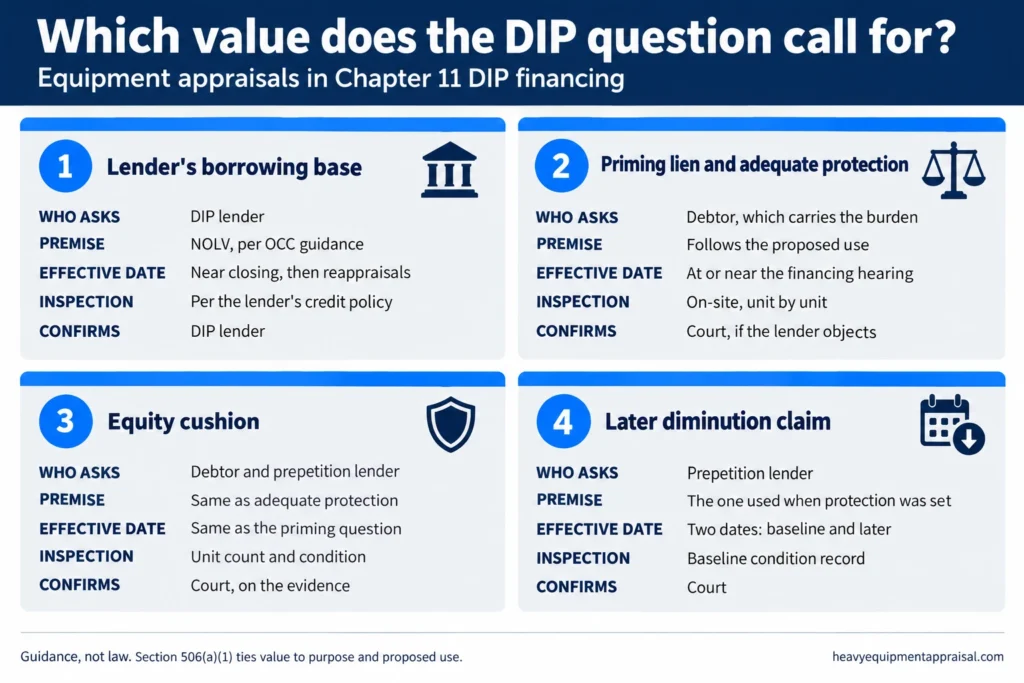
Premise of value names the sale or use conditions a value assumes. In DIP financing the question sets it, not the appraiser. The client of record confirms it in the engagement letter on counsel's advice, and the bankruptcy court decides disputes. The premises appraisers use:
- Continued use (going concern). Value installed and working in an operating business.
- Fair market value (FMV). A normal sale between a willing buyer and seller, neither under pressure. Common outside bankruptcy, it faces the same purpose-and-use test here.
- Orderly liquidation value (OLV). Value with a limited but reasonable time to find buyers, defined on our orderly liquidation value page.
- Net orderly liquidation value (NOLV). The collateral standard in OCC guidance for bank asset-based lenders, defined below.
- Forced liquidation value (FLV). Value when the equipment has to sell right away, such as at auction.
| DIP valuation question | Who asks | Usual premise | Effective date | Inspection level | Who confirms |
|---|---|---|---|---|---|
| The DIP lender's borrowing base | DIP lender, often the prepetition bank (OCC) | NOLV, per OCC asset-based lending guidance | Near closing, then per the reappraisal schedule | Lender's credit policy, appraiser independent of the credit transaction | DIP lender, in the credit agreement |
| Priming lien and adequate protection | Debtor, which carries the § 364(d)(2) burden, tested by the prepetition lender | Per proposed use under § 506(a)(1): continued use for equipment the business keeps operating, liquidation for units it will sell | Near the interim and final hearings | On-site, asset by asset, matched by the appraiser to the lien schedules | Debtor's counsel proposes, the court decides objections |
| Equity cushion | Debtor and prepetition lender, on opposite sides | The adequate protection premise | As for priming | As for priming, since the cushion is only as reliable as the unit count and condition behind it | Court, on the hearing evidence |
| Later diminution-in-value claim | Prepetition lender, claiming its protection fell short | The premise used when protection was set, at both dates | Two: a baseline counsel picks, such as the petition or financing order date, and the later date | A baseline condition record, without which a decline is hard to measure | Lender's counsel frames it, the court decides |
The table is guidance, not law. It applies § 506(a)(1), §§ 361 and 364(d), and OCC asset-based lending guidance to equipment. The replacement-value rule in § 506(a)(2) applies only to individual Chapter 7 and Chapter 13 debtors, not to a Chapter 11 business case.
The DIP lender's borrowing base and collateral appraisals
A borrowing base applies an advance rate to eligible collateral value. In DIP financing the credit agreement sets which business assets count and at what rate.
The OCC's Comptroller's Handbook booklet on asset-based lending, examiner guidance for national banks, says companies in financial distress often rely on asset-based lending for DIP financing, often a revolver whose base is commonly receivables and inventory. Equipment can be included, more often for distressed borrowers, but such agreements generally limit it, as less-liquid collateral, to a small share of the base.
The booklet's section on collateral appraisals says appraisals should provide NOLV, not cost or retail value, as the standard for collateral valuation. Its glossary defines NOLV as value in an orderly liquidation over a reasonable period, generally six to nine months, set by a competent party independent of the credit transaction. The booklet also calls for reappraisals, regularly and more often as issues arise.
Eastman Kodak's 2012 DIP lender presentation, filed with the SEC, described its DIP facilities as "for working capital and general corporate purposes during the Chapter 11 case," and the equipment component of its asset-based revolver as the lesser of $35 million and 75% of the NOLV of eligible machinery and equipment, with field exams and appraisals up to twice a year, unlimited during an event of default. That is one debtor's terms, not a market norm.
So a continued-use value is not the figure the DIP lender applies its advance rate to. Whether that lender will rely on an appraisal the debtor commissioned is its credit-policy call, settled before the equipment appraiser is engaged.
Priming liens, adequate protection, and the effective date in DIP financing
Adequate protection is what the Bankruptcy Code requires for a secured creditor whose collateral a priming lien puts at risk. Under 11 U.S.C. § 361, it can be cash payments, or additional or replacement liens, to the extent the § 364 lien decreases the value of the creditor's interest, or other relief giving the "indubitable equivalent" of that interest. The debtor proposes it, and the bankruptcy court decides if it is enough.
In United Savings Ass'n v. Timbers of Inwood Forest (1988), an automatic stay case, the Supreme Court held the protected interest excludes the right to foreclose immediately and is not adequately protected if the security is depreciating during the stay. Because § 361 measures payments and replacement liens by the decrease in value, protection for equipment the business keeps working turns partly on how fast it loses value.
In In re Winthrop Old Farm Nurseries (1st Cir. 1995), the First Circuit said a valuation for § 361 purposes looks to § 506(a). It quoted the 1978 Senate report: courts are not expected to treat value as, in every case, "forced sale liquidation value or full going concern value." The report allows wide latitude between them, with forced sale liquidation value as a minimum.
A debtor keeping its equipment working in the business points to continued use. A primed creditor weighing its recovery if the reorganization fails may press for a liquidation premise, such as the forced liquidation value an auction would bring. Section 506(a)(1) ties the answer to proposed use, and the court decides.
An equity cushion is the collateral value minus the primed claim, usually as a percentage of it. In a 2025 note, lawyers at Proskauer wrote that courts have generally treated roughly 20% as sufficient and below 10% as insufficient, with no bright line. The note cites SunTrust Bank v. Den-Mark Construction (E.D.N.C. 2009), which found about 11% insufficient. Those are a practitioner observation and one court's finding, not legal standards.
Take a hypothetical prepetition lender owed $4,000,000, secured by a fleet. In continued use at $5,000,000, the fleet leaves a $1,000,000 cushion, 25% of the claim. At forced liquidation, $3,600,000, it leaves no cushion and a $400,000 shortfall. Only the premise differs, not the equipment. A fully drawn $1,000,000 priming loan on the same fleet ranks ahead of that cushion and would use up all of it.
The effective date is the date the value is "as of." For the DIP financing motion it sits at or near the hearing, because § 506(a)(1) has value determined in conjunction with any hearing on the proposed disposition or use. The client of record confirms it on counsel's advice before the appraiser schedules the inspection.
At a preliminary (interim) hearing the question is narrower, because Rule 4001(c) lets the court authorize only credit needed to avoid immediate and irreparable harm. If the priming valuation becomes litigation at the final hearing, the inspection, the appraisal, and any review of the other side's appraisal must land inside the rule's 14 days or the longer schedule the bankruptcy court sets. That is the court's clock, and equipment spread across several yards is scheduled against it from the motion's filing.
How lenders and financial advisors test bankruptcy appraisals
A prepetition lender facing a priming lien, and any financial advisor on its side, reads the debtor's equipment appraisal for places the valuation can move. Bankruptcy appraisals on either side face these checks, so the debtor's appraiser builds for them.
Itemization that matches the collateral. The appraiser identifies each asset by make, model, serial number, hours, and location, matched to the lien schedules and UCC financing statements. The priming lien attaches to specific collateral, so a unit missing or under the wrong lienholder changes the cushion.
Inspection level. Whether the appraiser observed condition or assumed it. Where condition moves value, a desktop appraisal invites the question of how it was confirmed. We inspect or decline, and our page on desktop vs on-site equipment appraisal covers where the line falls.
Comparables suited to the premise. A forced liquidation opinion rests on auction results for like equipment. A continued-use opinion leaning on auction results without explanation gives the objecting creditor's appraiser an opening, as does a liquidation opinion built on dealer retail.
Stated assumptions. Whether the appraiser valued the equipment installed or removed, together or one unit at a time, and over what marketing period. An unstated assumption is one the other side gets to define.
The assignment elements. Our reports put the intended use and users, scope, premise, and effective date on the reviewer summary page. What an appraisal has to identify under USPAP, the appraisal standards our reports follow, is on our USPAP standards page. A report naming the wrong question or date fails before anyone reaches the comparables.
The objecting side may not need its own full appraisal. A review tests the debtor's appraisal on its own record, while a second appraisal produces a competing value, and our page on appraisal review vs second opinion covers which fits.
In valuation litigation, the report arrives with its appraiser as the witness. Bankruptcy Rule 9017 applies the Federal Rules of Evidence in a bankruptcy case, and Federal Rule of Evidence 702 applies to appraisers as to any expert: the offering party must show the court, more likely than not, that the testimony helps the trier of fact, rests on sufficient facts or data, and reliably applies reliable methods.
Rhett Crites, CMEA (NEBB Institute) and CAGA, signs every report we issue. He has been retained as an expert witness in federal litigation (Millennium Transit Services v. Arch Specialty Insurance) and is active in the Turnaround Management Association, with credentials on our qualifications page. The report we deliver is the report he defends under cross-examination.
What to send equipment appraisers
Equipment appraisers scope the assignment from these items:
- The equipment list. Make, model, serial number, year, hours or miles, and location for each asset.
- The lien schedules and UCC financing statements. They match the itemization to each lender's collateral and show which equipment is unencumbered.
- The DIP question. Borrowing base, adequate protection and equity cushion, or a diminution claim. It sets the premise.
- The intended use and users. The use is what the appraisal is for, such as the debtor's § 364(d) motion for DIP financing. The users are everyone besides the client relying on it, each named: the DIP lender, the prepetition lender, counsel and financial advisors for each, and the bankruptcy court if the report goes into evidence. Who relies on it shapes the report, so the client of record confirms both on counsel's advice before the appraiser starts.
- The effective date. Counsel's chosen date, or both dates for a diminution claim.
- The borrowing base terms. The term sheet's eligible-equipment definition and reappraisal terms.
- The hearing dates. Service of the motion, the interim hearing, and the final hearing.
Supporting records appraisers use for each unit are on our documents needed checklist.
FAQ
What is an equipment appraisal for debtor in possession financing?
An equipment appraisal for debtor in possession financing is a valuation of a Chapter 11 debtor's machinery and equipment for one question DIP financing under 11 U.S.C. § 364 raises: the borrowing base, adequate protection for a primed lender, an equity cushion, or a later claim that collateral lost value. Because § 506(a)(1) ties value to purpose and proposed use, that question sets the premise, effective date, and inspection level.
What is debtor-in-possession financing?
Debtor-in-possession financing, usually called DIP financing, is credit a Chapter 11 debtor obtains after filing, with bankruptcy court approval under 11 U.S.C. § 364, while it runs the business as debtor in possession. A priming lien under § 364(d) requires that credit be otherwise unavailable and the existing lienholder adequately protected.