
Equipment Appraiser Qualifications: Credentials & Standards

A qualified equipment appraiser holds a professional designation from a recognized body, complies with the Uniform Standards of Professional Appraisal Practice (USPAP), and demonstrates documented experience in the specific equipment category being valued.
Unlike real property appraisers, equipment appraisers have no state licensing requirement, making credential verification the primary quality control mechanism. SBA lenders, courts, and IRS reviewers all require or strongly prefer appraisals from credentialed professionals.
There Is No State License for Equipment Appraisers
No federal or state statute requires equipment appraisers to hold a government-issued license. This stands in direct contrast to real property appraisers, who must be state-certified under the Financial Institutions Reform, Recovery, and Enforcement Act (FIRREA) of 1989 for any federally related transaction.
FIRREA created the Appraiser Qualifications Board (AQB) within The Appraisal Foundation to set minimum education, experience, and examination criteria for real estate appraisers. The AQB has no jurisdiction over personal property, machinery, or equipment appraisers. No parallel legislation has ever extended that framework to the equipment appraisal profession.
The practical consequence is significant. A lender evaluating a commercial real estate appraisal can confirm the appraiser’s state certification through a public registry. A lender evaluating an equipment appraisal has no equivalent registry to check.
The burden of credential verification falls entirely on the party relying on the report. This is why professional designations and USPAP compliance function as the primary quality signals in equipment appraisal.
Organizations like the American Society of Appraisers (ASA) and the NEBB Institute and recognized personal property appraisal organizations fill the credentialing role that state licensing boards occupy in real property. Their designation programs impose education requirements, experience thresholds, peer-reviewed demonstration reports, and ethical standards. Without these voluntary credentialing structures, there would be no standardized mechanism to distinguish a qualified equipment appraiser from anyone claiming the title.
For an SBA lender, an attorney in litigation, or a business owner commissioning a fair market value opinion, verifying the appraiser’s designation is not optional due diligence. It is the only due diligence available.
The Two Primary Designations: ASA and CMEA
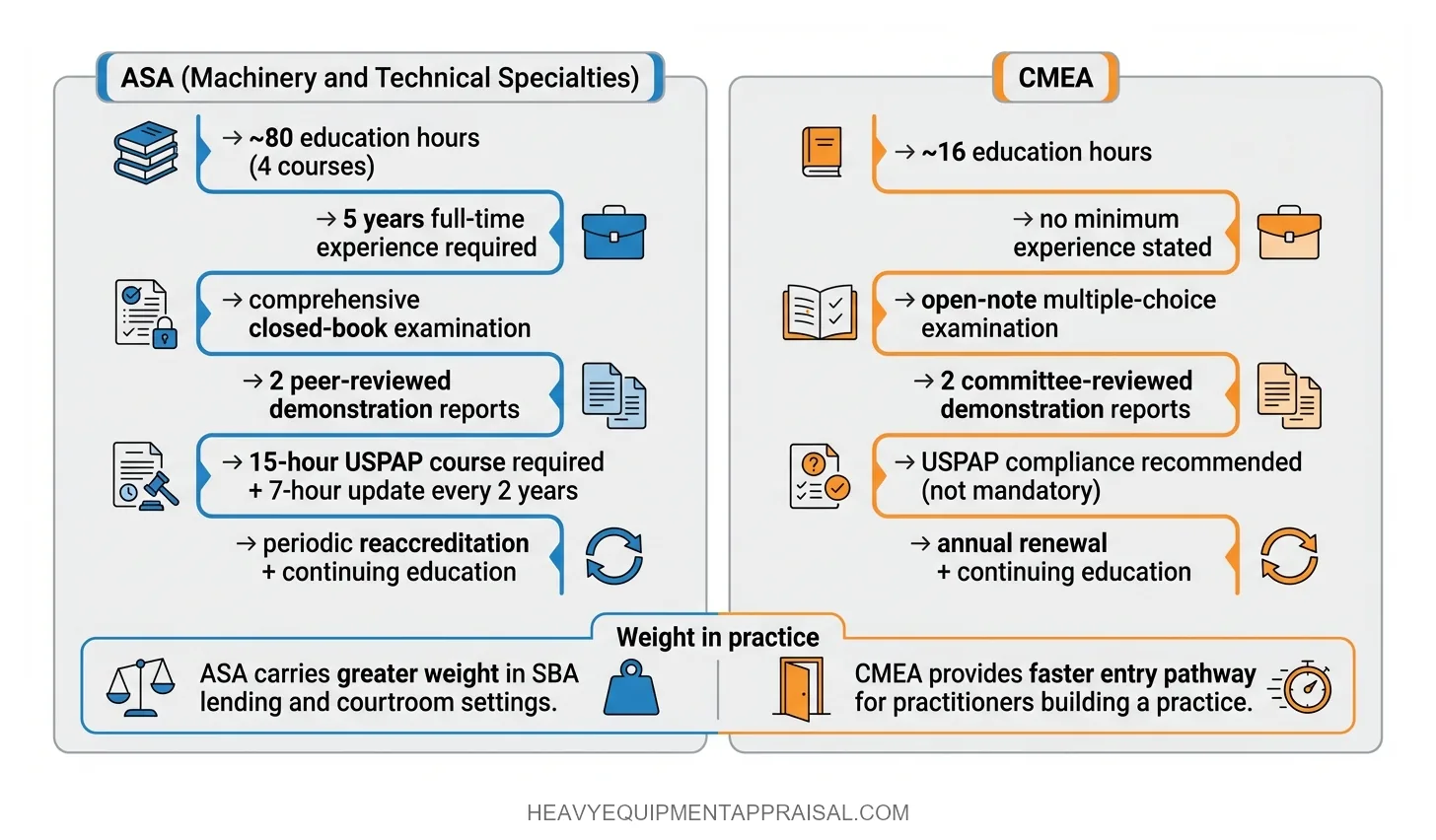
The ASA designation from the American Society of Appraisers and the CMEA designation are the two most widely recognized credentials in machinery and equipment appraisal.
Both signal that the holder has completed structured education, passed an examination, and committed to ethical standards. They differ substantially in experience thresholds, education depth, and the contexts where each carries the most weight.
ASA: Accredited Senior Appraiser (Machinery and Technical Specialties)
The ASA in Machinery and Technical Specialties (MTS) is the senior designation from the American Society of Appraisers. Candidates must:
- Complete four Principles of Valuation courses (roughly 80 hours of classroom instruction)
- Pass a comprehensive examination
- Submit two demonstration appraisal reports for peer review
- Document a minimum of five years of full-time appraisal experience
USPAP compliance is mandatory, with a 15-hour National USPAP Course required before designation and 7-hour updates on a two-year cycle.
The ASA requires continuing education and periodic reaccreditation. An earlier-stage pathway, the Accredited Member (AM) designation, allows candidates with two years of experience to earn a credential while building toward the full ASA.
CMEA and MCMEA Designations
The Certified Machinery and Equipment Appraiser (CMEA) designation requires completion of a structured education program, a signed ethics agreement, a proctored examination, and submission of two appraisal reports for review. USPAP compliance and adherence to Standards 7 and 8 are expected.
The Master CMEA (MCMEA) recognizes additional experience and completed assignments beyond the base CMEA. Annual renewal and continuing education maintain the designation.
| Requirement | ASA (MTS) | CMEA |
|---|---|---|
| Education hours | ~80 (4 courses) | ~16 |
| Minimum experience | 5 years full-time | None stated |
| Examination | Comprehensive, closed-book | Open-note, multiple choice |
| Demonstration reports | 2, peer-reviewed | 2, committee-reviewed |
| USPAP training | Required (15-hour + updates) | Recommended |
| Renewal cycle | Periodic reaccreditation + CE | Annual + CE |
Both designations appear in appraisal reports across lending, litigation, and tax contexts. The ASA carries more weight in SBA lending and courtroom settings due to its experience threshold and mandatory USPAP training.
The CMEA provides a faster entry point for practitioners building a practice. An appraiser’s designation determines whether the report meets the credentialing standards a lender or court requires, which directly affects the report’s admissibility and the reliance a decision-maker can place on the concluded value.
USPAP Compliance as a Baseline Requirement
The Uniform Standards of Professional Appraisal Practice (USPAP) establishes the minimum content, development, and ethical requirements for any credible equipment appraisal.
USPAP is not a credential. It is a set of rules governing how an appraisal is developed and reported, maintained by The Appraisal Foundation and updated on a two-year cycle. The current edition covers January 1, 2026, through December 31, 2027.
For equipment appraisals, the operative provisions are Standards 7 and 8.
Standard 7 governs appraisal development:
- Defining the scope of work
- Selecting appropriate approaches to value
- Applying them competently
Standard 8 governs reporting:
- What the written report must contain
- How the appraiser communicates the analysis
- What disclosures are required
These are distinct from Standards 1 and 2, which apply to real property. A party reviewing an equipment appraisal report should confirm the appraiser cites Standards 7 and 8 specifically.
Two USPAP provisions matter most for evaluating appraiser qualifications:
The Competency Rule requires an appraiser to possess the knowledge and experience necessary for the assignment, or to disclose any deficiency and take steps to address it before proceeding. The Ethics Rule prohibits advocacy for a client’s desired outcome and mandates disclosure of prior services involving the same property.
USPAP compliance and professional designation overlap but are not identical. The ASA requires USPAP training as a condition of accreditation. Other designation programs recommend USPAP compliance and require adherence to Standards 7 and 8 in reporting, but USPAP-specific education may remain voluntary. This means a CMEA appraiser’s USPAP training must be verified independently, while an ASA holder’s compliance is embedded in the designation itself.
Certain governing bodies make USPAP compliance explicit:
SBA Standard Operating Procedures require equipment appraisals for SBA loans to conform to USPAP. The IRS accepts USPAP-compliant appraisals for tax-related valuations involving charitable donations and estate transfers. Courts routinely scrutinize whether an expert’s appraisal methodology aligns with USPAP before admitting valuation testimony.
A report that fails USPAP compliance risks rejection at the point of use, regardless of the appraiser’s designation or the accuracy of the concluded value.
Equipment-Category Experience: What Credentials Don’t Guarantee
A professional designation confirms an appraiser’s general competency in machinery and equipment valuation methodology. It does not confirm competency in any specific equipment category. An ASA-designated appraiser with 20 years of experience valuing printing presses may have no basis for appraising a fleet of crawler excavators, a CNC machining center, or a marine vessel.
The designation certifies the appraiser’s training in the cost, sales comparison, and income approaches. It does not certify familiarity with the market dynamics, depreciation patterns, specification hierarchies, or comparable sales data for every equipment type.
USPAP’s Competency Rule addresses this directly.
An appraiser must possess the knowledge and experience necessary for a specific assignment before accepting it, or must disclose the deficiency and demonstrate steps taken to remedy it. In practice, many appraisers self-select into categories where they have depth. But USPAP does not prevent an appraiser from accepting an unfamiliar assignment. It only requires disclosure and remediation. The party relying on the report bears the responsibility of asking.
The most reliable verification is a list of comparable prior assignments.
Before engaging an appraiser, request examples of completed appraisals involving the same equipment category, similar asset volumes, and the same value type (fair market value, orderly liquidation value, or forced liquidation value).
An appraiser who has valued 500 pieces of construction equipment but never appraised semiconductor fabrication tools is not the right fit for a fab facility, regardless of designation tier.
Category-specific experience determines whether the appraiser can identify the right comparables, recognize abnormal condition factors, and apply depreciation curves that reflect how that equipment actually trades. Without it, the appraisal’s accuracy depends on general principles applied to unfamiliar territory, and the resulting value opinion carries materially higher risk of over- or understatement.
How Lenders, Attorneys, and Courts Evaluate Appraiser Qualifications
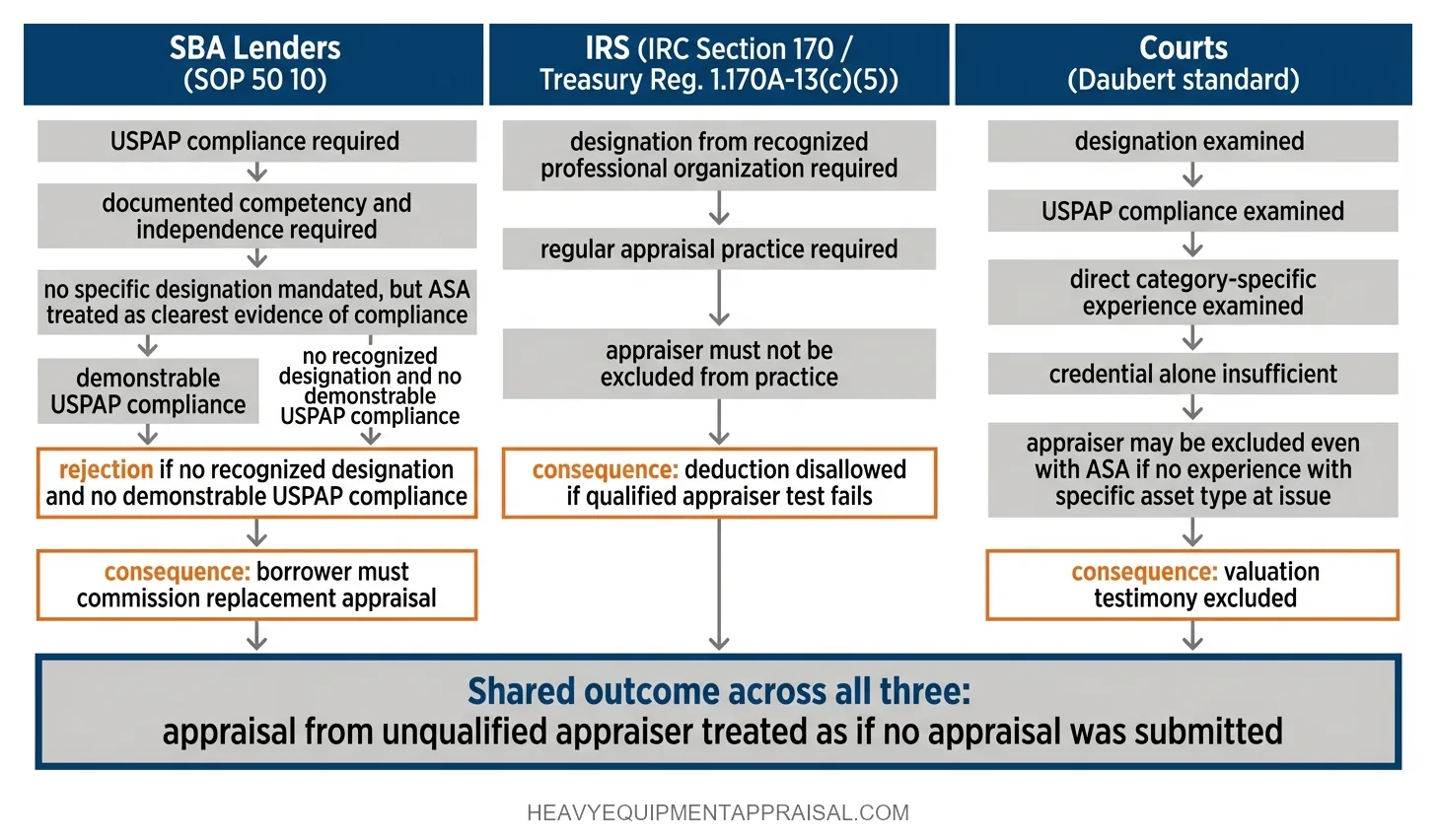
SBA lenders, the IRS, and courts each apply distinct qualification thresholds when deciding whether to accept an equipment appraisal, and failing any one of them can invalidate the report entirely.
SBA lenders follow the SBA Standard Operating Procedures (SOP 50 10), which require personal property appraisals to be performed by qualified appraisers who comply with USPAP. The SOP does not mandate a specific designation but requires documented competency and independence.
In practice, most SBA-preferred lenders treat an ASA designation as the clearest evidence that these requirements are met, because the ASA's mandatory USPAP training and five-year experience threshold align with the SOP's competency expectations.
A report from an appraiser with no recognized designation and no demonstrable USPAP compliance will typically be rejected during loan underwriting, forcing the borrower to commission a replacement appraisal at additional cost and delay.
The IRS defines a "qualified appraiser" under IRC Section 170 and Treasury Regulation 1.170A-13(c)(5). The appraiser must have earned an appraisal designation from a recognized professional organization or met minimum education and experience requirements. The appraiser must also demonstrate that they perform appraisals on a regular basis and are not excluded from practice.
For tax-related equipment valuations involving charitable contributions or estate transfers, an appraisal that fails the qualified appraiser test results in disallowance of the claimed deduction or valuation.
Courts evaluating expert testimony apply the Daubert standard (or its state equivalents). Under Daubert, a judge assesses whether the appraiser's methodology is reliable and whether the appraiser is qualified to apply it. This means credential alone is insufficient. The court examines the appraiser's designation, USPAP compliance, and direct experience with the equipment category at issue. An appraiser who holds an ASA but has never valued the specific asset type in dispute may still be excluded as an expert witness.
The practical consequence across all three contexts is the same: an appraisal submitted by an appraiser who does not meet the relevant qualification standard is treated as if no appraisal was submitted at all. The dollar figure in the report becomes irrelevant once the appraiser's qualifications are rejected, turning what was meant to support a loan, a tax position, or a litigation claim into a liability that must be replaced under time pressure.
How to Verify an Appraiser's Credentials
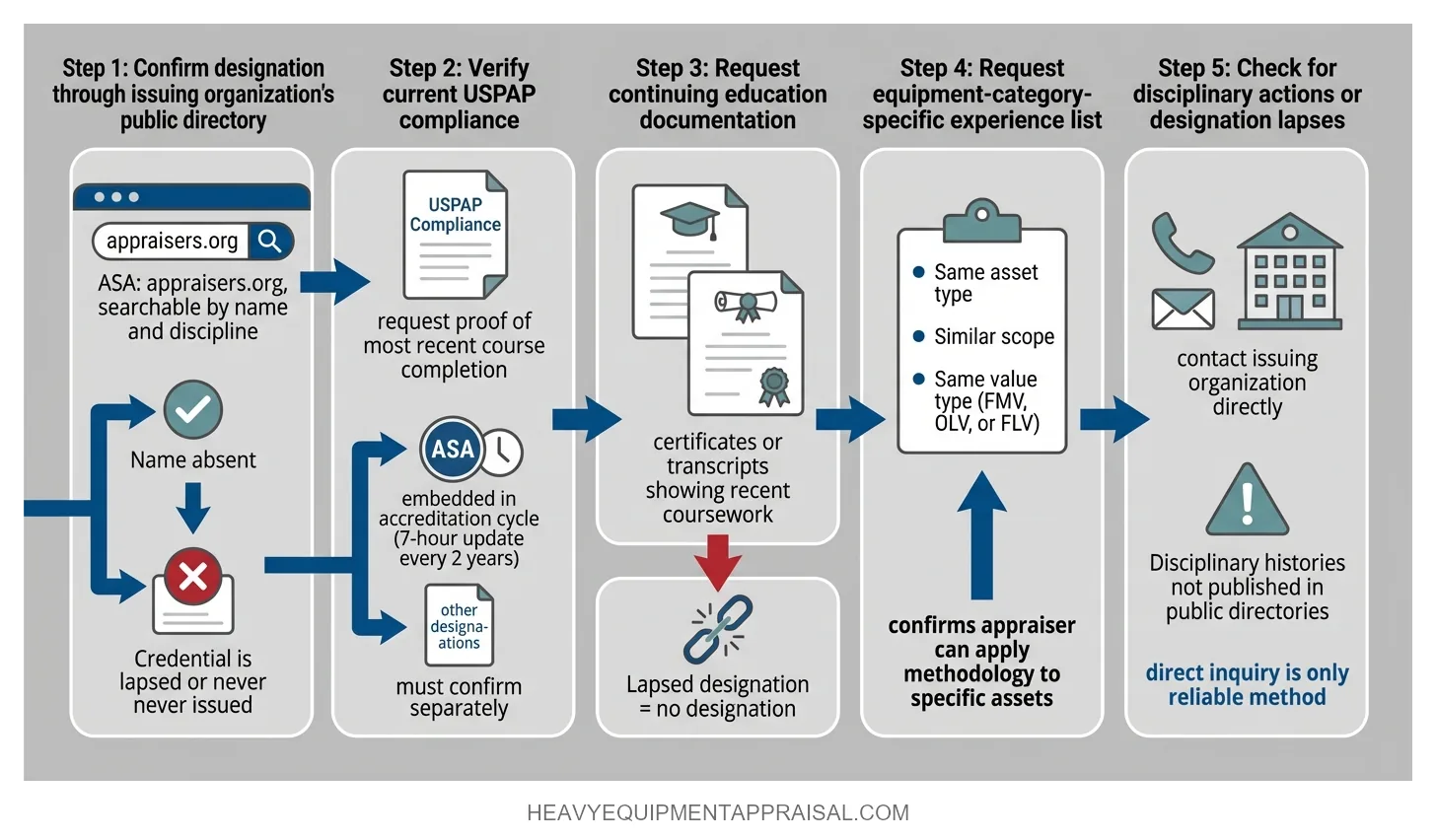
Confirming an equipment appraiser's qualifications requires checking multiple independent sources, not accepting a résumé or business card at face value. The following steps apply whether the verification is performed by a lender, an attorney, or a business owner commissioning an appraisal.
- Confirm the designation through the issuing organization's directory. The ASA maintains a public "Find an Appraiser" directory at appraisers.org, searchable by name, location, and discipline (Machinery and Technical Specialties). Other credentialing organizations maintain similar locator tools on their websites. If the appraiser's name does not appear in the directory for the claimed designation, the credential is either lapsed or was never issued.
- Verify current USPAP compliance. Ask the appraiser for proof of their most recent USPAP course completion. For ASA-designated appraisers, this is embedded in the accreditation cycle (7-hour update every two years). For other designation holders, USPAP training may be recommended but not mandatory, so compliance must be confirmed separately. The current USPAP edition covers 2024–2025.
- Request documentation of continuing education. Both the ASA and other credentialing bodies require ongoing education for designation renewal. Ask for certificates or transcripts showing recent coursework. A designation that has not been renewed is functionally equivalent to no designation.
- Ask for equipment-category-specific experience. Request a list of completed appraisals involving the same asset type, similar scope, and the same value type. General credential verification confirms methodology training. This step confirms the appraiser can apply that training to the assets in question.
- Check for disciplinary actions or designation lapses. Contact the issuing organization directly to ask whether the appraiser's designation is in good standing and whether any ethics complaints or disciplinary actions are on record. Most organizations do not publish disciplinary histories in their public directories, so a direct inquiry is the only reliable method.
Completing all five steps before signing an engagement letter protects the client from a report that passes internal review but collapses under external scrutiny from a lender's underwriting desk, an opposing counsel's challenge, or an IRS examiner's audit file.
What a Qualification Statement Should Include in an Appraisal Report
Every USPAP-compliant appraisal report must contain a qualification statement identifying the appraiser's credentials, experience, and competency for the specific assignment.
This section, sometimes called a "credentials addendum" or "appraiser qualifications page," appears at the end of the report and functions as the reader's primary tool for evaluating the appraiser without independent verification. Its absence from a report is a red flag that warrants immediate inquiry.
The qualification statement should contain the following elements:
Professional designation(s) held: The specific credential (ASA, AM, CMEA, MCMEA) and the issuing organization, with the discipline identified (e.g., Machinery and Technical Specialties).
Years of relevant appraisal experience: Total years performing machinery and equipment appraisals, not years in adjacent fields like equipment sales or maintenance.
Equipment-category experience: A summary of prior assignments involving the same or closely related asset types. A qualification statement that lists only general categories ("industrial equipment") without specificity offers little assurance of competency for the assets in the report.
USPAP compliance statement: An explicit declaration that the appraisal was developed and reported in conformity with USPAP, citing the applicable edition and the specific standards (7 and 8 for personal property).
Competency and limiting conditions: Any disclosures required by the Competency Rule, including steps taken to address knowledge gaps for unfamiliar equipment types or valuation scenarios.
Continuing education: Evidence of current designation status, recent USPAP update completion, and relevant coursework.
A qualification statement that omits any of these elements weakens the report's defensibility under third-party review. A lender's underwriter, an IRS examiner, or an opposing attorney will read this section before evaluating a single value conclusion, making it the first place the report's credibility is tested or dismissed.
FAQ
Do equipment appraisers need a state license?
Equipment appraisers do not need a state license, but assignment requirements vary by state, asset type, and appraisal purpose.
What is the difference between an ASA and a CMEA designation?
The main difference between ASA and CMEA is that ASA offers broader appraisal recognition, while CMEA specializes in machinery and equipment valuation.
What does USPAP compliance mean for an equipment appraisal?
USPAP compliance means the equipment appraisal follows the Uniform Standards of Professional Appraisal Practice. It requires the appraiser to define the assignment, remain independent and objective, use credible methods, keep proper workfiles, and report conclusions clearly. USPAP compliance improves appraisal defensibility for lenders, courts, insurers, and tax matters.
How does the IRS define a qualified appraiser for equipment?
The IRS defines a qualified appraiser for equipment as a competent, independent professional with education and experience in valuing that specific type of property.
What is the Daubert standard and how does it apply to equipment appraisers in court?
The Daubert standard requires equipment appraisers in court to present reliable methods, sufficient data, and clearly explained conclusions that a judge can admit as expert evidence.
How do I verify an equipment appraiser's credentials?
Verify an equipment appraiser’s credentials by confirming the designation, checking the issuing body, reviewing USPAP training, and matching the appraiser’s experience to the specific equipment.
What should a qualification statement include in an equipment appraisal report?
A qualification statement should identify the appraiser’s credentials, equipment valuation experience, USPAP competency, independence, and any limits on scope or expertise.
Does an ASA or CMEA designation guarantee equipment-category expertise?
An ASA or CMEA designation shows professional appraisal qualification, but it does not by itself prove expertise in a specific equipment category.
What happens if an equipment appraisal is submitted by an unqualified appraiser?
An equipment appraisal submitted by an unqualified appraiser may be rejected, discounted, or challenged. Courts may exclude it under expert-evidence rules, lenders may refuse to rely on it, and the IRS or insurers may question the valuation. The report also becomes harder to defend because weak qualifications undermine credibility, methodology, and conclusions.