
36 Types of Heavy Equipment: Names, Uses, Pictures & Common AKA Terms

A working appraiser’s reference. Each category below covers what the machine does and what people call it. Where we’ve inspected the type on a real contractor fleet, you’ll see a field note with the year, model, hours, and value we appraised.
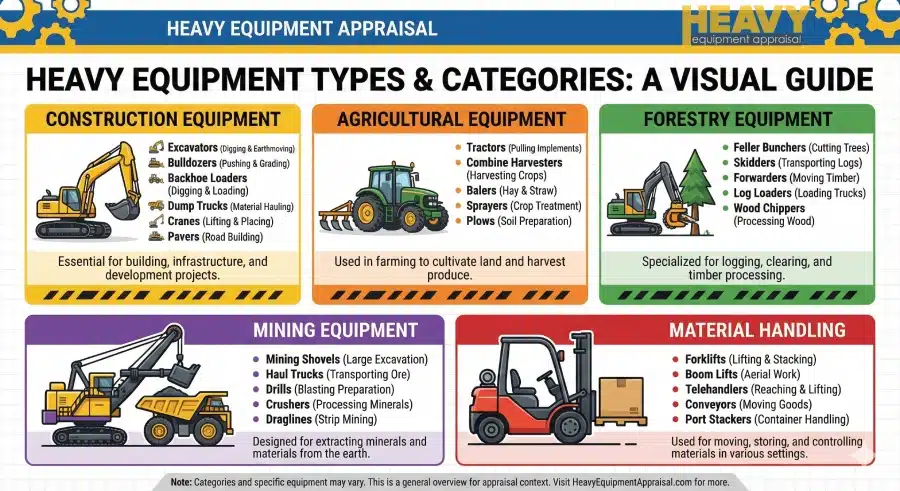
Three fleets anchor most of the notes:
- E-Z Excavating in Frederick, Colorado (100+ units, 2012)
- Carder, Inc. in Lamar, Colorado (101 units, 2014)
- An oilfield-services contractor in Bloomfield, New Mexico (104 units, 2017)
Across three contractor fleet appraisals we performed between 2012 and 2017: 1) E-Z Excavating in Frederick, Colorado (100+ units) 2) Carder, Inc. in Lamar, Colorado (101 units) 3) an oilfield-services contractor in Bloomfield, New Mexico (104 units) – the equipment categories that drove the most value were not always the categories with the highest unit counts. Pickups and small trailers dominated by count. But excavators in the 13-ton to 33-ton class, wheel loaders in the Cat 928/938/966 range, and the Cat 420-series backhoe loader showed up across all three fleets and carried most of the value. The machines that created the most valuation questions were the ones with the widest configuration variance: backhoes with or without extendahoes, excavators with or without thumbs, loaders with general-purpose vs. pallet-fork attachments, and dump-style trucks where chassis miles told one story and box wear told another.
Earthmoving Equipment Types
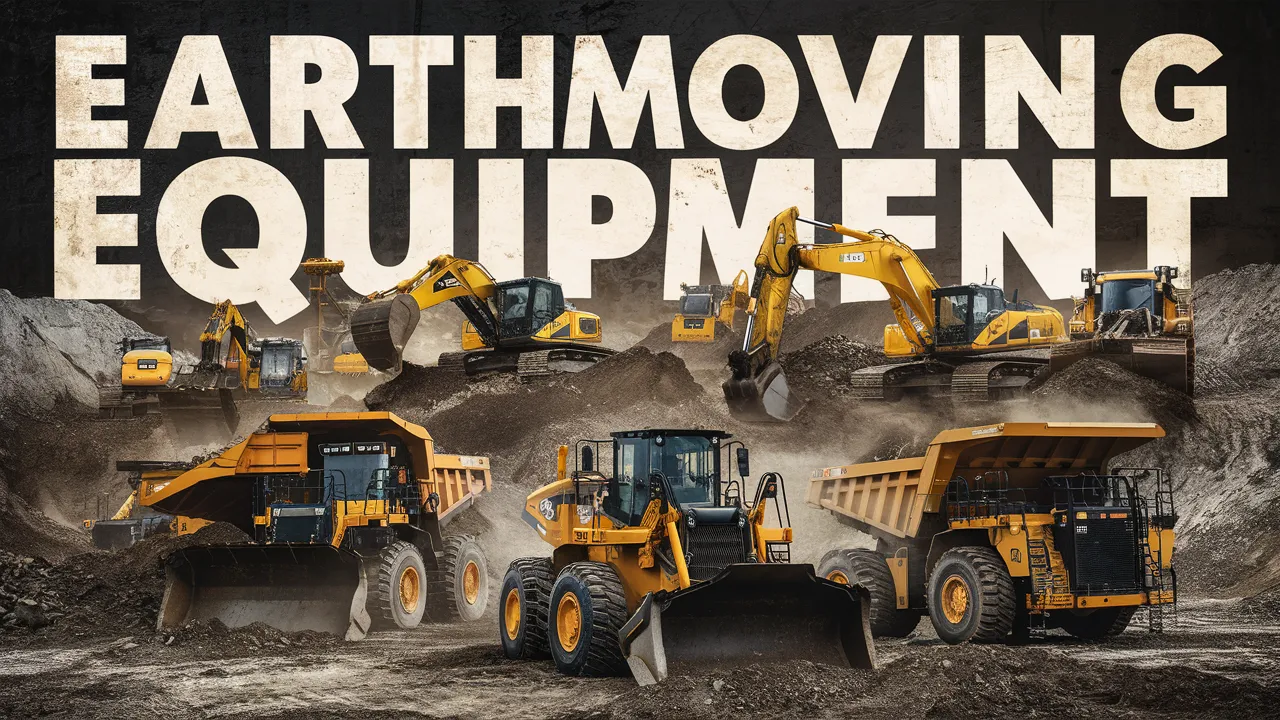
The first step in any major construction project is earthmoving: using specialized equipment to clear, grade, and prepare the land. With machines like loaders and graders, these powerful tools ensure the terrain is shaped and stabilized to spec.
Below is the core earthmoving equipment that sets the stage for every construction project:
Backhoes
Also known as: backhoe loader, backhoe digger, TLB, hoe, JCB
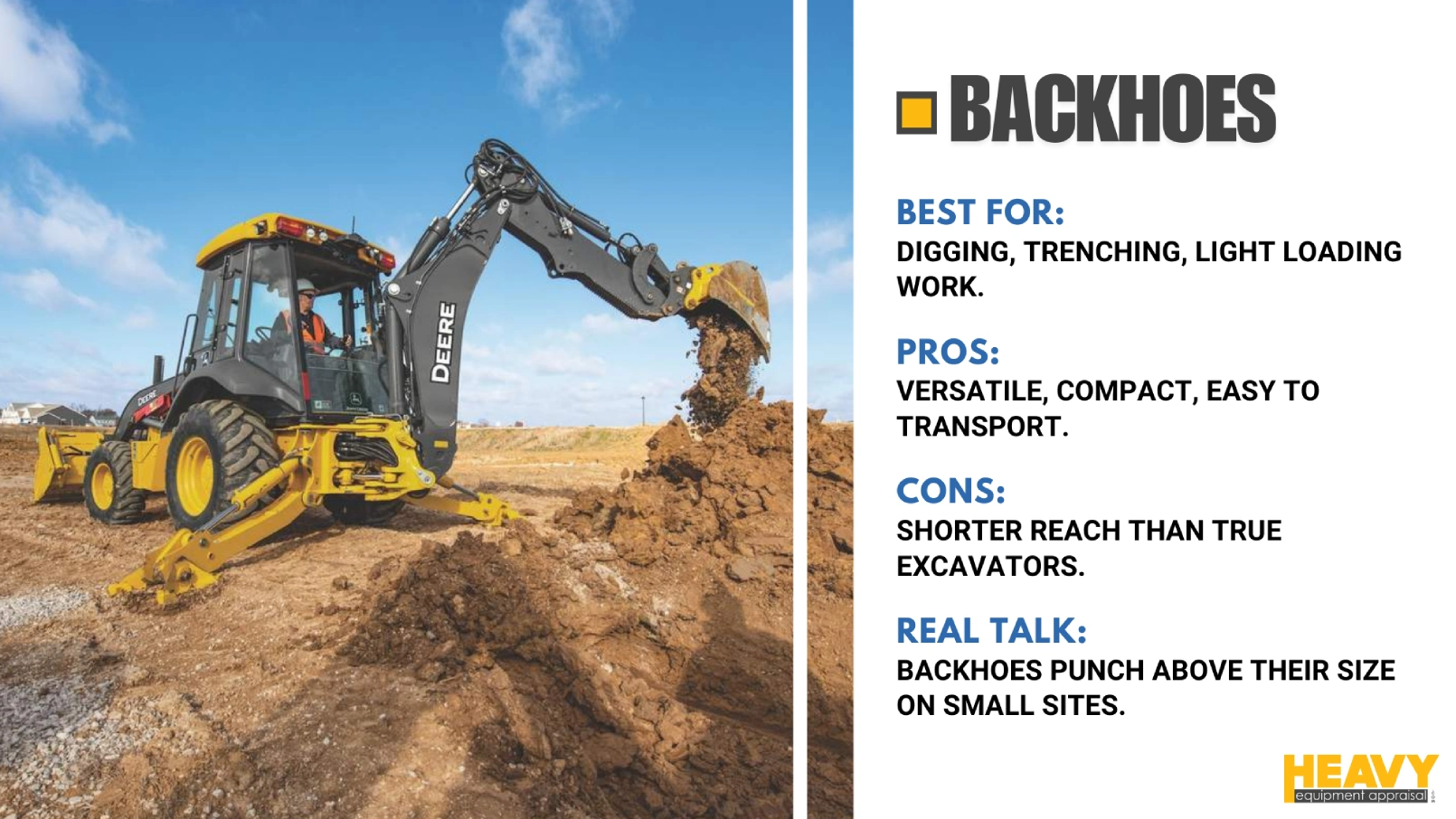
A backhoe is a versatile construction machine with a front loader bucket and a rear digging arm. Contractors use backhoes for trenching, excavation, loading, and light demolition. Backhoes work well on small to medium job sites due to mobility, lower operating costs, and multi-function capability.
| Attribute | Typical Range / Example | Practical takeaway |
|---|---|---|
| Ideal jobs | Earthmoving, trenching, light demolition, farm chores | One machine can dig, load, and back‑fill. Perfect for small‑site excavation plus material haul‑off |
| Minimum site space | ≈ 15 ft × 15 ft swing clearance | Fits tight suburban lots without clipping fences or buried utilities |
| Mobility | Wheeled | Drives up to 25 mph, so you can road it between nearby jobs and skip a low‑boy trailer |
| Skill level to operate | DIY‑friendly minis; certification for larger rigs | Small units suit owner‑operators, while full‑size backhoes need a licensed heavy‑equipment operator |
| Average rental cost | $300 – $600 / day | Lets you price a weekend sewer‑line dig against hiring a contractor |
| Typical purchase price | $70 k used mini → $150 k+ new | Shows the capital outlay if you want a year‑round earthmover in your fleet |
| Operating weight | 6 – 16 tons | Tells whether a 20‑ton equipment trailer is enough or you’ll need transport permits |
| Key capability | Max dig depth 14 – 17 ft | Reaches common basement footing and utility depths in one pass |
| Popular OEM models | Cat 420F • Deere 310SL • JCB 3CX | Well‑known brands mean easy parts, quick service, and strong resale value |
The front part is commonly known as the boom, while the latter is known as the dipper-stick or dipper.
The boom can be connected to any heavy vehicle, though when it is mounted on a front loader, it is known as a "backhoe loader".
The boom is connected to a king-post which allows it to move in various degrees from left to right while digging out dirt.
Uses of a Backhoe
Backhoes are used for trenching, excavation, loading materials, backfilling, and light demolition. Contractors commonly use backhoes for utility installation, drainage work, road maintenance, landscaping, and small construction projects where versatility and mobility are required.
Backhoe loader value moves on year and hours together, not either alone. In one 2017 oilfield-fleet appraisal we inspected four Cat 420-series backhoe loaders side by side: 1) a 2004 Cat 420D with no hour reading available appraised at $25,000 2) a 2005 Cat 420D with 2,534 hours appraised at $32,000 3) a 2006 Cat 420D with 6,254 hours appraised at $35,000 4) and a 2015 Cat 430F2 with 2,100 hours appraised at $90,000. The 2006 had nearly three times the hours of the 2005, but it appraised slightly higher because of the model year and the configuration. The 2015 430F2 was worth nearly the other three combined, which is the kind of finding a "2015 backhoe, $X" lookup never captures.
Bulldozers
Also known as: dozer, crawler tractor, Cat, push Cat
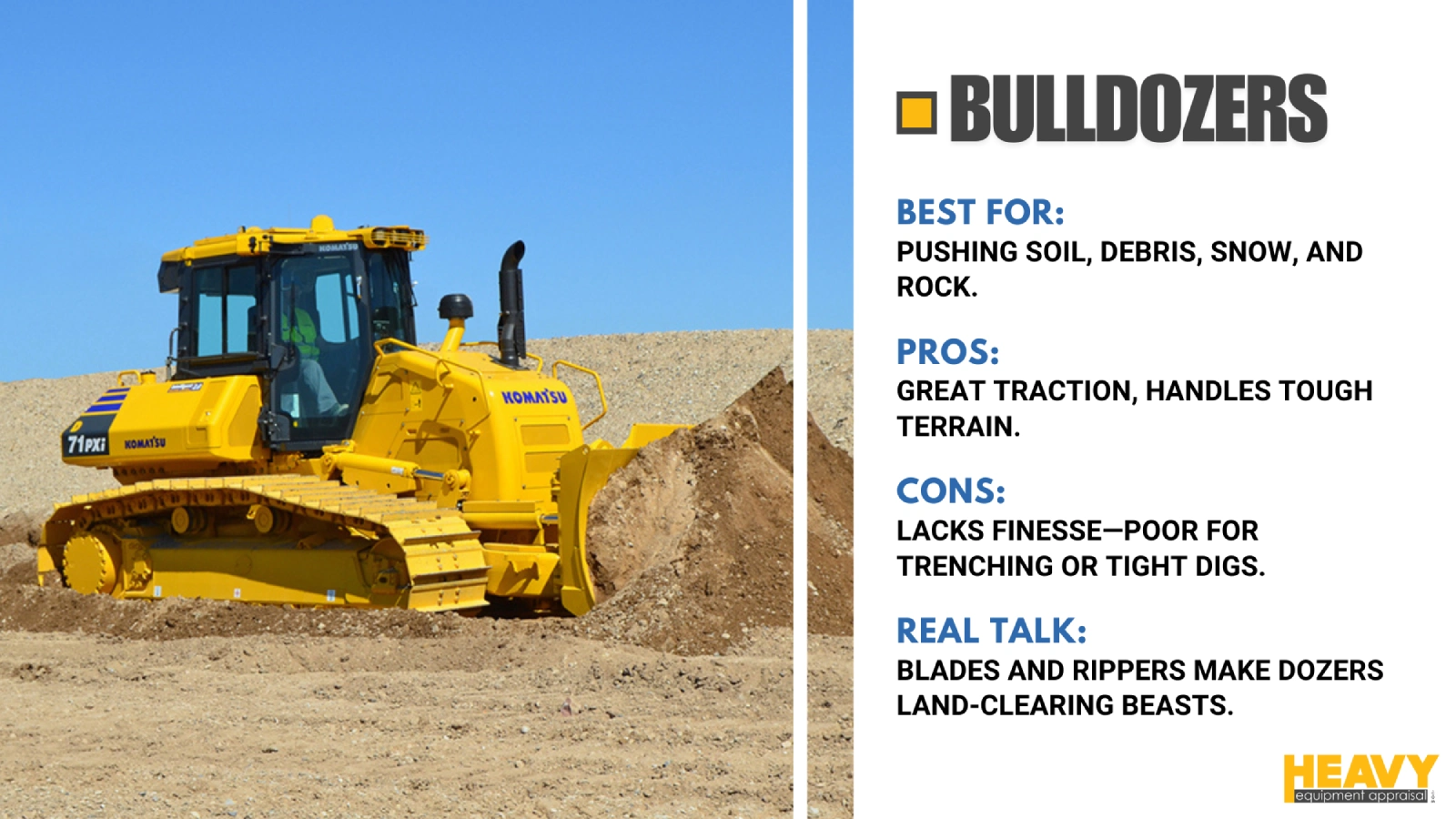
A bulldozer is a tracked or wheeled machine that pushes and spreads soil, rock, and debris using a front blade. Use a bulldozer for rough grading, clearing brush, stripping topsoil, pushing fill, cutting slopes, building pads and roads, and ripping hard ground with a rear ripper.
Dozers prioritize traction and pushing power over speed.
Uses of a Bulldozer
Bulldozers are used for land clearing, grading, leveling ground, and pushing large volumes of soil or debris. Contractors rely on bulldozers for site preparation, road construction, mining operations, slope shaping, and demolition support, especially on rough, uneven, or unstable terrain.
Excavators
Also known as: digger, trackhoe, 360, rubber duck, power shovel
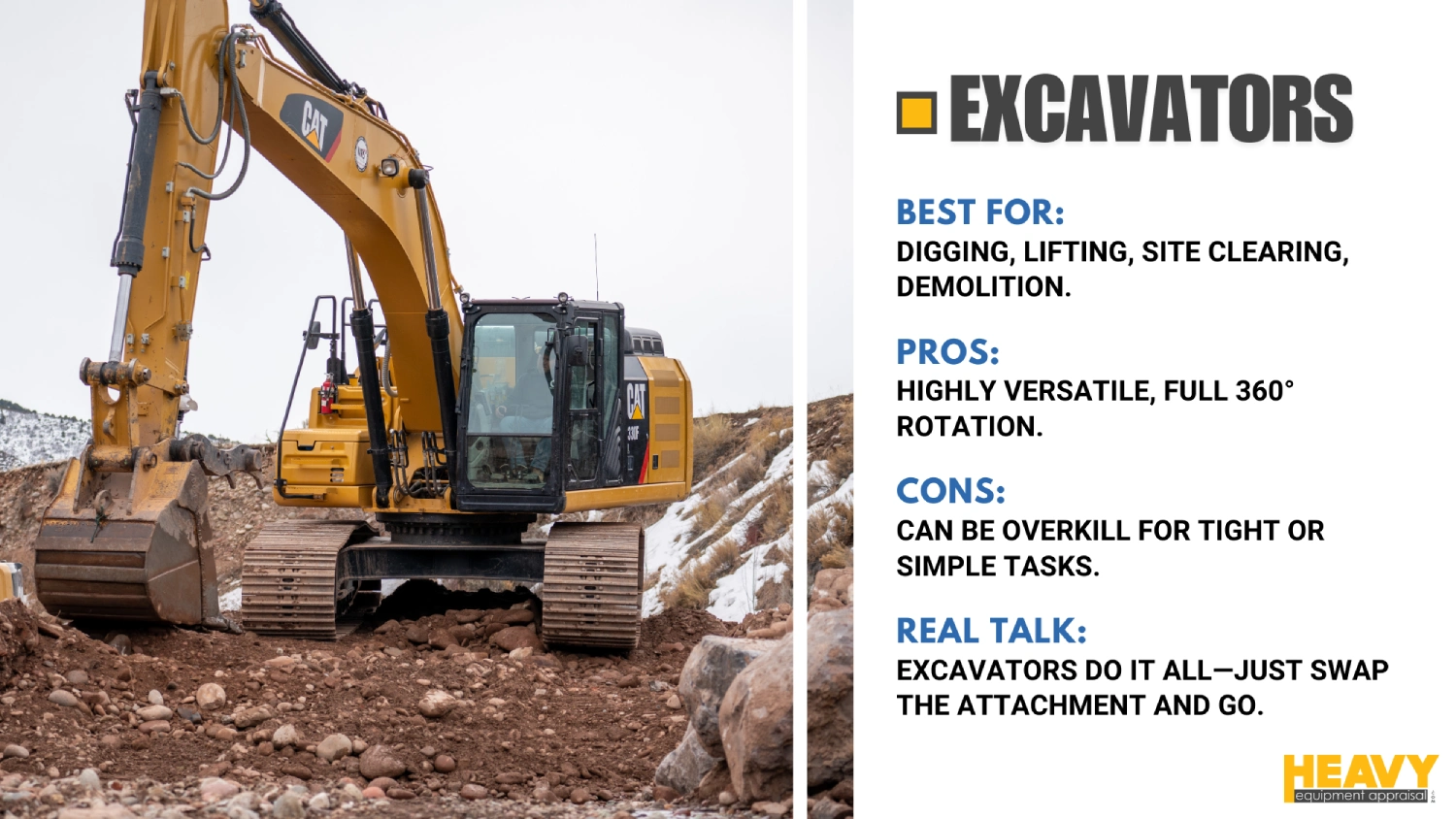
An excavator is a digging machine with a boom, stick, and bucket mounted on a rotating upper structure (360° swing) over tracks or wheels. Use an excavator for trenching, mass excavation, foundation digging, loading trucks, lifting pipe or structures with rigging, placing riprap, and demolition with attachments like breakers, thumbs, and grapples.
All moving parts in an excavator use hydraulic fluids, motors, and cylinders. Its movement is different from cable-operated excavators that use steel ropes and wrenches to initiate motion.
Excavators are sometimes called “360” as they move in all directions during projects.
Uses of Excavators
The 360-degree angle movement of excavator parts allows it to do multiple functions. Such include forestry work, digging foundations and trenches, material handling, construction, mining, drilling shafts, snow removal, and many more.
Two excavators with the same badge can appraise very differently once year and hours are stacked together. In a 2012 SBA fleet inspection in Frederick, Colorado, I appraised a 2000 Cat 330BL at $75,000, a 2006 Cat 330CL with 7,948 hours at $140,000, and a 2002 Cat 330C with 14,219 hours at $100,000. Same model family, three different value stories. The 2006 unit was worth $40,000 more than the 2002 - half the hours and a more recent model. But the 2000 unit was worth $25,000 less than the 2002 despite being a much older machine with no recorded hours, because by that point the buyer pool was looking past it for the newer C-series. Year, hours, and configuration are not interchangeable inputs. They reinforce or undercut each other in ways a single-variable lookup misses.
Loaders
Also known as: bucket loader, front-end loader, front loader, payloader, scoop loader, wheel loader
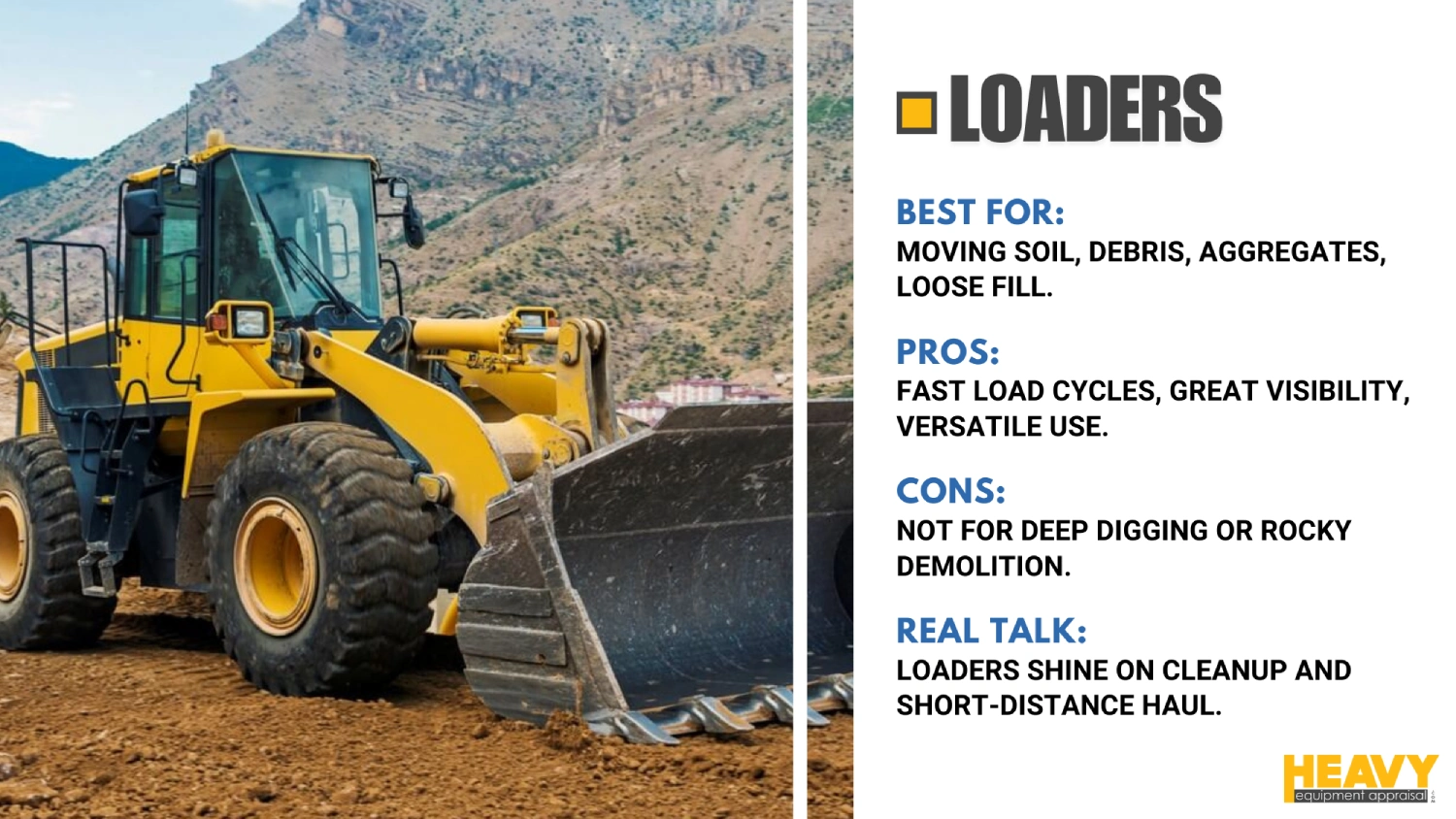
As their name suggests, loaders move aside things like excavated soil, demolition waste, raw minerals, etc. It has a front part armed with a steel bucket, while the back part connects to a vehicle.
A loader has shorter arms, and the movement of the material involves the whole equipment (plus the vehicle).
A loader can mount on a wheeled or tracked vehicle. A wheeled loader is efficient while moving around in areas of fair terrain, while the latter moves in scrappy and rough terrains.
Graders
Also known as: motor grader, road grader, blade, maintainer, patrol
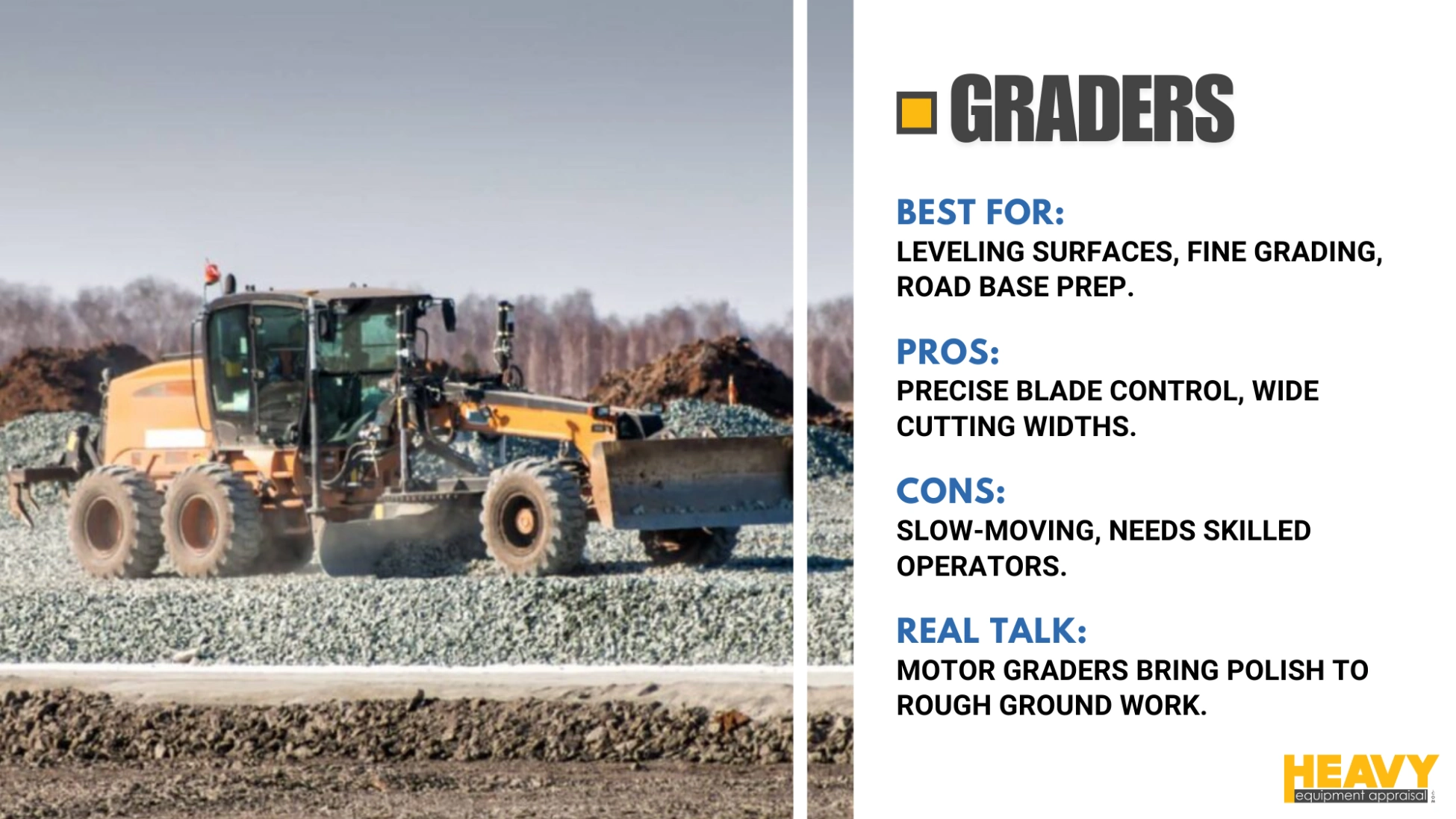
A grader, also known as a motor grader, is a heavy construction machine with a long blade for leveling the ground during the grading process.
They are standard equipment in road construction mainly due to the horizontal balance on the front and behind wheels.
Before, graders were attached to horsebacks, but modern models are engine-powered, hence the name “motor graders”.
Basic models have three axles, with one axle at the front, and the other two at the rear below the engine and operating cabin.
Motor graders also help remove snow during winter, as their long blades are 8 to 24 feet wide. Graders are powerful machines, and you must understand how to operate them before using them.
Trenchers
Also known as: ditcher, chain trencher, rockwheel, Ditch Witch, Ground Hog
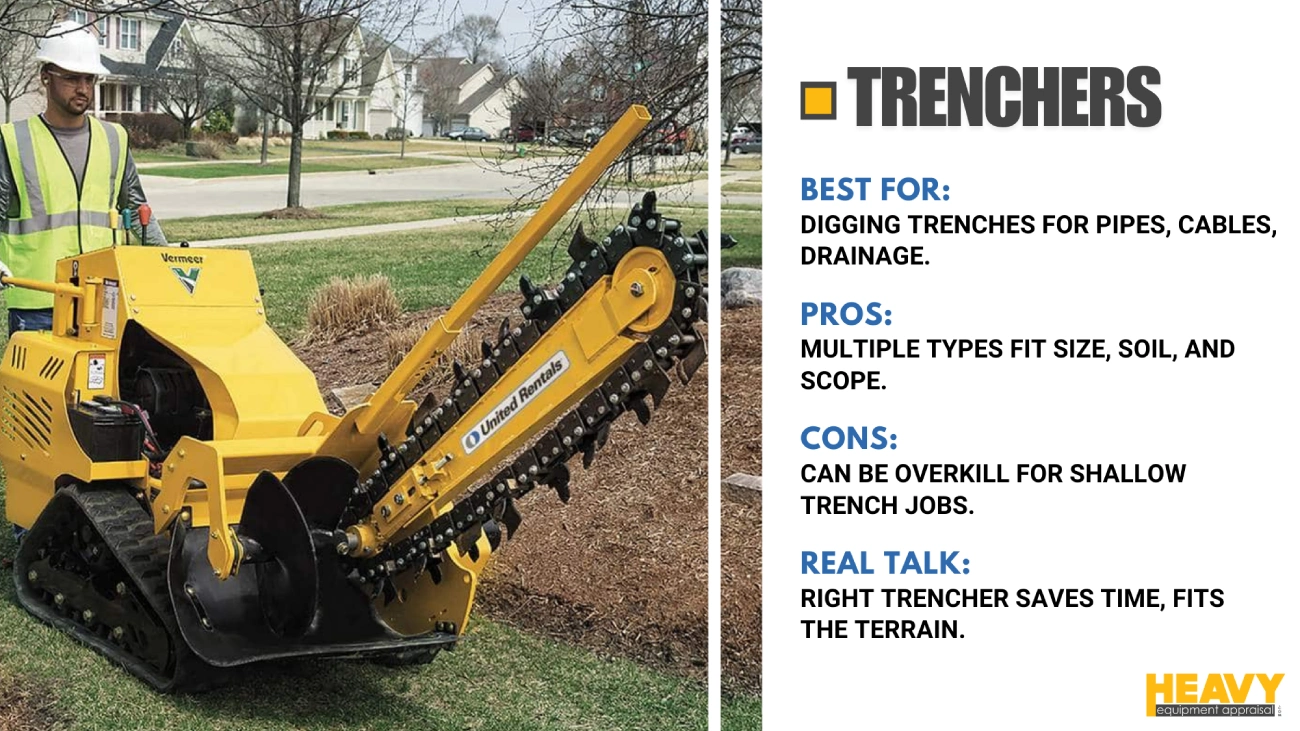
Trenchers, also known as Trenching Machines, are used to dig trenches in the ground. The trenchers may be used to lay pipes and ground cables or in preparation for trench warfare.
Several configurations of trenchers are available in construction ranging in size, function, and power. Here are the common types of trenchers today:
- Chain Trencher- A chain trencher utilizes a digging chain or belt attached to a metal frame, similar to a chainsaw. It is best for rough grounds with hard rocks that would be too difficult for a bucket-type excavator.
- Wheel Trencher- A wheel trencher has a serrated metal wheel for cutting the ground. It is cheaper to maintain than chain trenchers and can work in soft and hard soils. The wheel trencher is similar to an “all-terrain vehicle”.
- Portable Trencher- Land trenchers are lightweight (around 200 pounds) and can work on small pieces of land like a lawn or in landscaping. They may use a blade or a chain to cut through the ground, rotating in a vertical plane.
- Micro Trencher- While a portable trencher is small, a micro trencher is even smaller. It is made specifically for urban places where space and maneuverability are challenging. The toothed blades are small and cut the ground in smaller dimensions to do small-scale conventional trench digging.
Scrapers
Also known as: earth scraper, motor scraper, pan, bowl, carryall, pull pan
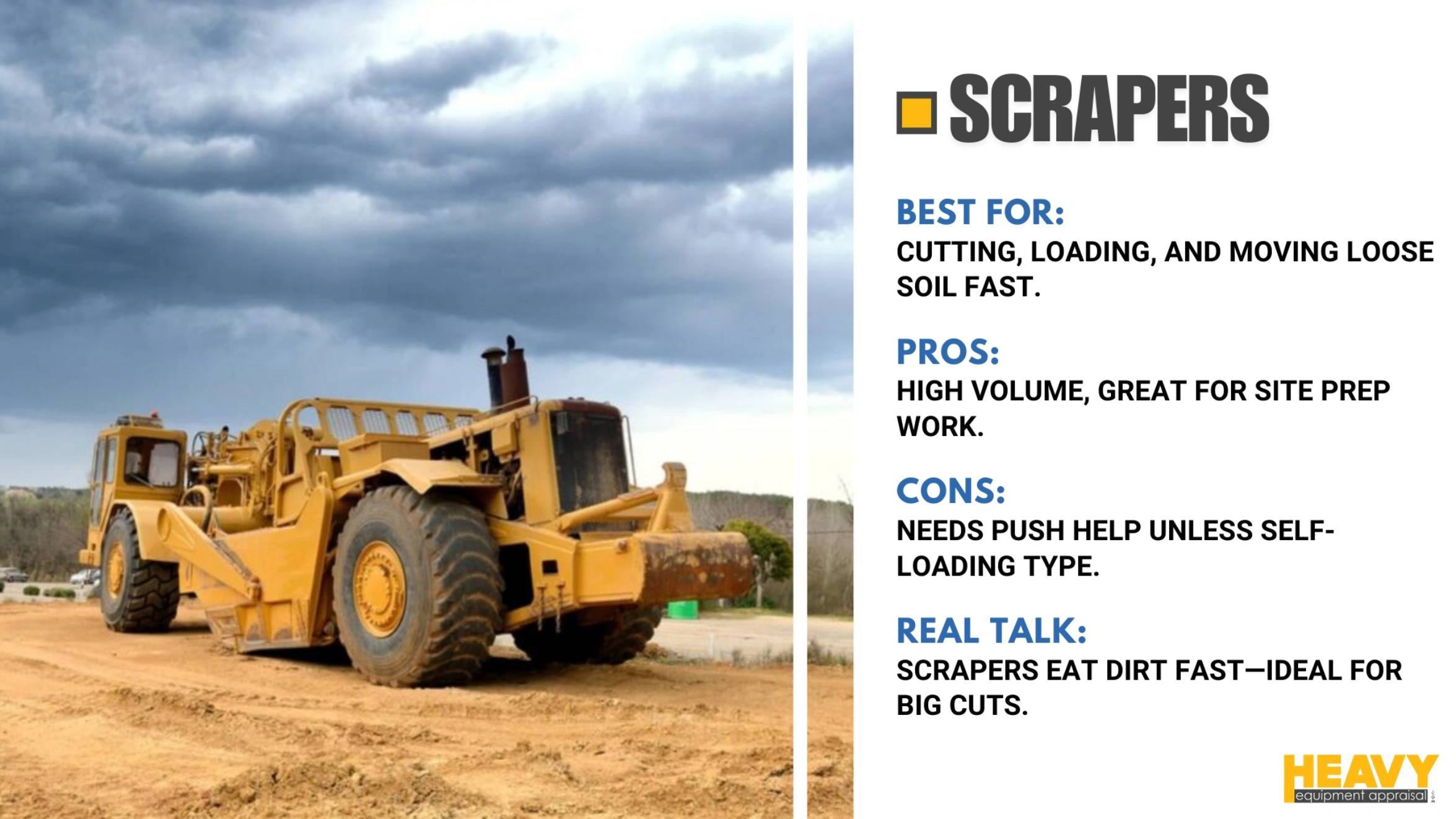
A wheel-tractor scraper is heavy equipment used to transport loose-earth materials in preparation for ground leveling or grading.
It contains two parts: the front part is a vehicle with a driver’s cabin, while the rear has a scraping machine.
The scraping machine uses a blade to cut through the soil where it is collected through a conveyor belt system and stored in the hopper.
Once the hopper is full, the tractor scraper can move the dirt and offload to a different location.
Wheel tractor scrapers come in different configurations, including:
- Open bowl- needs a pushcart or bulldozer to help in loading dirt.
- Tandem scrapers- it has a separate scraper and tractor engines allowing them to move through slippery surfaces or steep areas. It requires a push cart when offloading the materials.
- Pull-type scraper- utilizes a farm tractor or a bulldozer to pull. They can be used individually or connected in two or three for maximum load.
Other common types of scrapers include augers, tandem push-pull, and elevating scrapers.
Construction and Paving Equipment Types
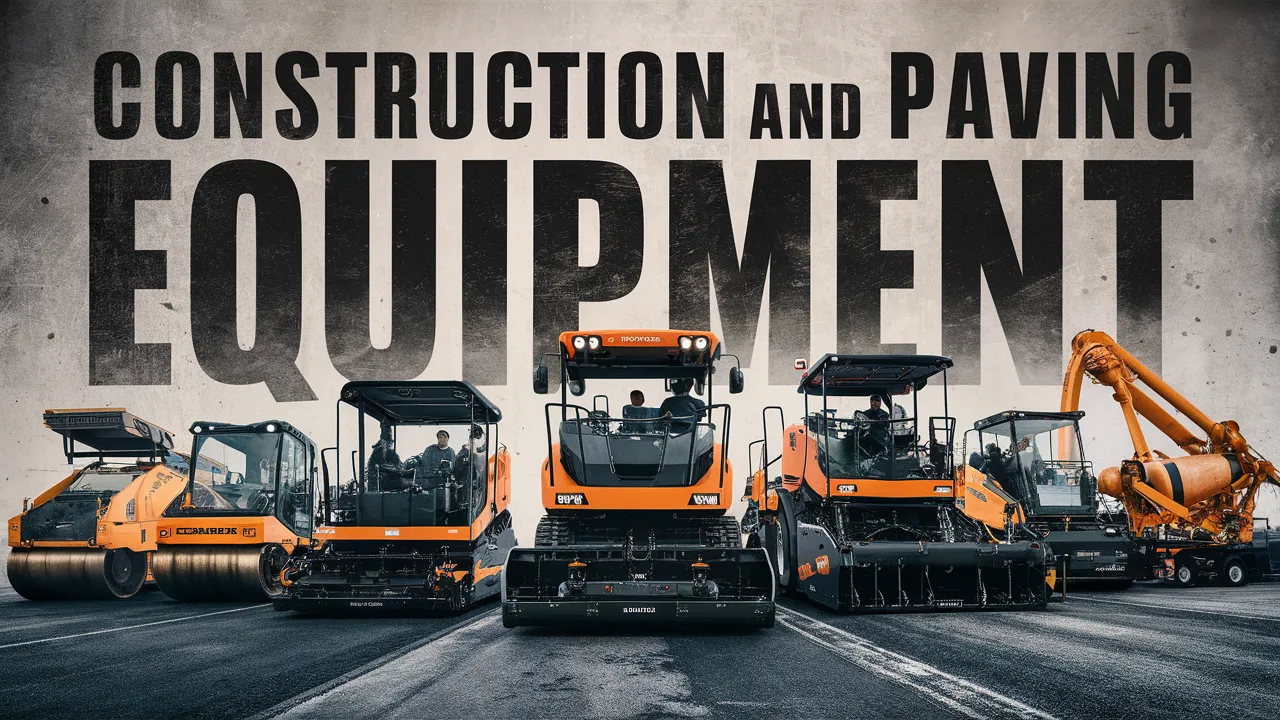
After the earth is moved and the site is prepped, construction and paving equipment take over to build solid foundations and finished surfaces. From compactors to pavers, these machines ensure that every layer of your project is laid with precision and durability.
Here’s a list of the essential construction and paving equipment that brings your project from groundwork to completion:
Compactors
Also known as: roller, road roller, vibratory roller, plate compactor, Wacker, vib roller
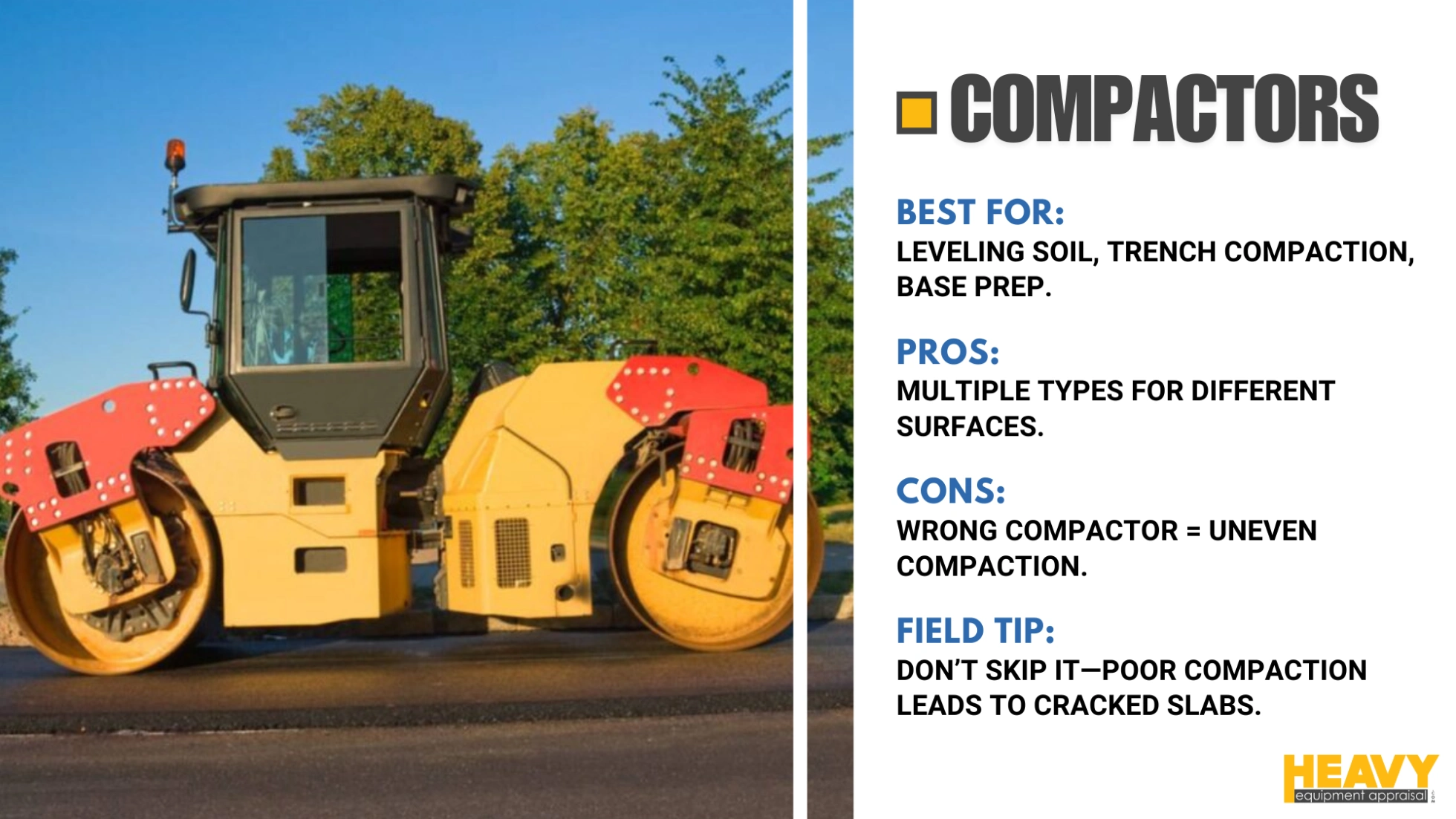
Constructing on loose earth never ends well. Compactors are crucial equipment for solidifying particles in the ground using pneumatics and heavy rollers.
The repetitive force breaks down debris into a level, flat surface.
There are several types of compactors in construction:
- Plate Compactor- has a large plate used to level the ground, particularly in roads and housing projects.
- Rammer Compactor- it is mainly used to compact narrow fields and trenches for ground pipes, water supply, etc.
- Drum Rollers- also known as road rollers or compact rollers, drum rollers are used in construction or commercial terrains to level the surface. Mainly used in foundation projects to compact crushed rock, or asphalt layers before adding another layer.
Vibratory compactors are a good example of why "age = depreciation" is a lazy rule. In a 2014 appraisal of a gravel-mining operation in Lamar, Colorado, the fleet included a 1978 Dynapac CC50A smooth-drum compactor and a 1989 Case W252 compactor (36 and 25 years old at the time of inspection). Both still appraised at meaningful working values ($3,500 and $2,500 fair market, respectively) because the job they do (making sure the next layer can be placed on something solid) has not changed in 40 years. Compactors do not age out the same way an electronics-heavy machine does. A working hydraulic and drum system on a recognizable platform retains a value floor that a "this machine is from 1978" pricing approach blows right past.
Pavers
Also known as: asphalt paver, paving machine, paver finisher, road paver
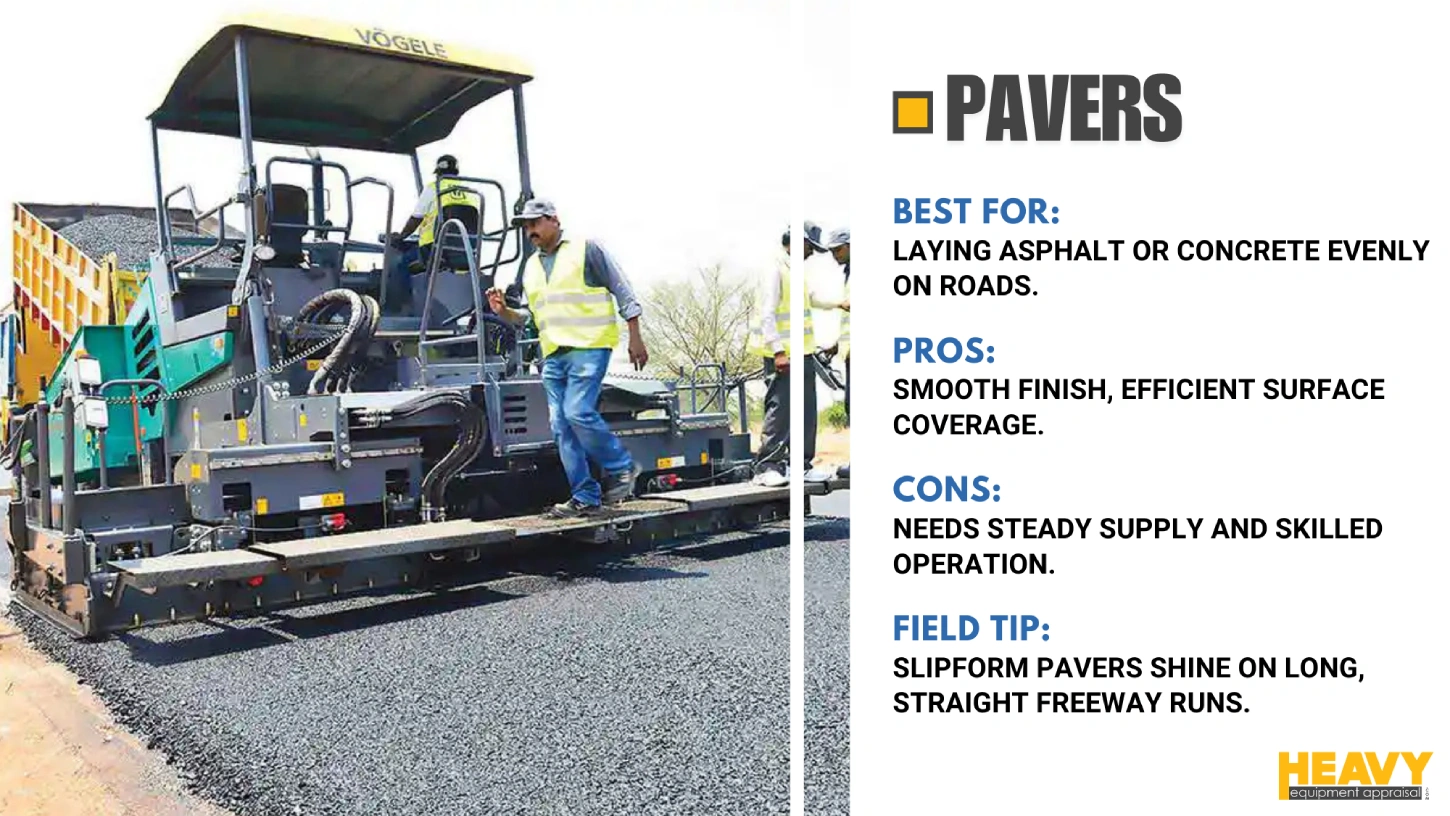
Also known as a paving machine, paver finisher, or asphalt paver, this construction equipment is mainly used in road construction to carry and lay asphalt.
Asphalt pavers emerged in the 1920s after successful tests from the Chicago testing Laboratory, which identified their role in constructing asphalt roads.
The heavy feeding bucket distributes asphalt evenly on the surface, providing compaction as it rolls on top.
You’ll typically find a slipform paver in freeways laying concrete instead of asphalt. This paver uses ready-mix concrete to spread across the surface and level with wide blades.
Cold Planers
Also known as: milling machine, asphalt grinder, planer, road profiler, cold miller
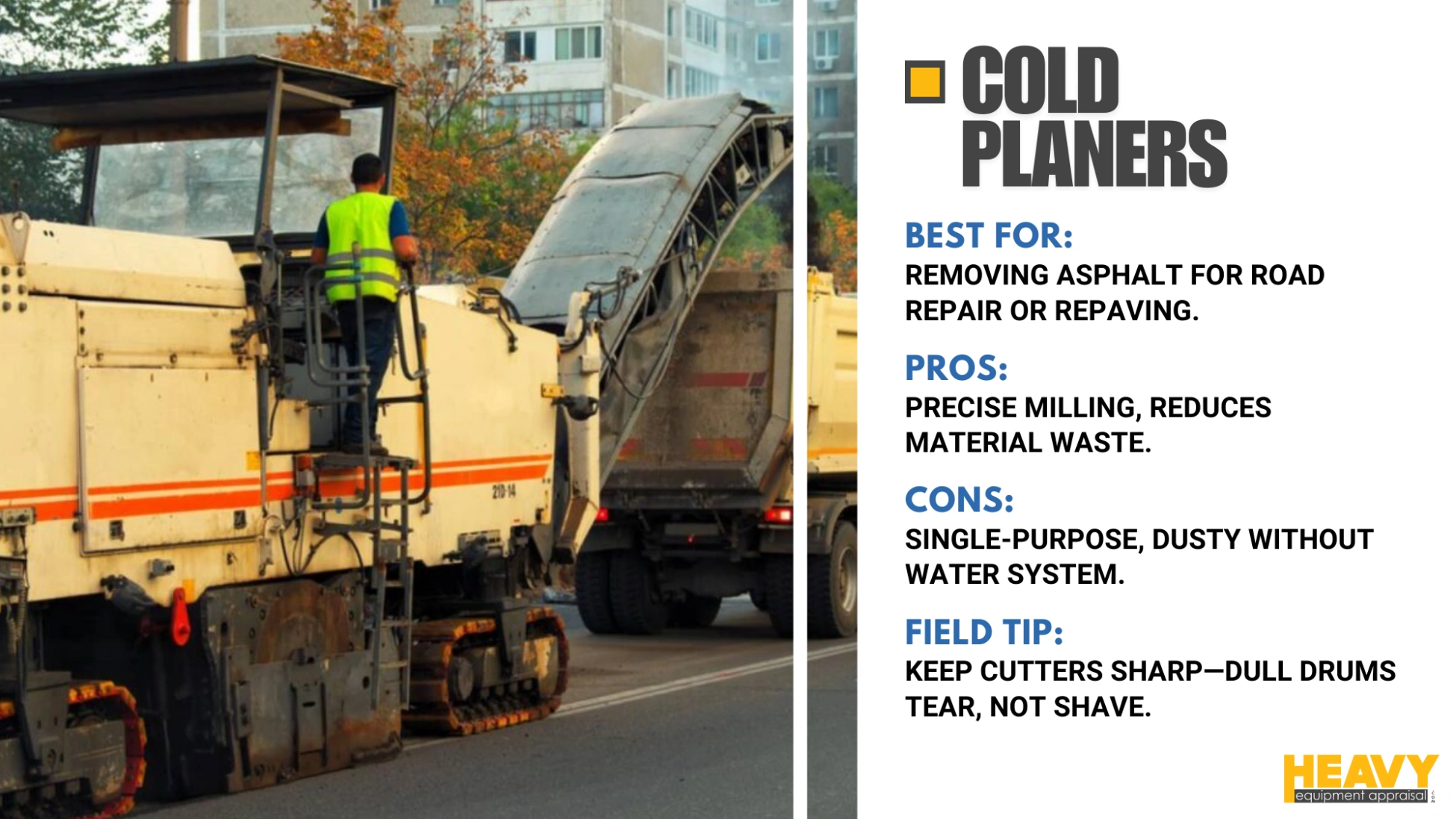
In road construction, asphalt has to be laid hot, but once it cools down, moving it is tricky. Specialized construction equipment is needed to remove the asphalt, and that’s where cold planers come in.
A cold planer uses carbide cutters and rotating drums to remove asphalt and move it in a dump truck. Depending on the power, cold planers can perform in-depth or shallow removals.
The process is often dusty, and some equipment comes with water sprinklers to minimize pollution and maintain cleanliness.
Cold planers are specialized and are explicitly used to remove asphalt, especially in repaving. It may not have many functions, but only one is crucial to any road construction or repair.
Concrete Mixers
Also known as: cement mixer, mixer truck, barrel mixer, agitator truck, ready-mix truck
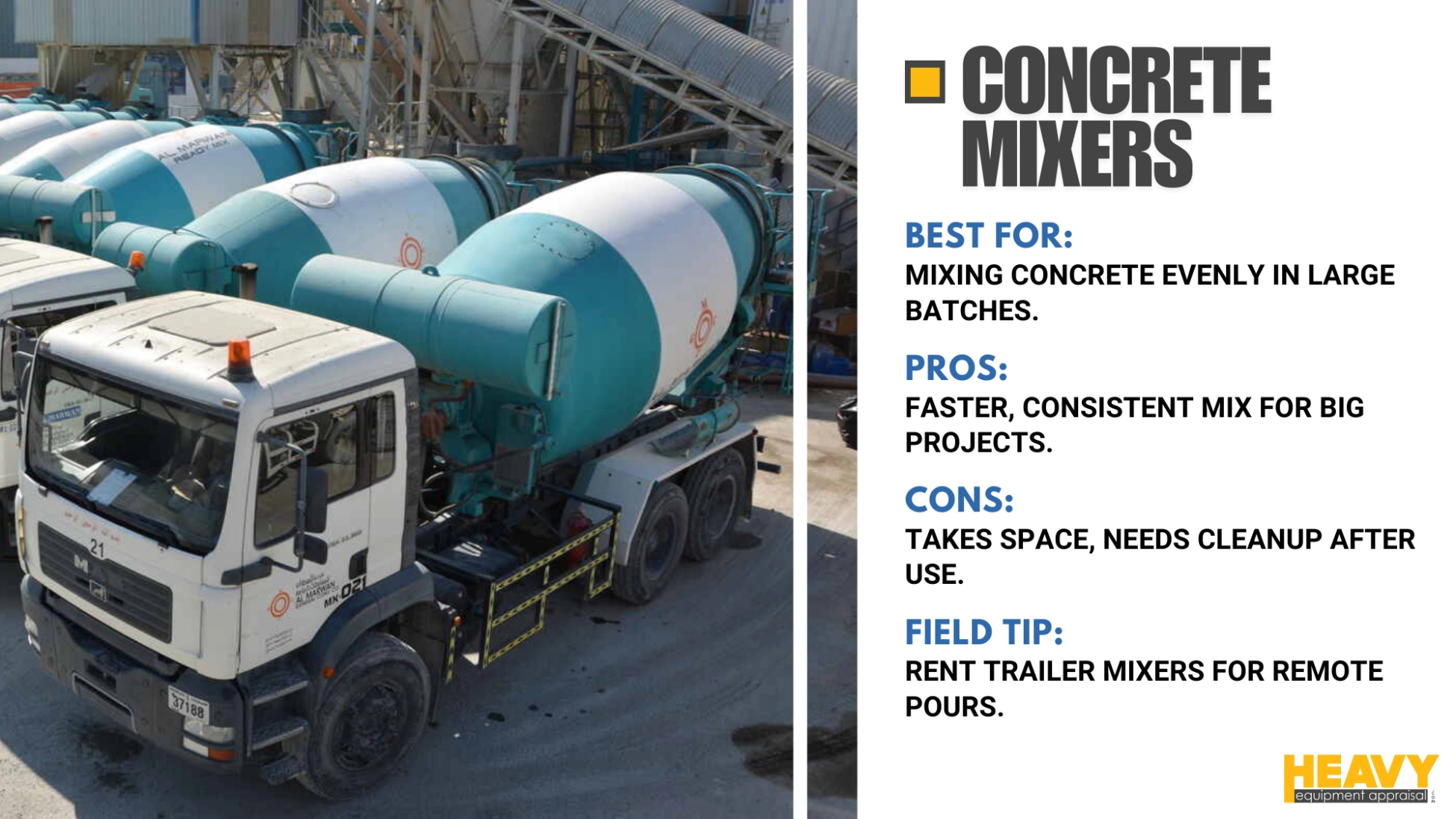
A simple hand drill with a blade may not get the job done when you want to mix large batches of concrete.
That’s where mixers come in. It resembles a large rotating drum that allows concrete to mix evenly in large batches.
Mixers can be set up on construction sites or attached to trailers for transportation. Concrete companies have the latter to cater to clients who need preset concrete in large construction projects.
Concrete Pumps
Also known as: pump truck, boom pump, line pump, concrete pumper, pumpcrete
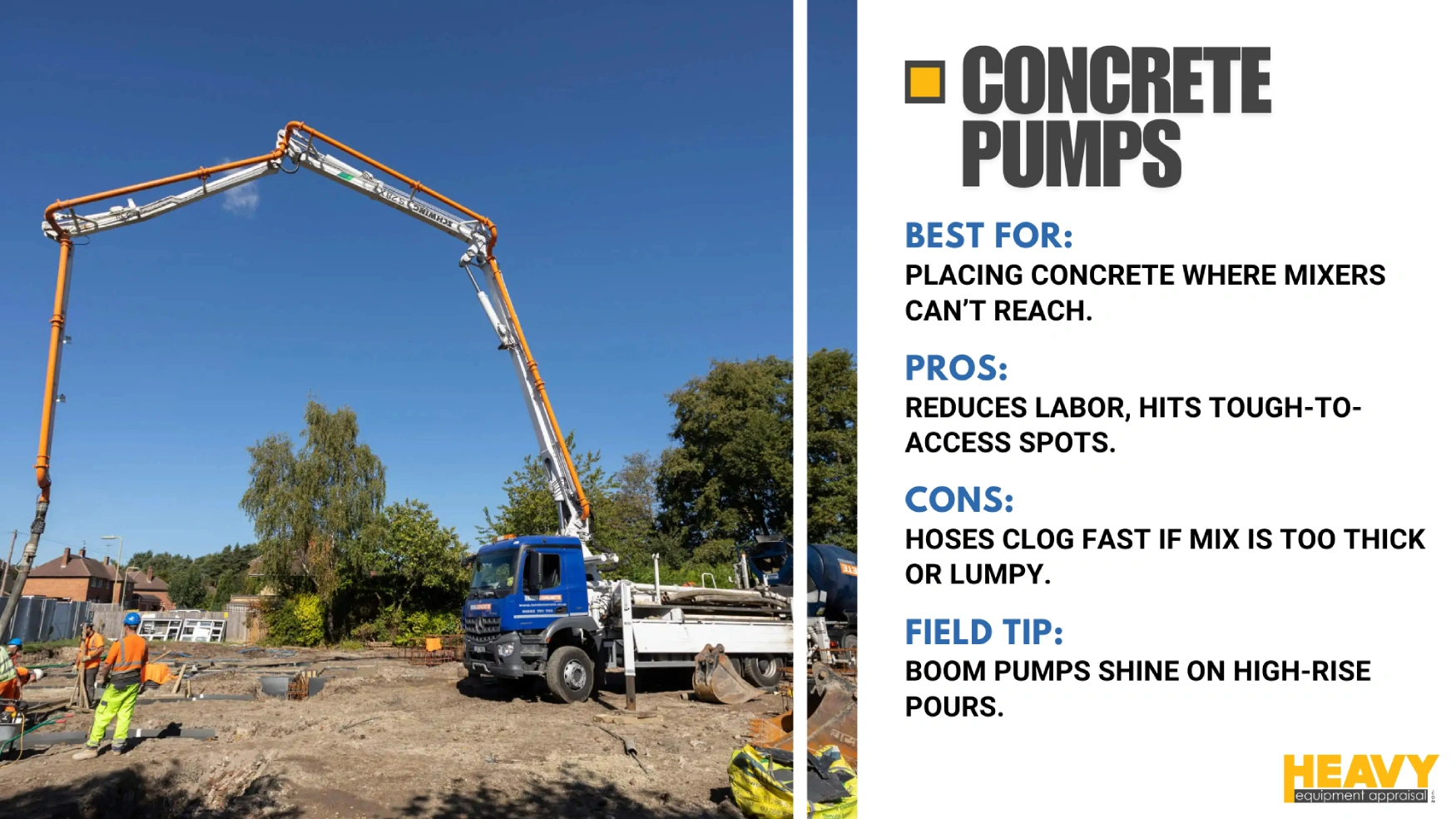
A concrete pump is a construction machine used to distribute liquid concrete through a pumping process. There are two major types of concrete pumps:
- Boom concrete pump- it is a modern version of a concrete pump attached to trucks or semi-trailers depending on the length. The boom is a robotic arm that directs where the concrete is placed in accurate measurements. Boom pumps are used in large construction projects as they save on labor and time due to pumping high volumes of concrete.
- Line-concrete pumps- these were the first type of concrete pumps connected to a truck or a trailer. The pump is manually attached using flexible concrete or steel hoses that lead to an outlet where the concrete is intended. The lengths vary from 10’,12.5’,25’, and 50’ depending on the hose diameter.
Other types of concrete pumps include rail-mounted and skid-mounted concrete pumps used in tunnels and mining sites on specialized projects.
Heavy Transport Equipment Types
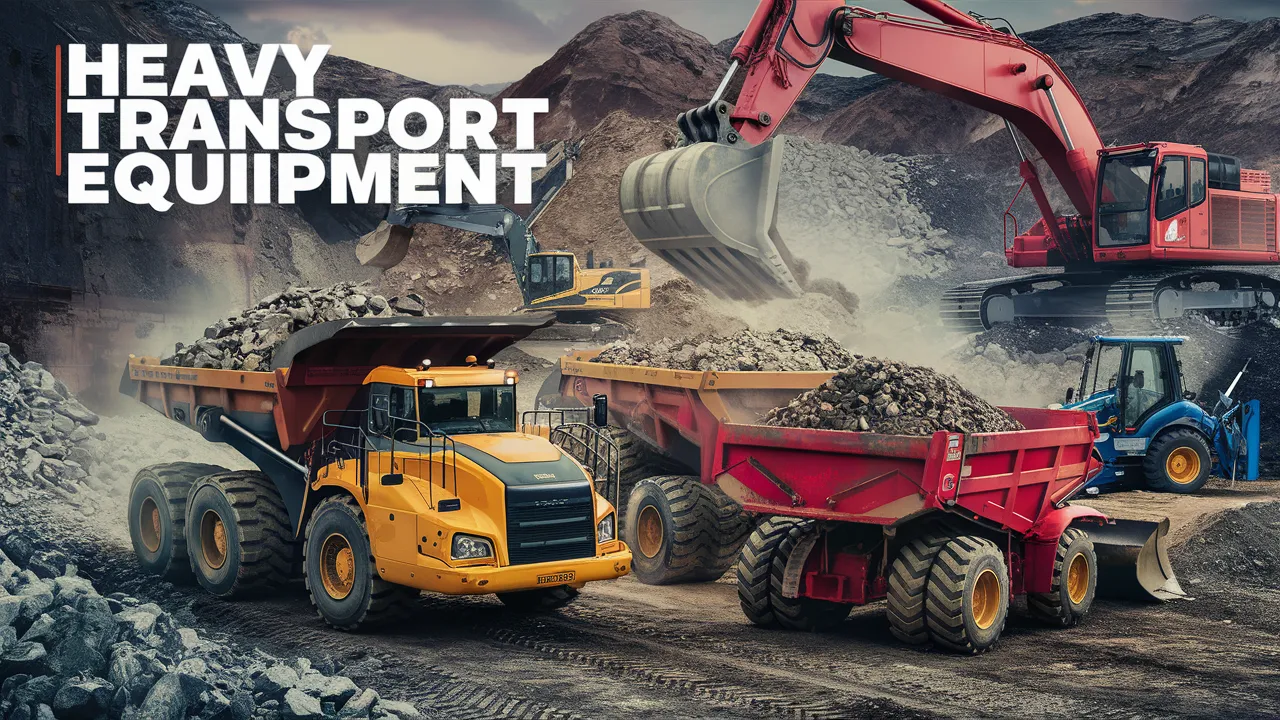
With construction and paving well underway, heavy transport equipment takes charge of hauling materials across the site. These machines, like dump trucks and articulated haulers, are built for the heavy lifting and transporting that keep the workflow steady and uninterrupted.
Below is the heavy transport equipment essential for moving bulk materials:
Dump Trucks
Also known as: dumper, tipper, tip truck, haul truck, rock truck, rigid dump truck
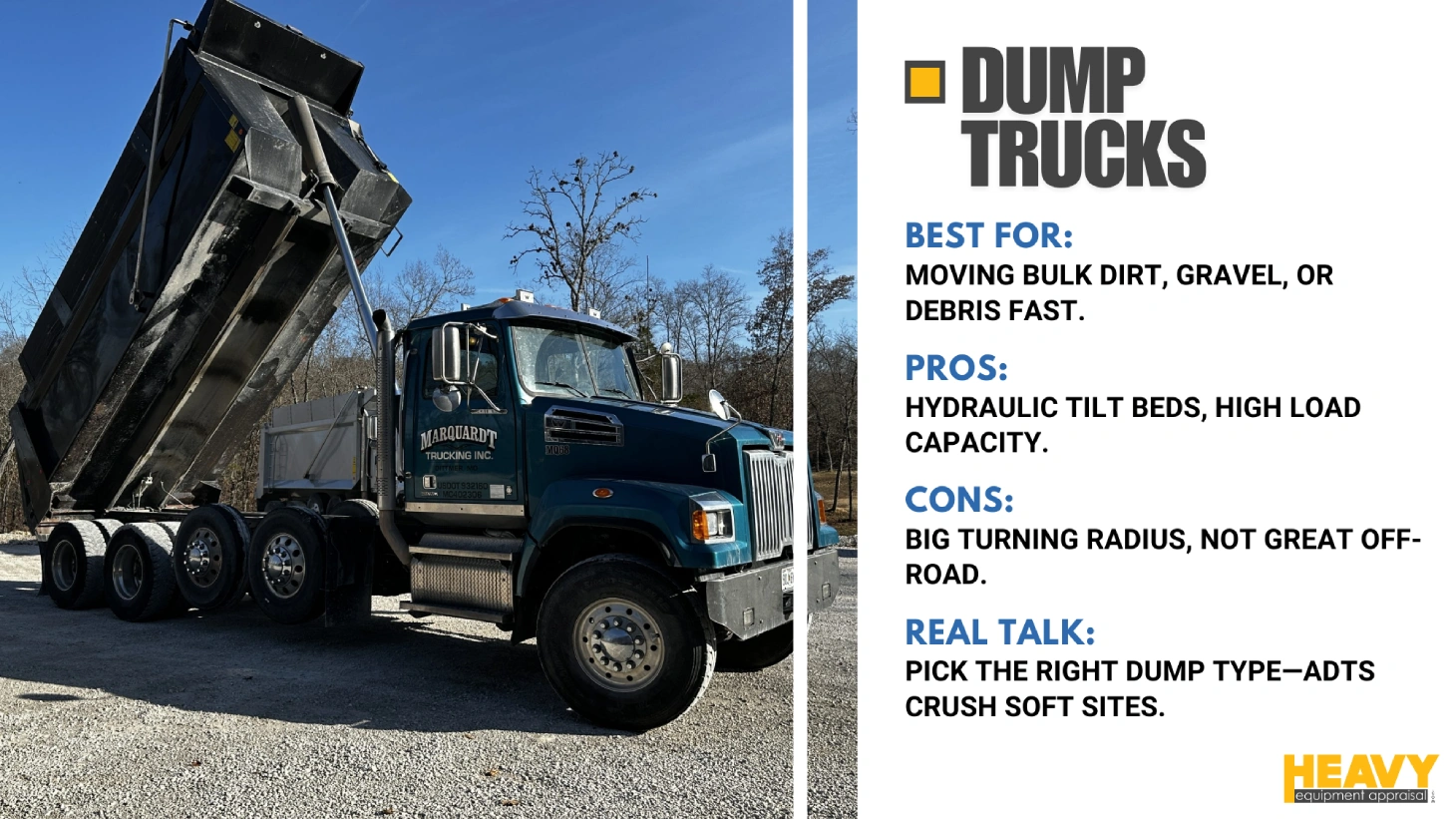
Dump trucks are used in massive construction projects to carry large quantities of material from one site to another.
The trucks contain a huge open-box bed behind them and big wheels to carry the total load of material, which can easily reach 10 tons.
The bed operates on hydraulic rams to lift the debris during offloading. Dump trucks come in different heavy equipment types, depending on the task at hand. Here are popular types of dump trucks:
- Standard dump truck- it has a chassis with a dump bed connected on top in a lever and horizontal hydraulic ram arrangement.
- Transfer dump truck- it is a standard dump truck with an extra movable cargo container loaded on a trailer. The transfer dump truck can hold construction aggregate, snow, wood chips, gravel, sand, etc. The essence of the second truck is to maximize load efficiency, particularly on highways with weight restrictions.
- Superdump truck- it is a standard dump truck loaded with a load bearing, liftable axle rated up to 13,000 pounds. The truck is designed in a way it adheres to the federal bridge formula, though it can carry loads of up to 80,000 pounds.
- Side dump truck- the side dump truck is connected to a 2-axle semi-trailer with hydraulic rams that allow the body to tilt horizontally and dump materials on the left or right side of the trailer. It makes it easy for quick loading and unloading of goods.
- Semi-trailer end dump truck- the semi-trailer end dump is a combination of a trailer and tractor with a hydraulic hoist. The 3-axle tractor pulls the 2-axle, dual-tire trailer such that the weight is more on the trailer than the tractor pulling.
- Belly dump- it is a type of dump truck with a gate at the bottom that releases material from the “belly” of the trailer. The gate has a clamshell design to allow precise offloading when laying materials. It is mainly used for material transport and stockpiling.
Dump truck appraisals get separated quickly between the chassis and the body. In a 2017 inspection in Bloomfield, New Mexico, we appraised a 2004 Peterbilt 385 dump truck with 658,227 miles at $40,000. Six hundred fifty-eight thousand miles on a chassis would scare an automotive buyer, but on a heavy-spec Peterbilt with a well-maintained dump body, the next buyer was not paying for miles, they were paying for a frame, an engine, a transmission, and a body that was still earning. The same fleet had multiple end-dump trailers separately valued from the tractors pulling them, because trailer value moves with body condition, hoist condition, and tarp/gate hardware rather than tractor miles. Selecting by "dump truck" without separating the rolling chassis from the dumping body is one of the more common ways equipment lists understate or overstate value.
Articulated Hauler
Also known as: articulated dump truck, ADT, articulated lorry, yuke
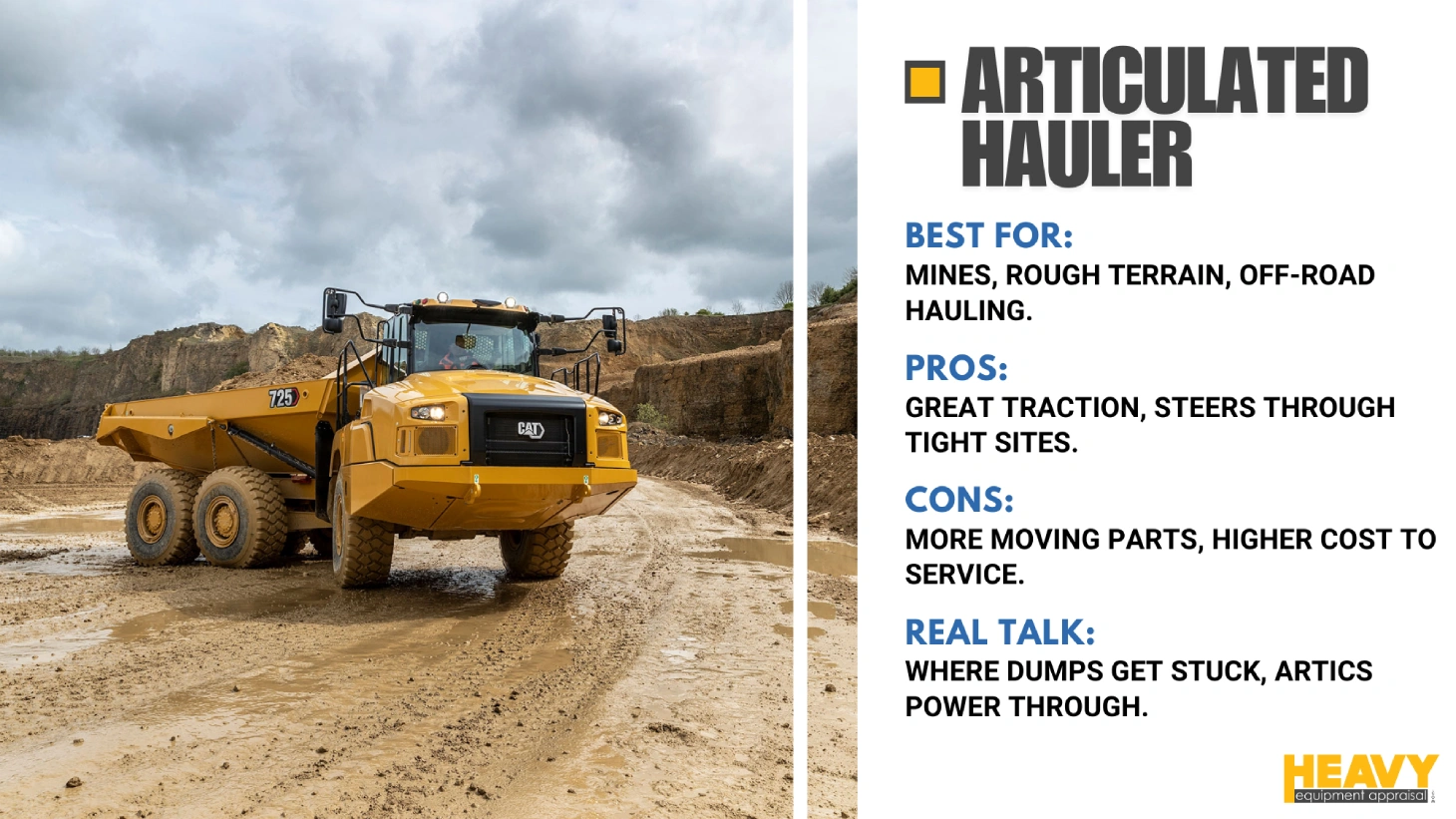
In areas where a dump truck cannot maneuver, articulated haulers come in handy. It is a type of dumper with an off-road, all-wheel-drive capacity with a distinct power unit.
An articulated hauler consists of a narrow trailer and dump box connecting the driver cab through a pivoting hinge. They are used in challenging worksites with poor pavements or roads where a dump truck would fit.
The all-wheel mechanism means steering is accomplished through hydraulic cylinders that power both axles. It provides a low center of gravity, adaptable to rough or slippery terrain.
Articulated haulers are conventional in mining, recycling, aggregate hauling, and utility construction sites.
Material Handling Equipment Types
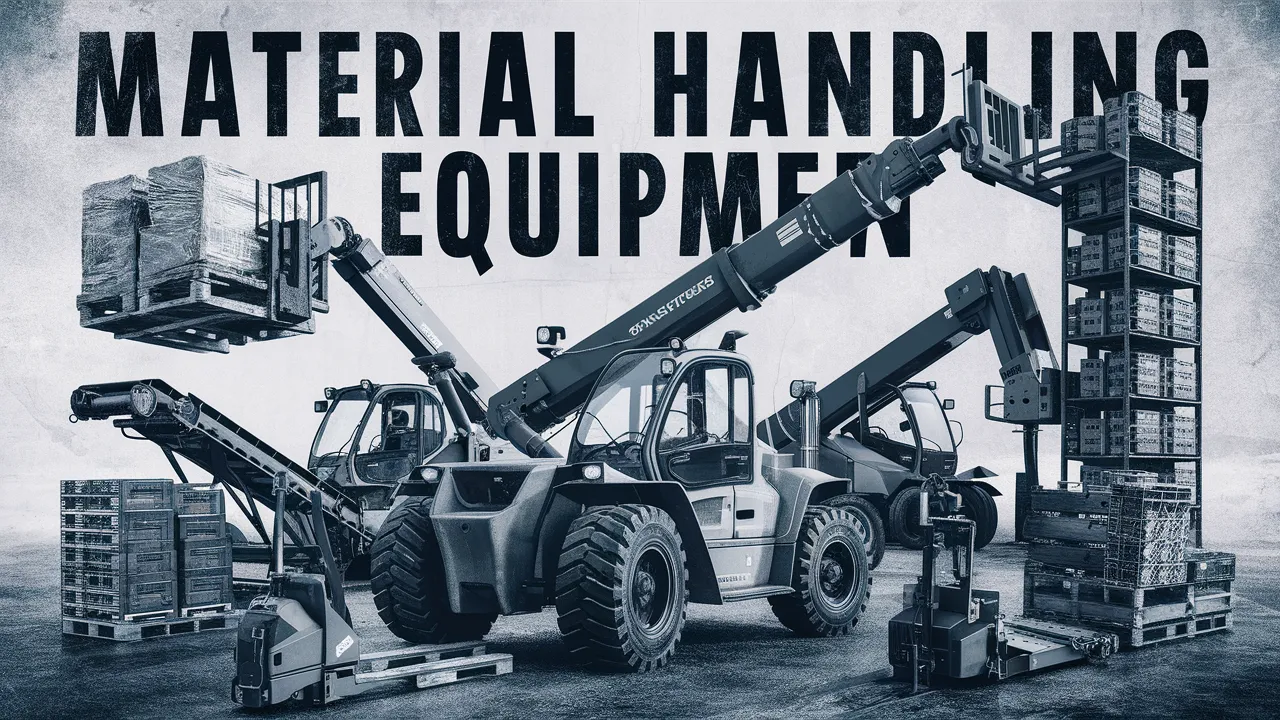
With heavy loads delivered, material handling equipment steps in to distribute and manage resources on-site. Forklifts, reach stackers, and conveyor systems work together to move materials quickly and safely, ensuring that every piece is where it needs to be.
Here’s the material handling equipment that drives on-site productivity:
Forklifts
Also known as: fork truck, lift truck, tow-motor, hi-lo, stacker
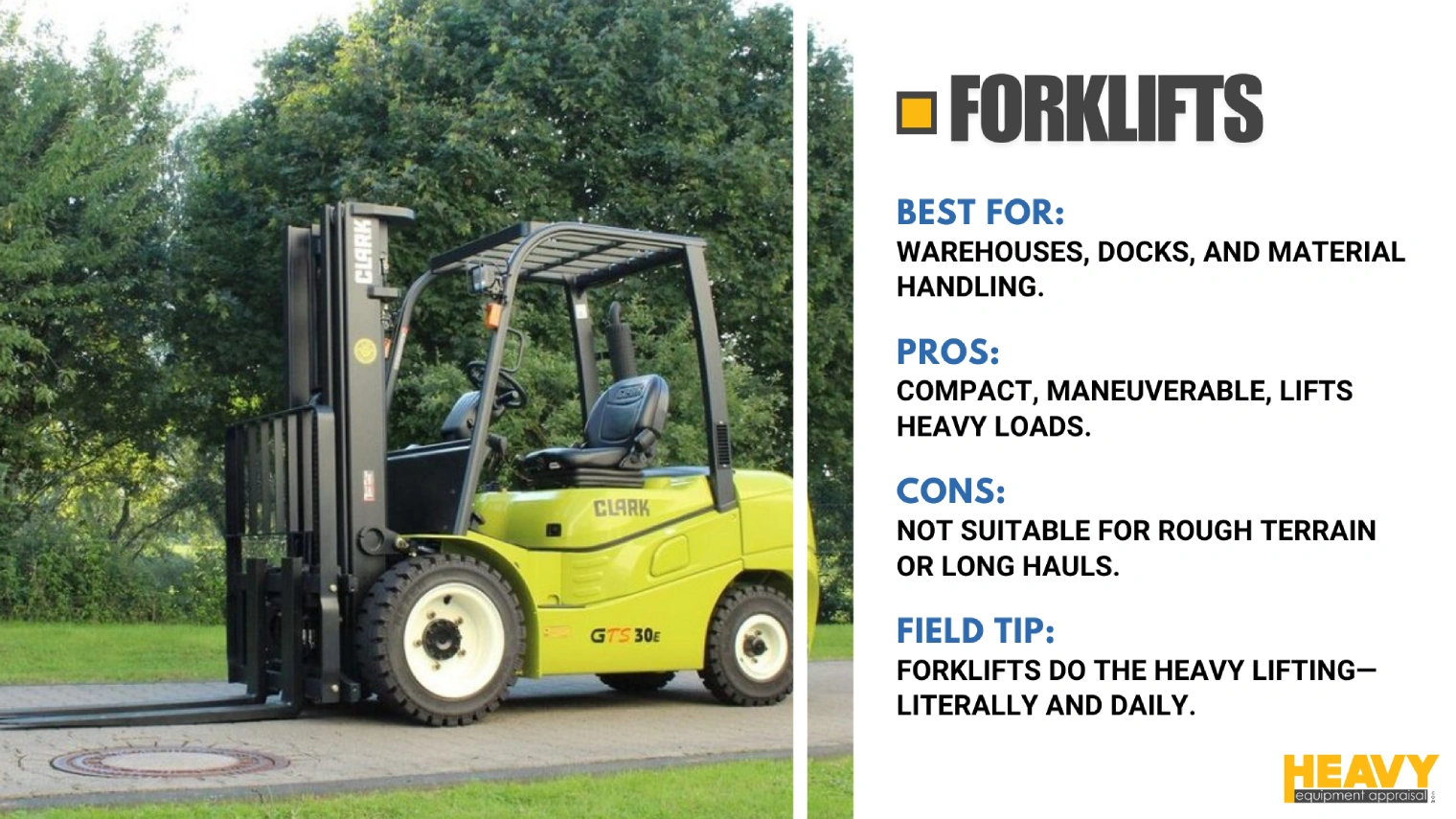
A forklift is a small construction vehicle attached to a forked platform on the front of the vehicle used to carry and move cargo.
Forklifts are essential in warehouses, construction sites, and commercial storage facilities. It uses hydraulic cylinders and roller chain pulleys to lift heavy material upwards, and then the vehicle moves it to another location.
Forklifts are used in commercial sites when moving material in rough terrains over long distances. However, they are more common in shipping warehouses for loading and unloading trucks with goods.
Other common areas where you’d find a forklift include a dockyard, recycling plants, and snow plows.
Telehandlers
Also known as: telescopic handler, teleporter, reach forklift, boom forklift, zoom boom
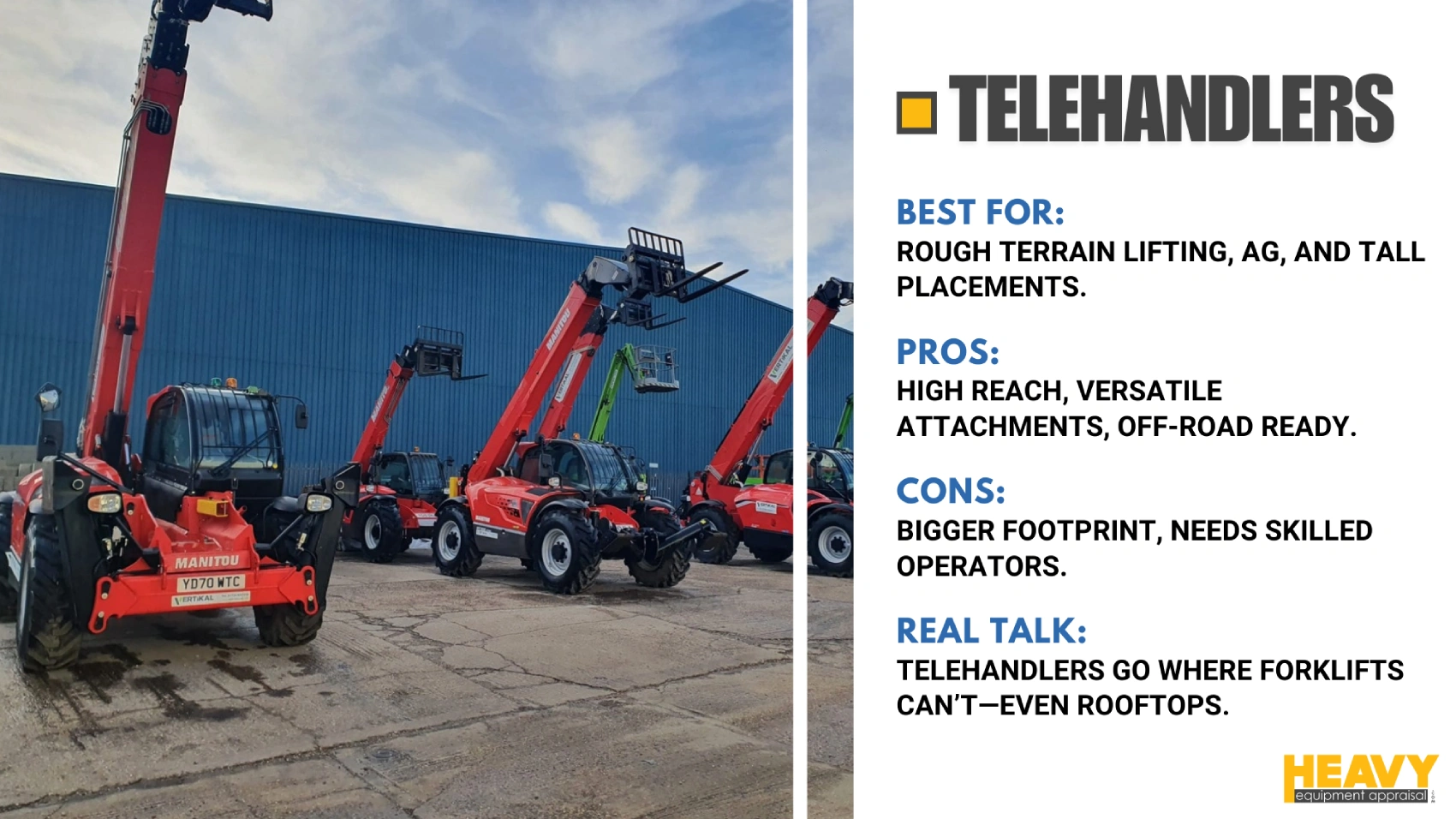
Telehandlers are massive construction equipment that lifts bulk materials in tough terrains. They have similar functions to a forklift, but have a flexible boom and are mostly used in commercial and agriculture projects.
Also known as a reach forklift or teleporter, a telehandler’s boom is long and can extend upwards and forwards from the vehicle. The tail end of the boom contains attachments like pallet forks, buckers, winch, or muck grabs.
Folks in North America sometimes refer to telehandlers as cherry pickers due to how they operate.
Pallet forks are popular attachments with a versatile function of moving loads in unconventional places for a typical forklift. For instance, telehandlers can remove pallet boxes from a trailer and place them as high as a 2-story building rooftop.
Telehandlers are also great in agriculture when the bucket or bucket grab is attached to the boom. Again, it helps move heavy materials to places unreachable from traditional equipment like a backhoe loader or a wheeled loader.
Reach Stackers
Also known as: container handler, intermodal handler, stacker, reach stacker
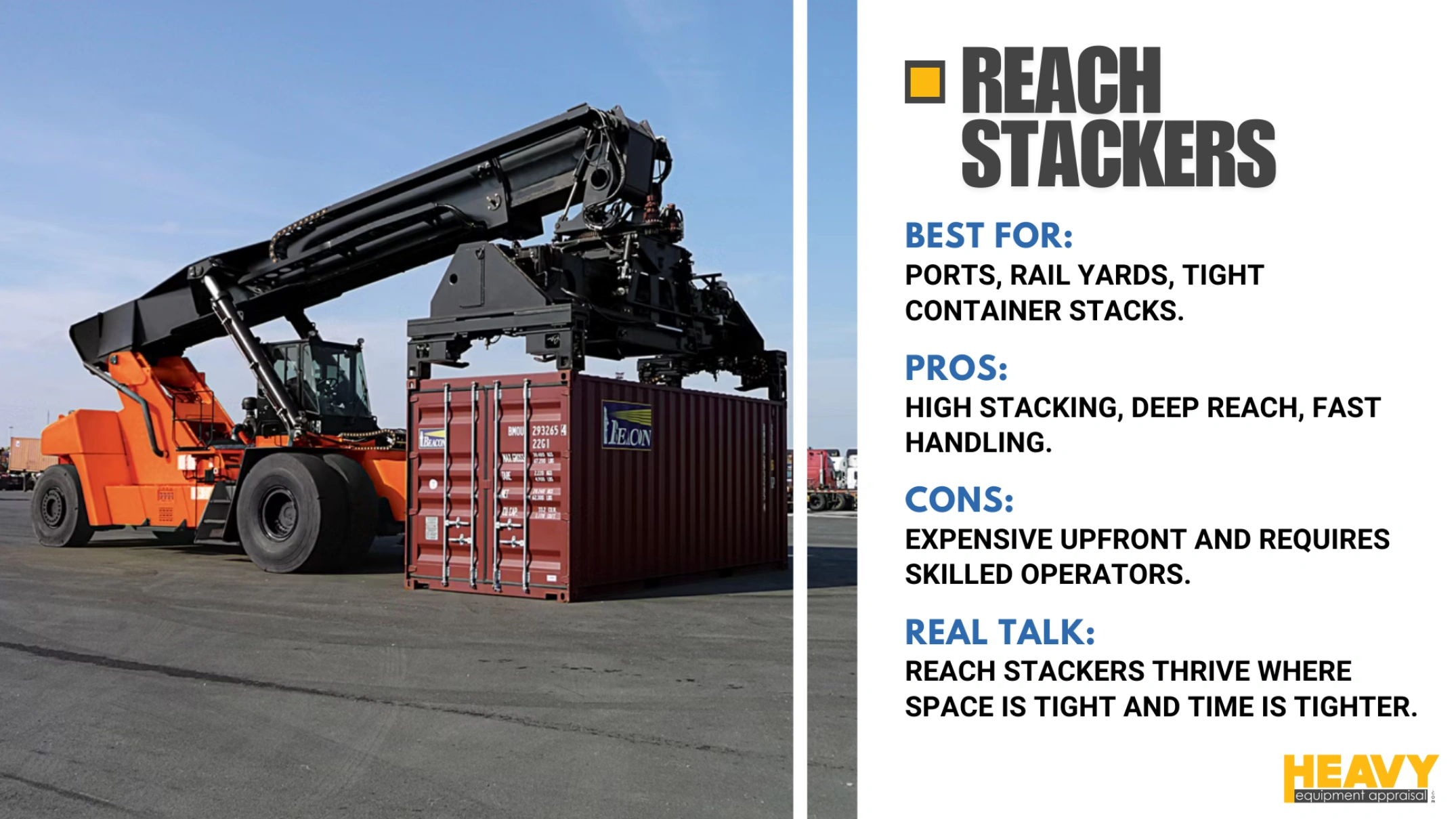
Reach stackers are specialized material handling machines engineered for precision and efficiency in the movement and stacking of intermodal containers. These machines are staples where space optimization is crucial:
- Ports
- Intermodal terminals
The extendable boom of a reach stacker allows operators to handle containers at varying heights and depths, providing the flexibility to stack containers in high rows. This capability maximizes yard space, ensuring that (even in confined areas) containers can be organized effectively without compromising access or maneuverability.
Conveyor Systems
Also known as: conveyor, conveyor belt, belt conveyor, material handling system, belt
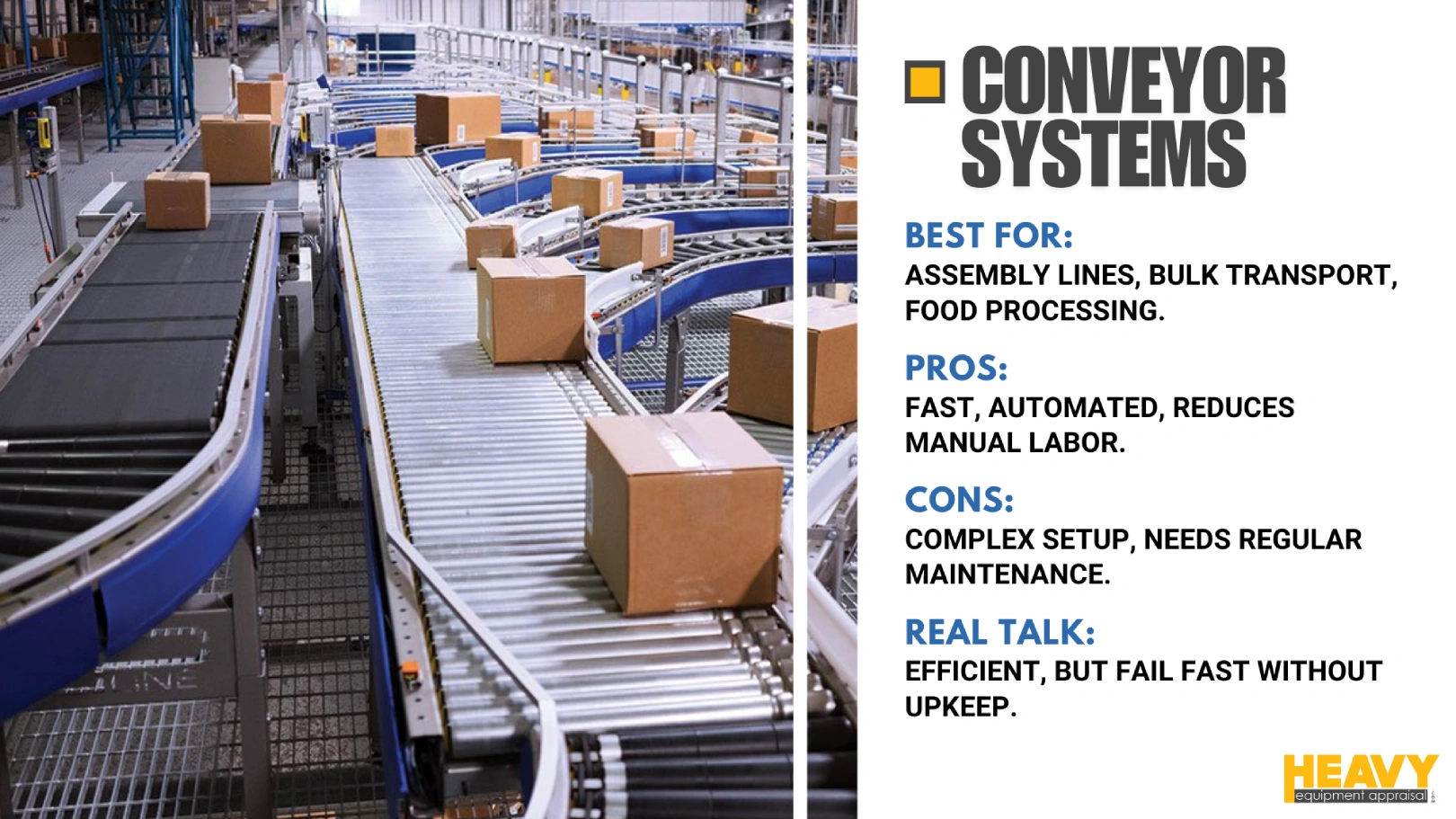
A conveyor system is an integral component in industrial material handling, engineered for the seamless transfer of goods across production lines. These systems are equipped with motorized belts or screw mechanisms, designed to move heavy or bulk materials such as automotive parts, aggregates, or food products with precision and speed.
Conveyor systems are often customized with variable speed drives, cleated belts, and incline adjustments to accommodate specific operational requirements, ensuring optimal throughput and efficiency.
Applications of Conveyor Systems
In the automotive industry, conveyor systems are used for moving components through various assembly stages, from stamping to final inspection.
In mining and aggregate production, they handle bulk material transport across long distances, reducing manual labor and enhancing workflow.
Conveyor systems are also critical in food processing, where they maintain hygiene standards while moving products through different processing stages.
Lifting and Access Equipment Types
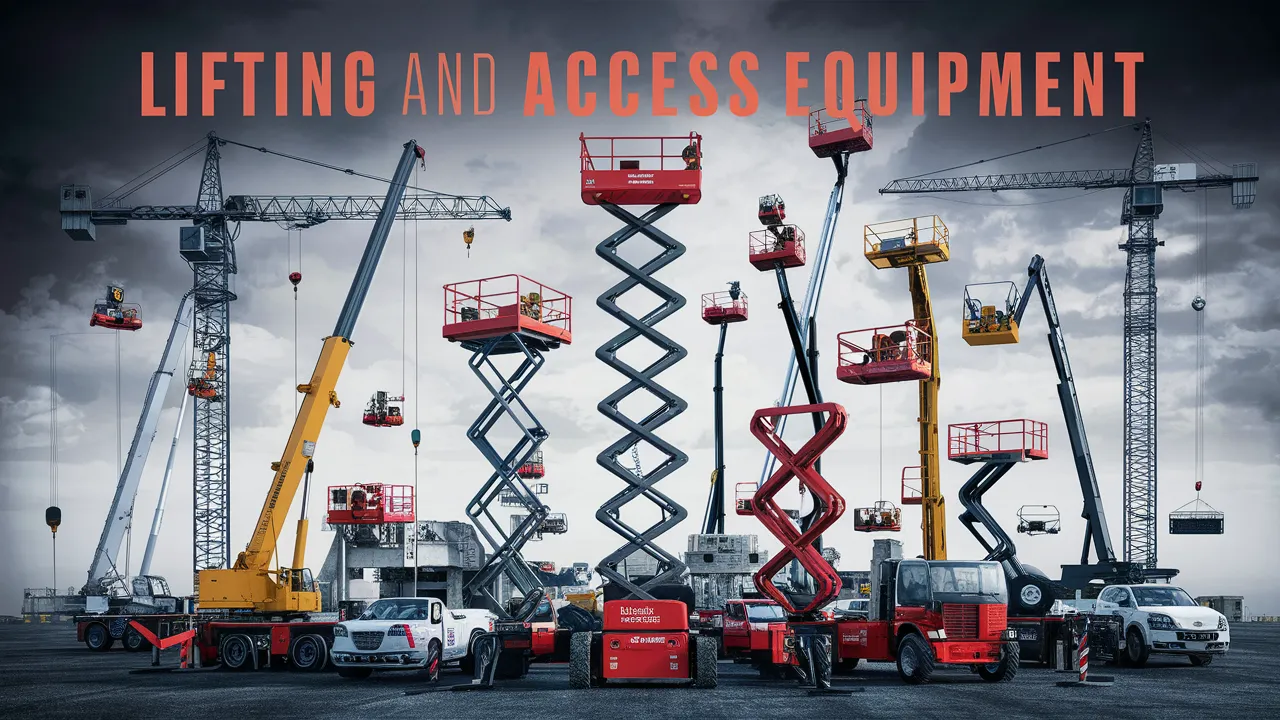
For projects that reach above ground level, lifting and access equipment ensures materials and crews get where they need to be. Cranes handle the heavy vertical loads, while manlifts and boom lifts provide secure access to work areas at height.
Here’s the critical lifting and access equipment:
Cranes
Also known as: hoist, jib, derrick, tower crane, mobile crane, skyhook
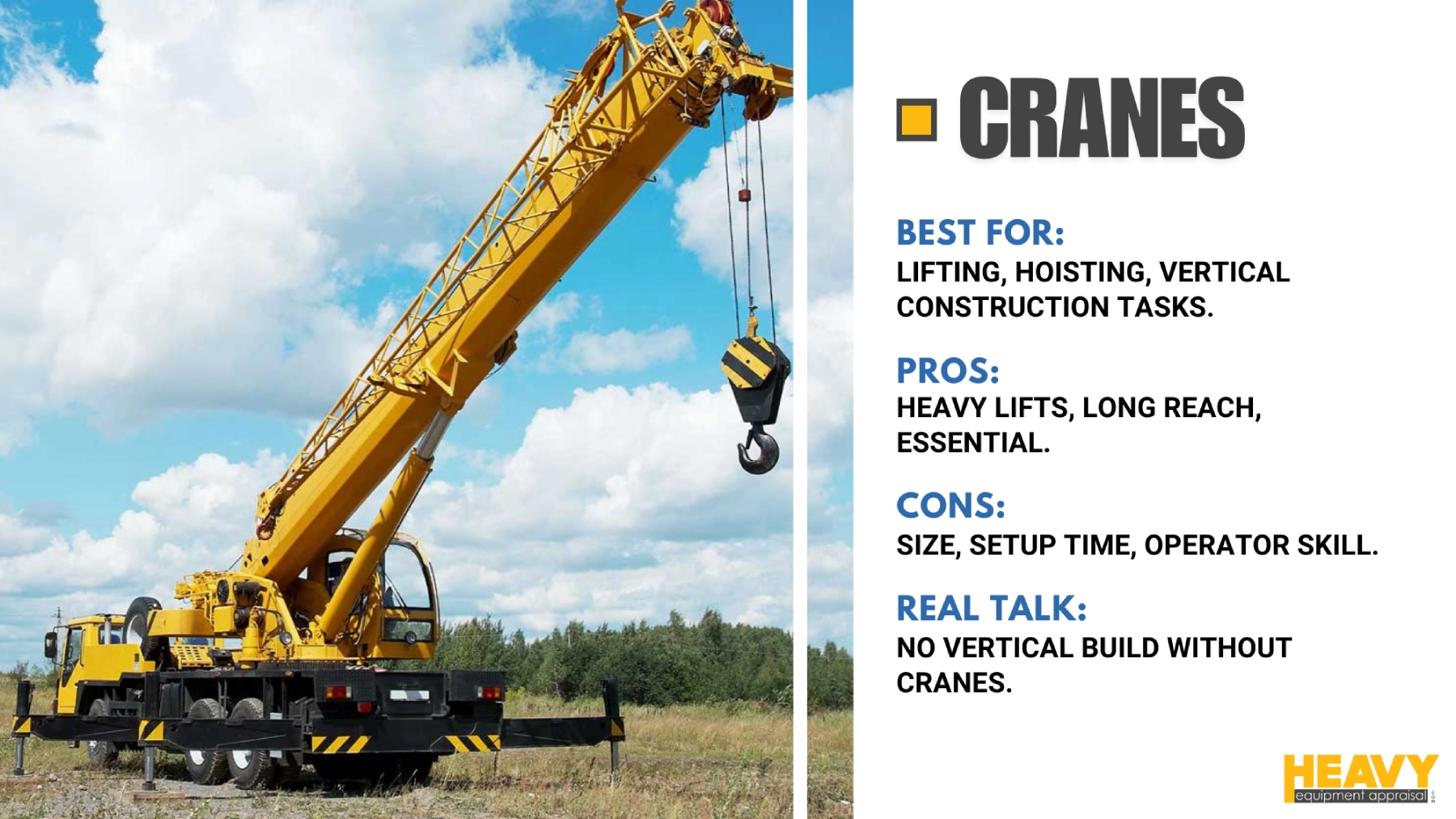
Another common construction equipment is a tower crane. It consists of wire ropes, chains, and sheaves used to lift and move heavy material across a site.
Tower cranes have a simple lifting mechanism to lift heavy objects beyond the capability of a human being. The T shape uses a balance to offset any upward movement for lifting heavy materials.
Cranes are particularly common in ports for loading and unloading freight or in manufacturing sites for assembling large equipment. It can carry anything from concrete blocks, containers, frames, steel trusses, etc.
Typical tower cranes have a cabin on top which may sit several hundreds of feet above the ground.
Manlifts
Also known as: aerial work platform, AWP, cherry picker, boom lift, personnel lift, aerial lift, man basket
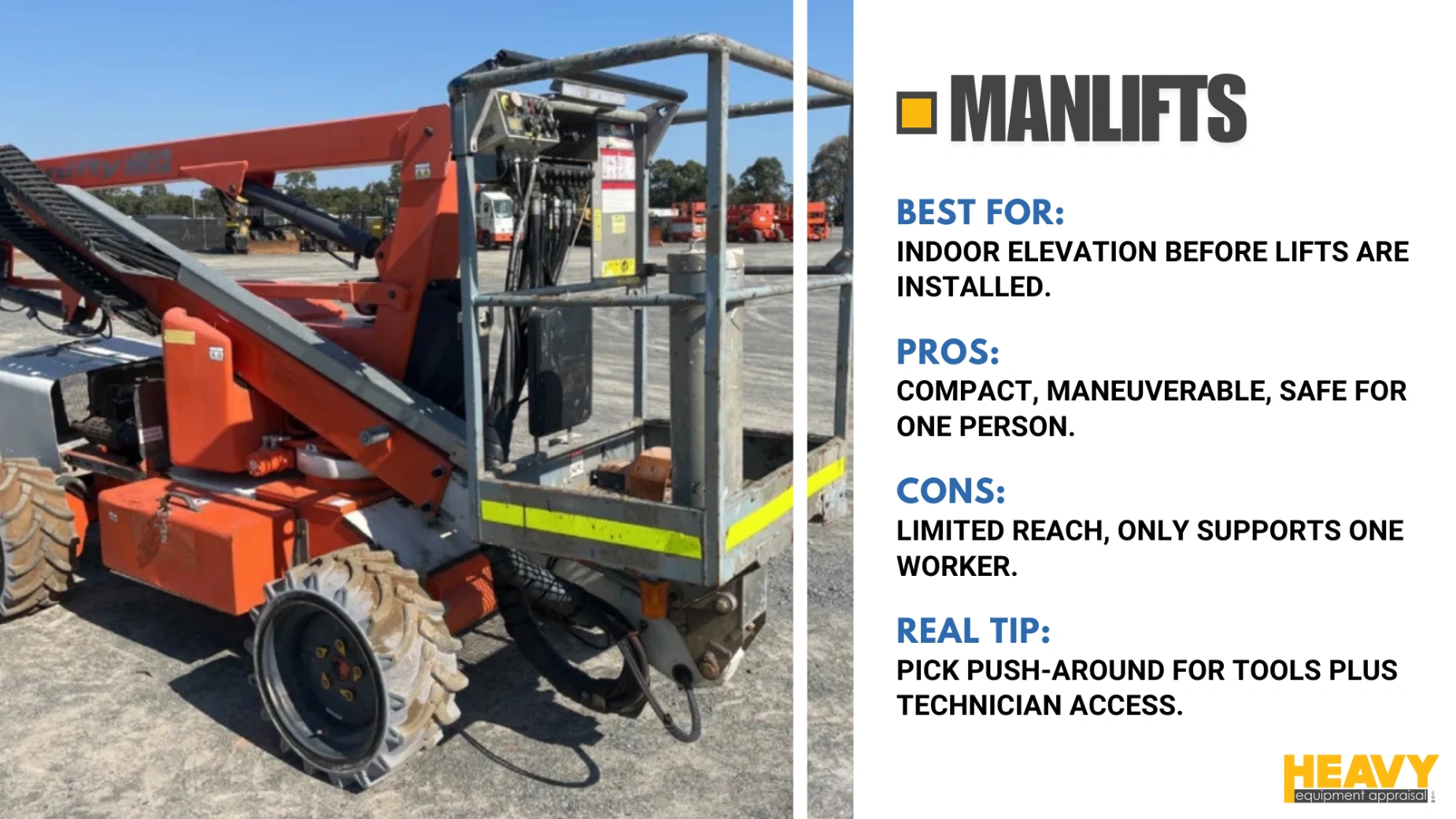
Building high structures require plenty of equipment, and one of them is a manlift. It is a small piece of equipment that helps people in buildings where elevators and lifts are not yet installed.
They are four-wheeled, small, and designed to lift only one person.
Manlifts, also known as personal lifts, or personnel lifts have three main types: belt-drive, self-propelled, and push-around.
- Self-propelled manlifts- it is the smallest of the three and can raise a person or small construction material to 20 feet. The size makes it maneuver in small alleys and doorways within a building.
- Push-around manlifts- it is slightly bigger than self-propelled and can go to heights as high as 50 feet. It also has enough space to fit a worker and a couple of tools in small spots. The push-around lift uses hydraulic wheels and a collapsible frame to move up and down through corridors.
- Belt manlifts- it is the largest manlift with heavy-duty construction and retractable legs. With an extended neck, it can soar to heights of 34+ feet rotating 360 degrees. The joint on the neck allows it to maneuver through obstructions like power lines without alighting personnel.
Scissor Lifts
Also known as: scissor platform, vertical lift, lift table, Skyjack
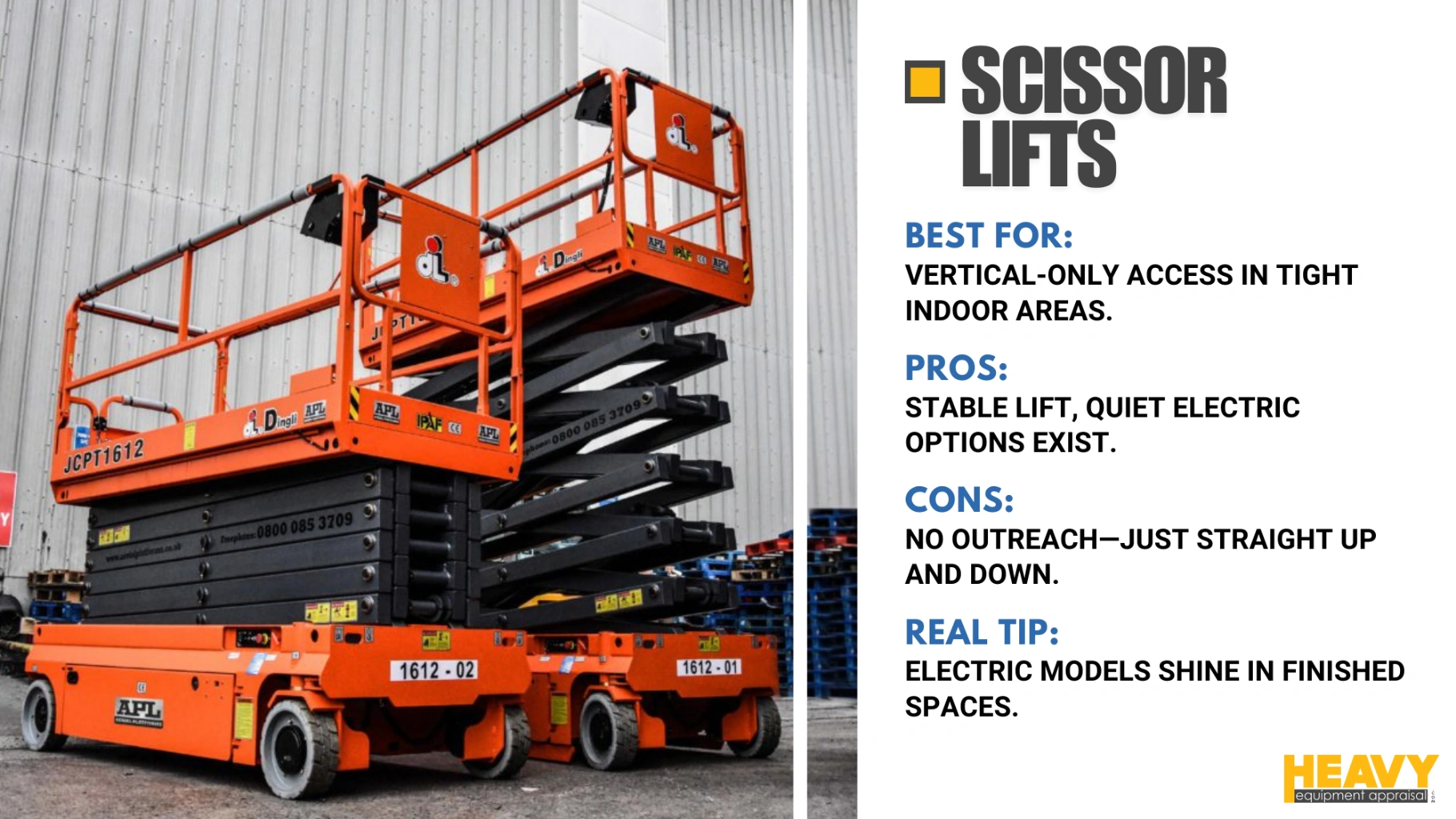
A scissor lift is vital in projects where a boom or telescope would not fit, particularly indoors.
It has a raising mechanism of “X” shaped supports and only moves in a vertical motion. The scissor lifts don’t need a driver, but can be truck mounted for specialized use.
Like a manlift, scissor lifts use hydraulic jacks to carry one or two personnel. An electric version is ideal for light indoor work, while a gas-powered model could be good for adding extra lifting torque.
Mining Equipment Types
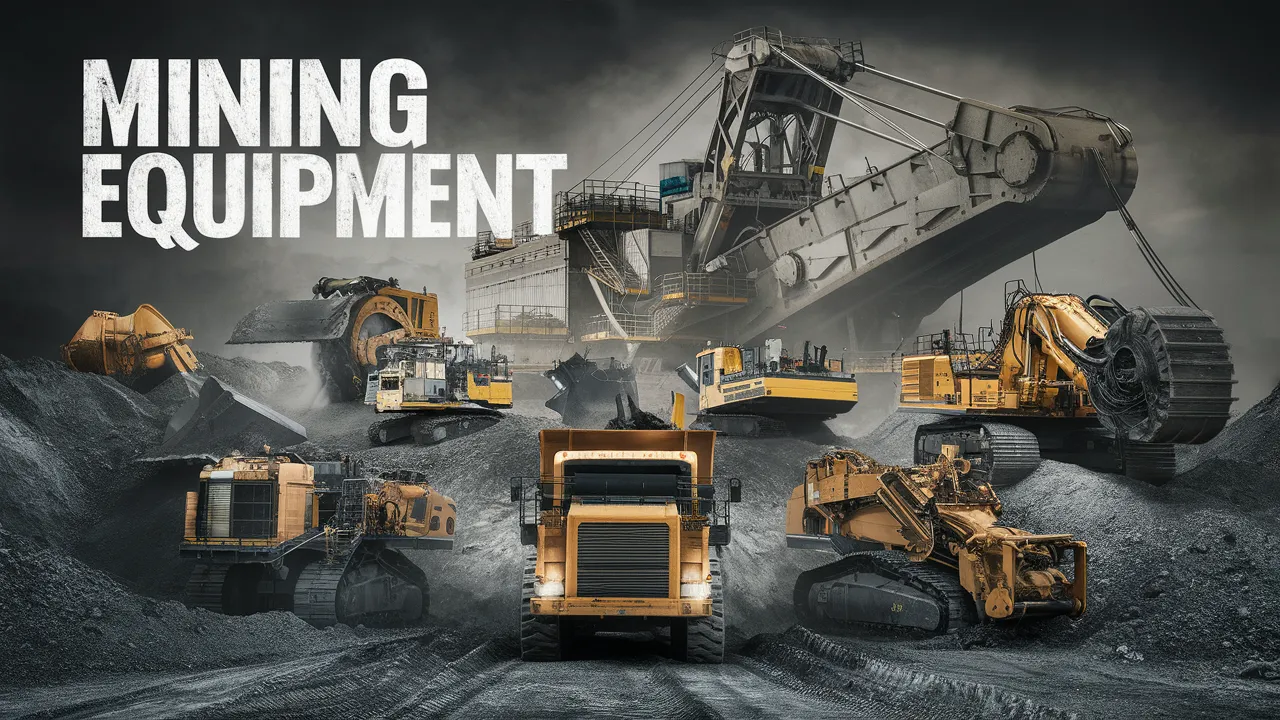
Mining operations push machinery to its limits, requiring equipment that can handle extreme stresses.
Draglines remove large overburden layers with precision, and tunnel boring machines carve through rock with relentless efficiency. Here’s the mining equipment that meets the demands of industrial-scale material extraction:
Dragline Excavator
Also known as: dragline, walking dragline
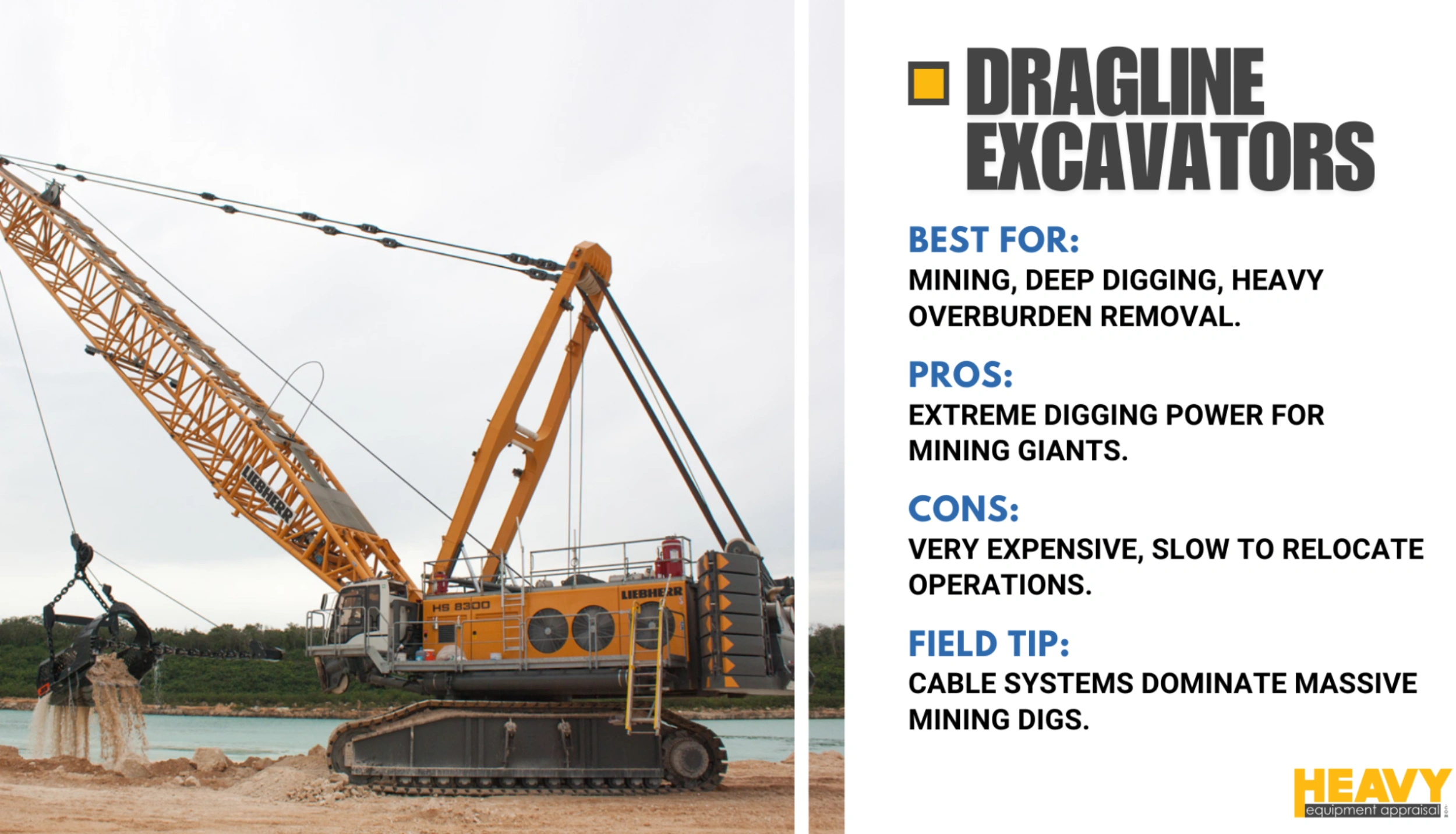
Dragline excavators are large industrial equipment used in mining and construction activities.
They have a long boom connected to a bucket with metal ropes and hinges to facilitate the movement of heavy debris from one place to another across a deep surface.
Dragline excavators are one of the heaviest types of equipment in construction, and most models are assembled at the construction site rather than transported.
A few smaller ones exist but will still weigh up to 8,000 tons.
Because they are tall, draglines are perfect for deep surface mining, port construction, and underwater excavations. The smaller models are common in canal dredging, pond construction, road construction, and more.
Electric Rope Shovels
Also known as: rope shovel, electric shovel, mining shovel, power shovel, wire rope shovel
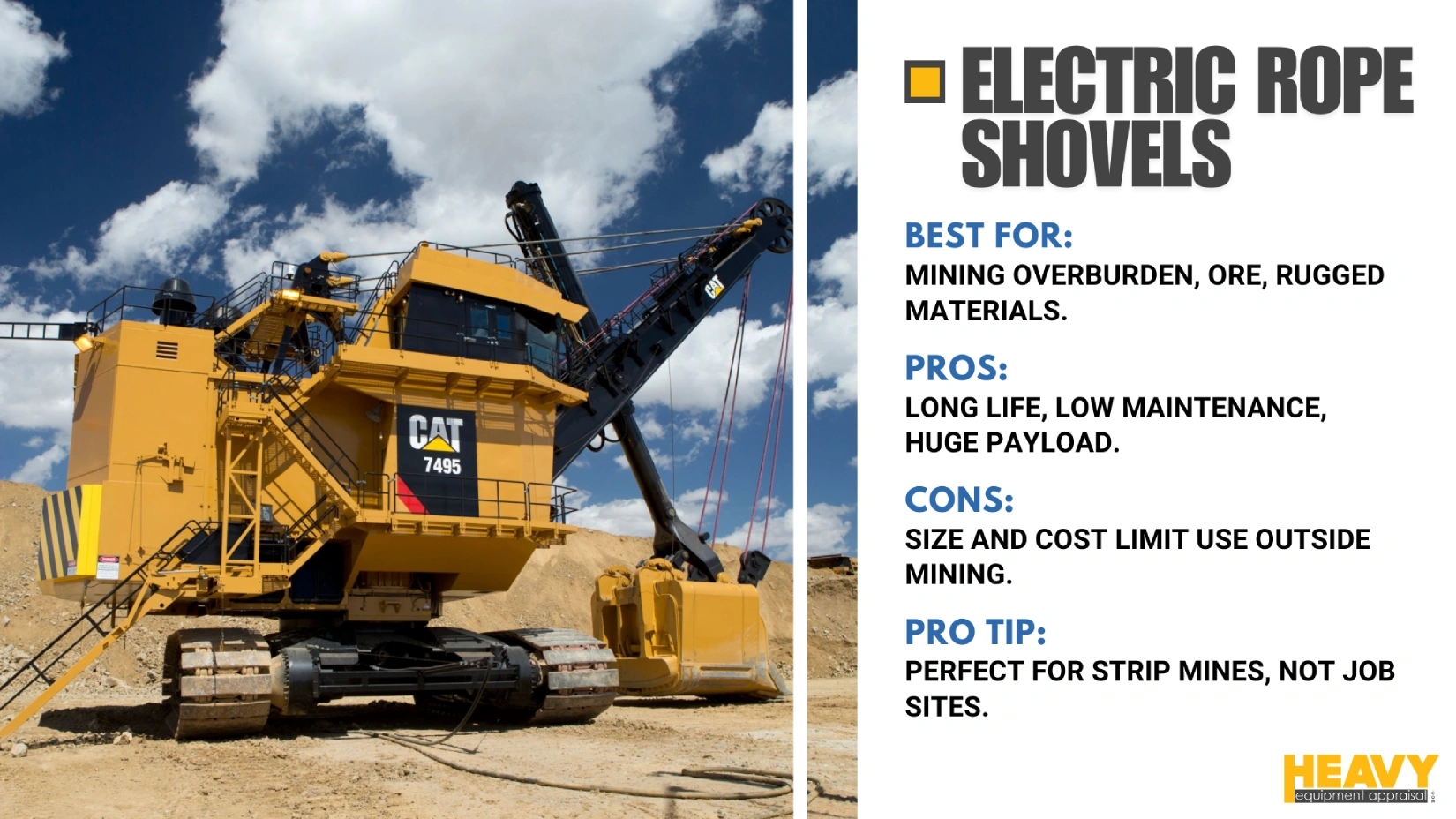
Electric rope shovels are crucial to mining projects and probably explicit to this environment as they can handle heavy, rugged materials such as ore and overburden.
It has few moving parts and lasts longer than most equipment on this list. The electric-powered rope is also easy to operate and maintain.
An electric rope shovel may also replace the work of a dragline at a smaller scale by moving materials from one place to another. You may find applications in construction, although very minimal.
Off-Highway Trucks
Also known as: haul truck, mining truck, rigid dump truck, rock truck, heavy hauler, yuke
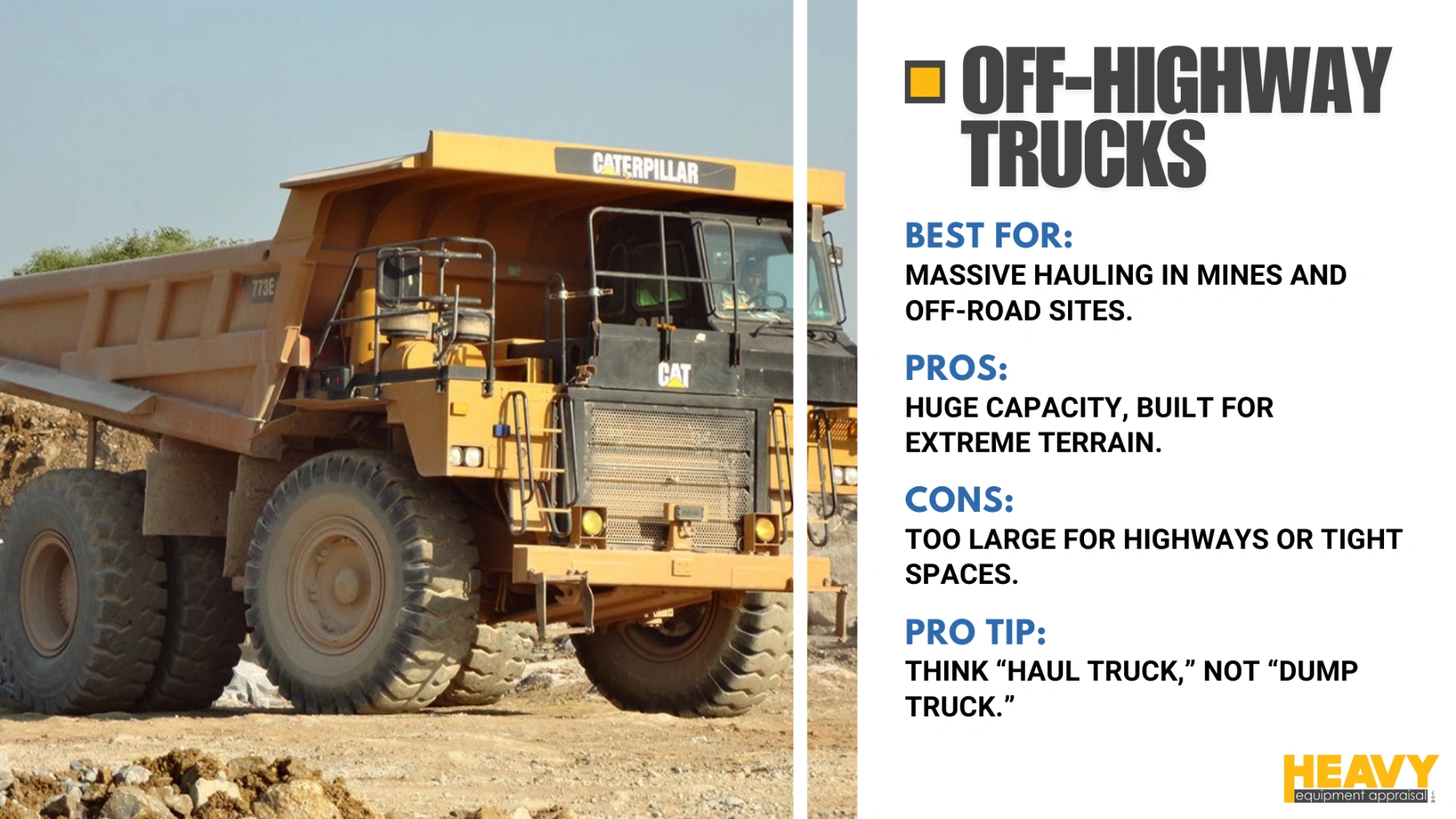
Dump trucks and skid steers are great, but sometimes you need something a bit bigger and tougher on surfaces.
Off-highway trucks are huge trucks designed to work in unfinished environments in mining and dirt-hauling jobs.
Due to its heavy use in the mining environment, the term “dump” is not used to define these trucks. They are commonly known as haul trucks as they are strictly off-road machines.
Forestry Equipment Types
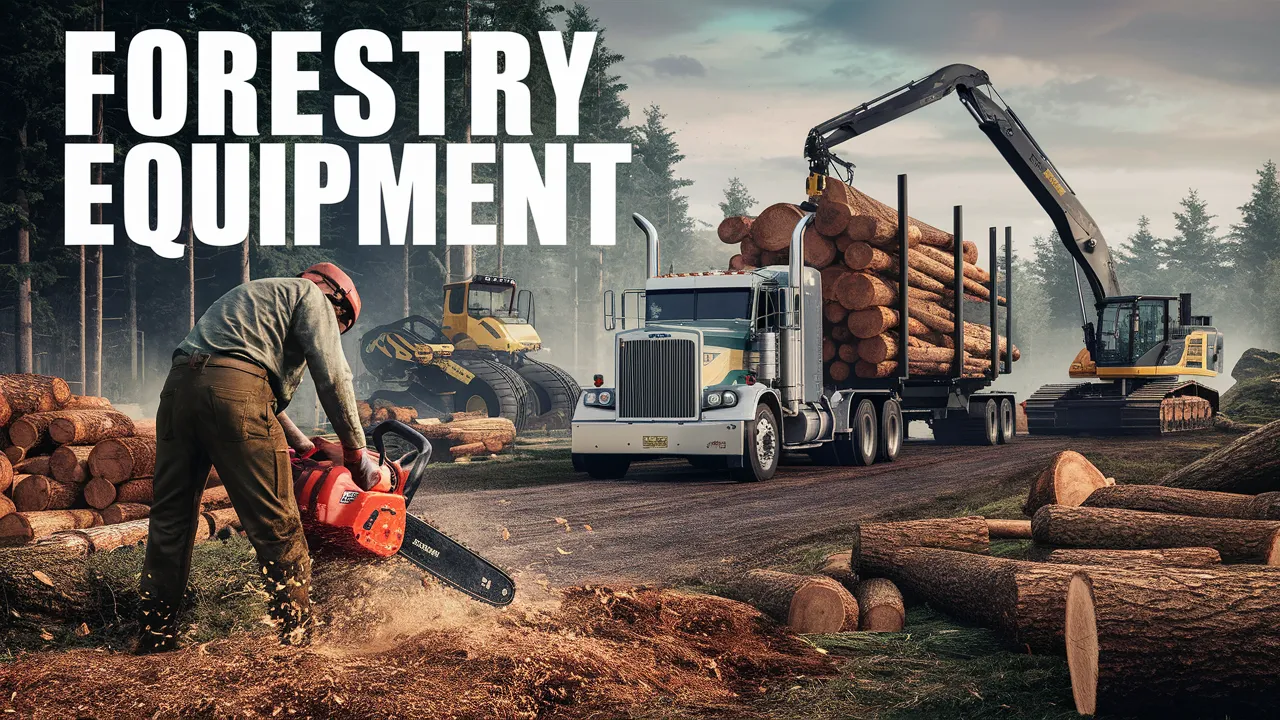
Navigating the forest floor requires equipment with both strength and precision. Feller bunchers quickly process trees, while knuckleboom loaders efficiently stack and load logs for transport.
Below is the forestry equipment essential for maximizing yield and minimizing downtime in logging operations:
Feller Bunchers
Also known as: tree harvester, feller, buncher, tree cutter, tree shear
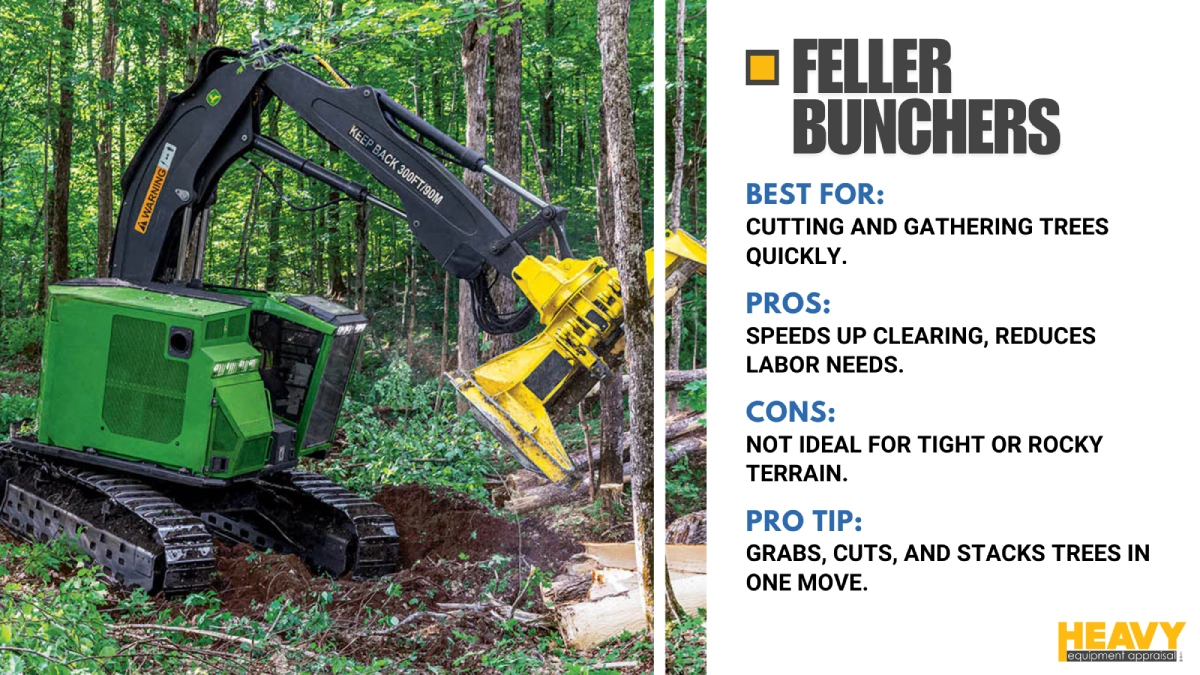
A feller buncher is a tree-cutting heavy equipment used to remove large trees on a construction site. The machine uses a sturdy boom and a grabber to rapidly gather and cut a tree before felling it.
Through its mechanisms, the feller buncher can transport the trees to one place at a go.
A typical feller would cut a tree down to the ground, assemble it from different locations and then have the loaders and dump trucks pick it up.
The feller buncher cuts the trees without felling and assembles them in one location.
Performing both of these harvesting functions is mainly done by a tree-grabbing device equipped with the feller buncher. The circular pinching device has a chain saw designed to cut trees once it grabs it.
Forwarder
Also known as: log forwarder, timber forwarder, woods wagon, log buggy
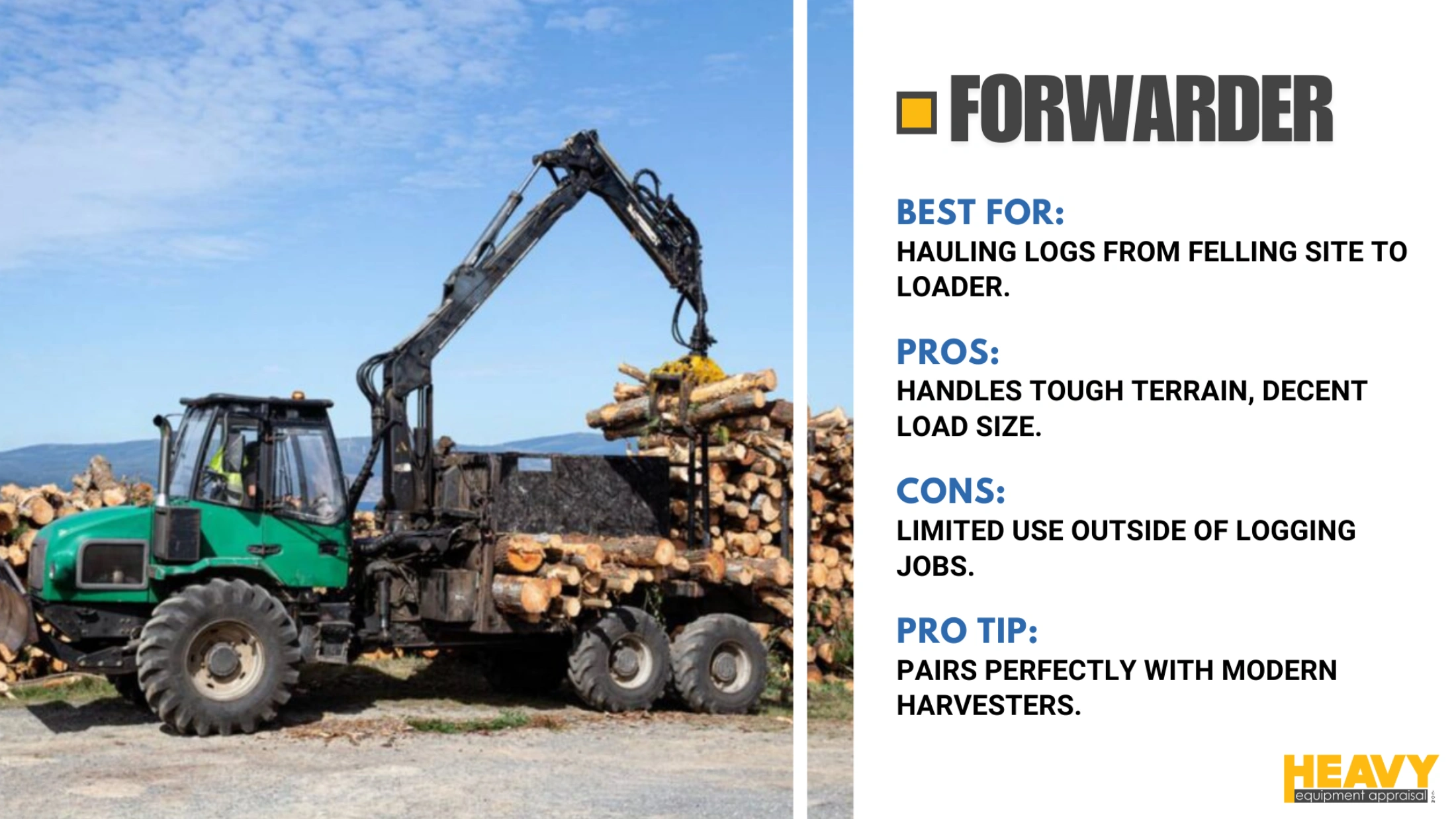
A forwarder is used in forestry and logging jobs to transport felled logs to the loading sites.
The eight-wheeled machine is designed for off-road terrains, with most models having a front dozer blade to help clear pathways and stack up logs.
Forwarders also have models with tracks instead of wheels where the terrain is unbearable. It is specific forestry equipment designed to best suit forestry operations needs.
Forwarders work hand-in-hand with harvesters; they help move felled timber to a loading zone.
The loading capacity of forwarders is pretty decent and ranges from 1 ton to 25 tons depending on the model. They may also come in rotating cabs, automated boom control functions, adjustable stake heights, and more.
Knuckleboom Loader
Also known as: knuckleboom, log loader, grapple loader, swing machine, grapple
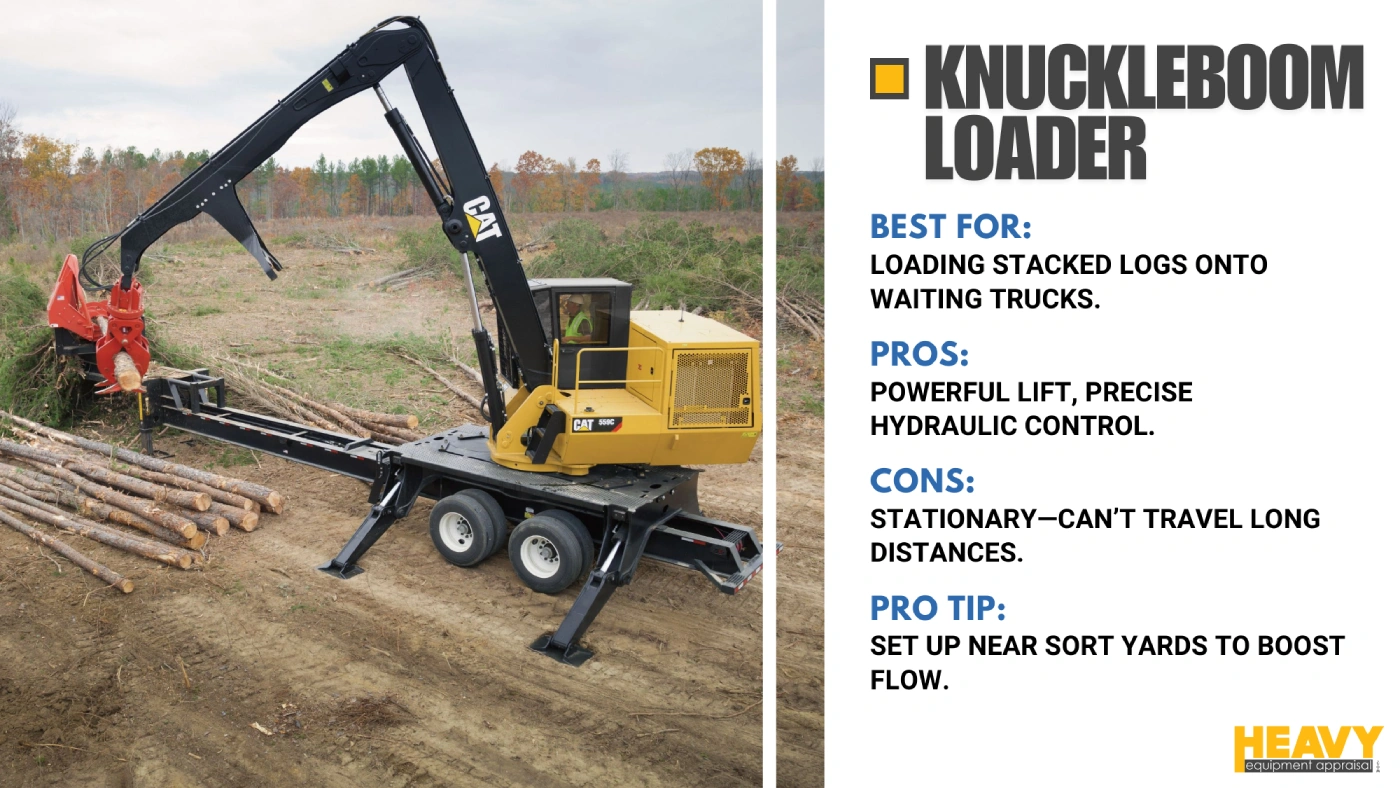
A knuckleboom loader is heavy equipment designed to carry logs. It is similar to a forwarder but much larger, with tracks instead of wheels.
The machine is mainly used in loading zones where logs have been accumulated by the knuckleboom loader. It has a crane system to carry the logs and place them on trucks for transporting. Knuckleboom loaders have rotating cabs and rarely move long distances.
New models like the John Deere 437D have smart hydraulic systems that sense the amount of load and use the exacto power to lift. It improves efficiency, performance, and fuel consumption.
Skidders
Also known as: log skidder, timber skidder, cable skidder, grapple skidder
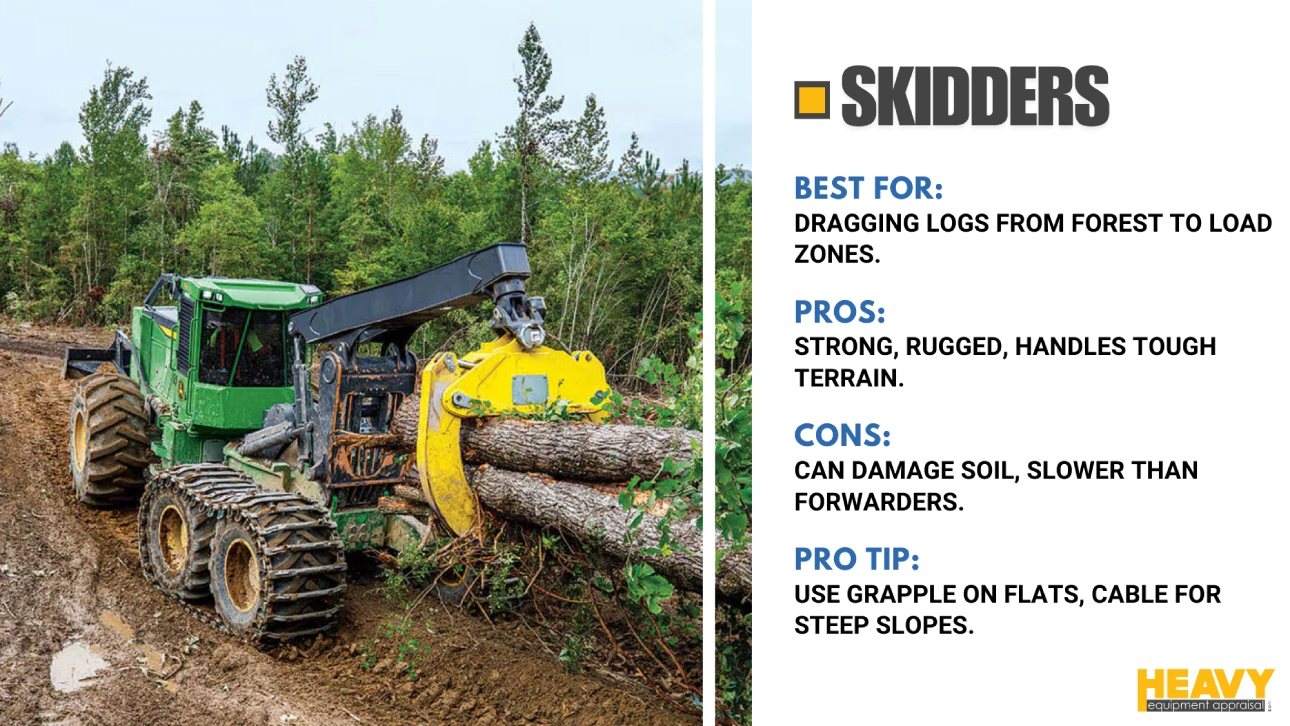
A skidder is heavy equipment that cuts trees and pulls them out of the forest. Unlike forwarders which lift logs off the ground, skidders carry and drag the tree logs as they move to the loading zone.
There are two main types of skidders; grapple skidders and cable skidders. A cable skidder is attached to a series of cables that must wrap the logs before being moved.
They are more likely to involve a second operator to help with wrapping. Cable skidders are efficient in hilly areas and mountains where the grapple would be prone to damage.
Grapple skidders don’t need a second operator and have a tong-like grappling system, similar to a forwarder. The grappler is attached to a boom and lifts logs quicker, especially when moving on smoother surfaces.
Both types of skidders have safety measures to protect the operator during movement. The cab is enclosed in a steel cage, which prevents falling tree limbs or debris harm the operator.
Farming Equipment Types
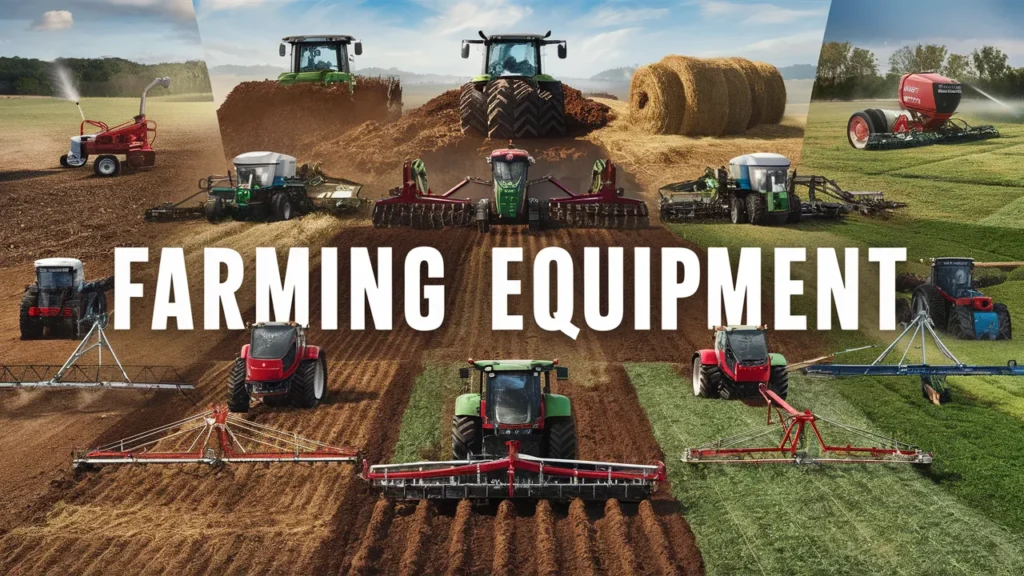
Agriculture demands robust machinery that tackles the entire growing cycle.
Combines streamline harvesting by simultaneously cutting, threshing, and cleaning crops. Meanwhile, subsoilers break up compacted layers to enhance root penetration, and advanced seeders provide consistent row spacing for even crop development.
Here is a sample of the farming equipment essential for industrial-scale agriculture:
Tractors
Also known as: farm tractor, ag tractor, tractor unit, prime mover, puller
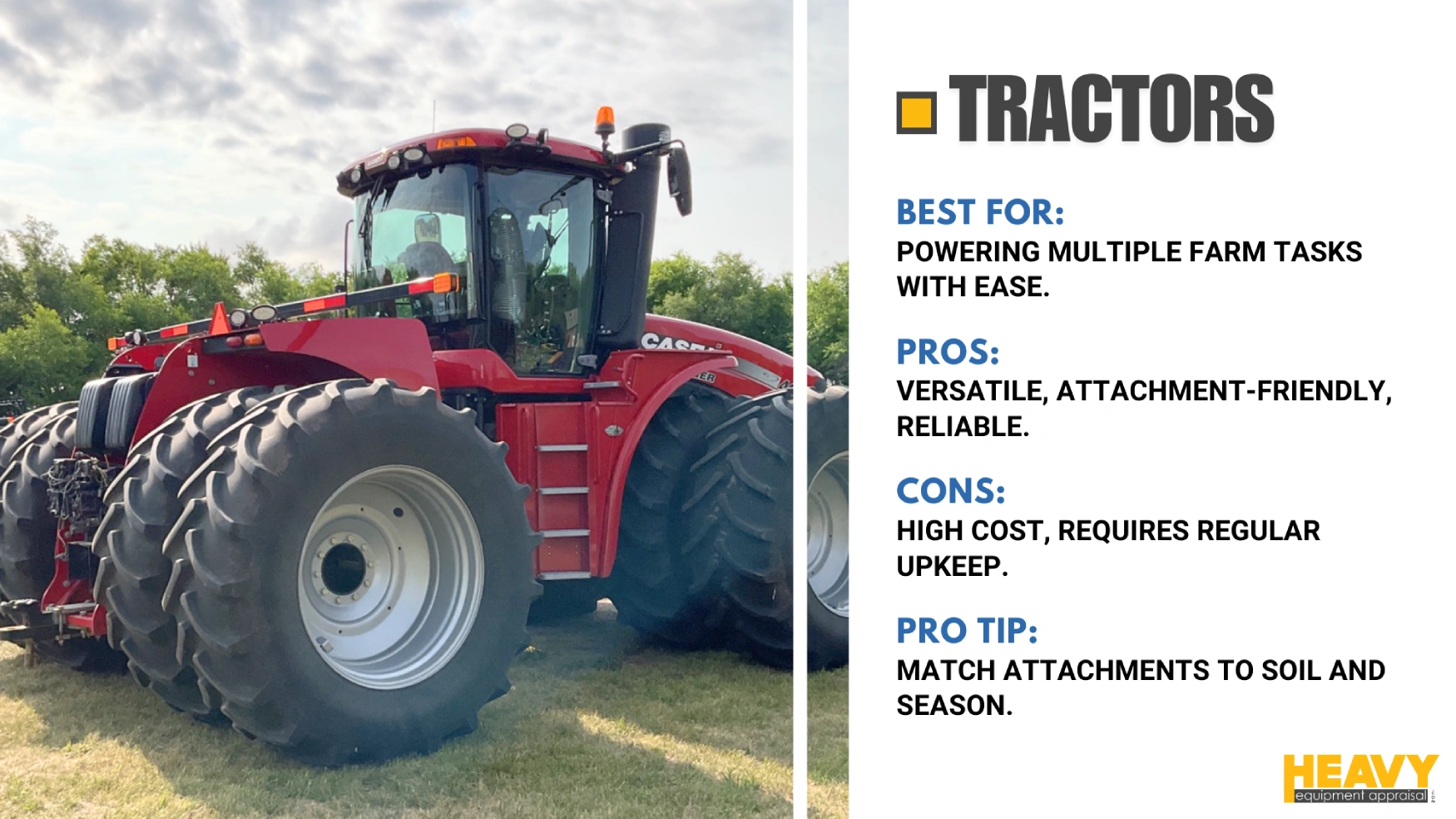
Tractors are the heartbeat of any farm, essential for powering a wide range of critical tasks. Without them, modern farming simply wouldn't function.
Tractors aren't just about moving dirt, they're about versatility. Different attachments unlock a multitude of farming tasks, making tractors indispensable. Here’s how they shape farming operations:
- Plows: Break and turn the soil.
- Cultivators: Aerate and prepare the seedbed.
- Seeders: Ensure precise planting.
- Balers: Compress and package hay or straw into manageable bales.
Combine/Harvester
Also known as: combine, harvester, grain harvester, combine harvester, thresher, reaper
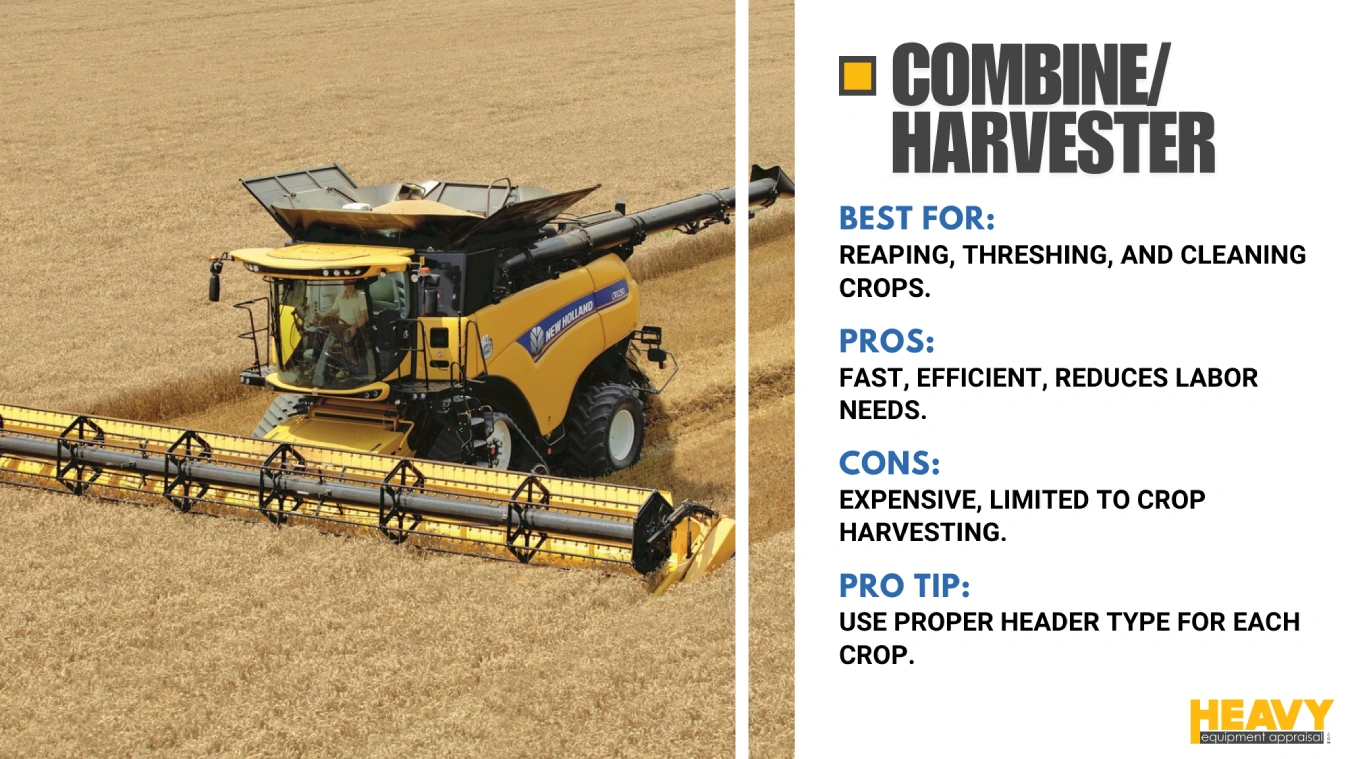
A harvester or a combine harvester is heavy industrial equipment used in modern farming. As its name suggests, it helps in the large-scale harvesting of crops with three main functions; reaping, threshing, and cleaning.
This allows crops to be harvested faster and more efficiently in large amounts. A harvester consists of a front header with cutting blades rotating in a motion similar to the wheels.
The harvester headers cut crops with a cutter bar from the bottom and move them into the threshing drum through a conveyor belt. Inside the threshing drum, grains are separated from the stem and straw as they are further directed to the screen for further processing.
A combined harvester is purely made for farming as it has specific features and functions beneficial to crop harvesting. Nevertheless, it is critical equipment for modern farmers.
Irrigation Systems
Also known as: pivot, sprinkler system, irrigation rig, center pivot, water wheel
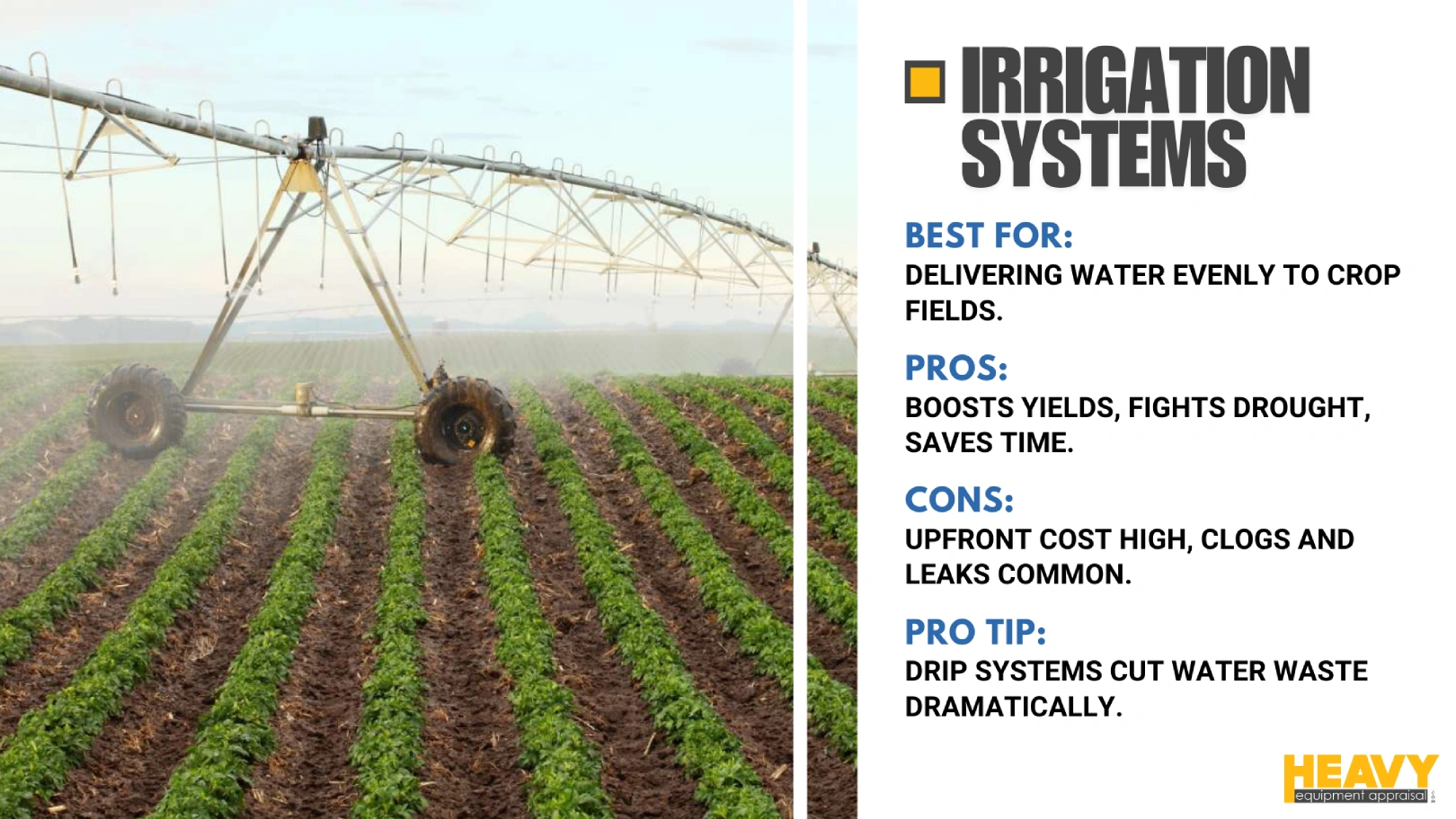
Irrigation systems distribute water across fields, ensuring crops receive consistent hydration, particularly in regions like California’s Central Valley, the Great Plains, and Arizona’s arid landscapes.
Different systems cater to specific needs:
- Drip Irrigation: Delivers water directly to the roots of crops like tomatoes, strawberries, and grapes, reducing waste.
- Pivot Systems: Efficiently irrigate large-scale crops such as corn, soybeans, and alfalfa, ideal for flat, expansive fields.
- Flood Irrigation: Commonly used for water-intensive crops like rice and sugarcane, where fields are temporarily submerged.
These systems are vital for maintaining productivity in areas with unreliable rainfall.
Multi-Purpose Equipment Types
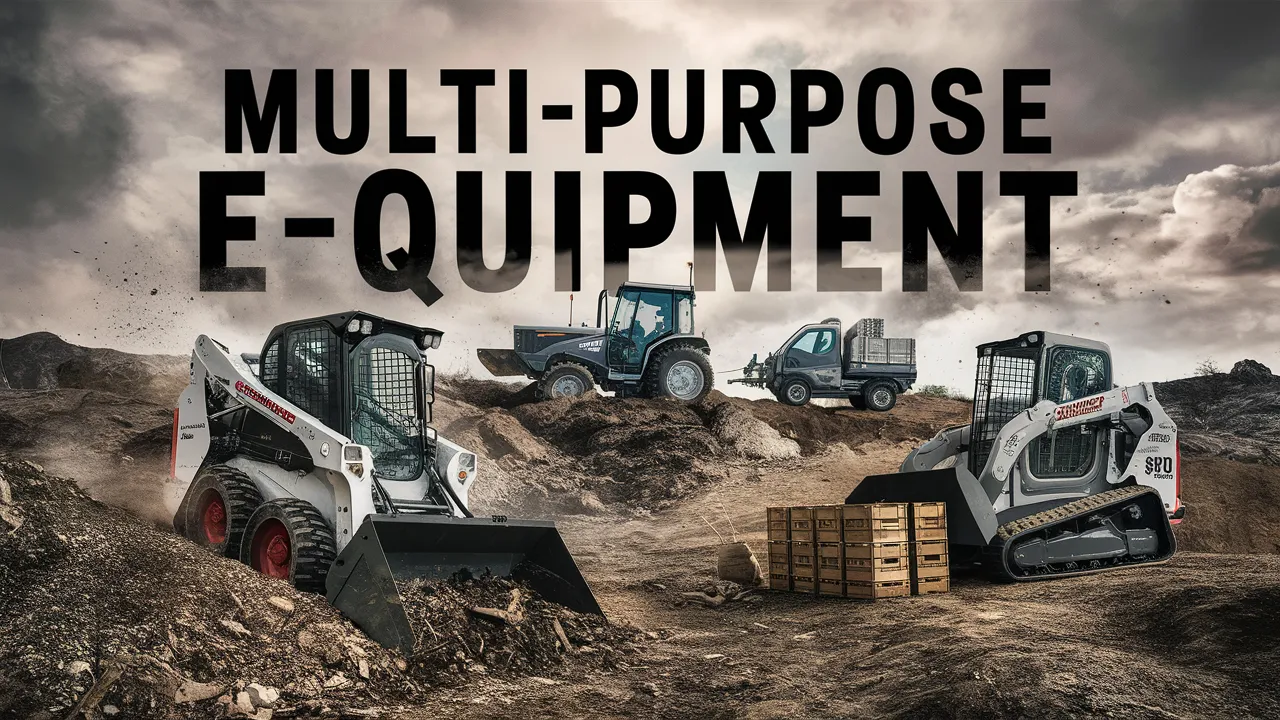
On complex job sites, multi-purpose equipment is your go-to for tasks that demand versatility and efficiency. These machines handle everything from grading to material transport, eliminating the need for multiple specialized units.
Below is a list of essential multi-purpose equipment that keeps projects moving smoothly:
Skid-Steer Loaders
Also known as: skid loader, skid steer, Bobcat, mini loader
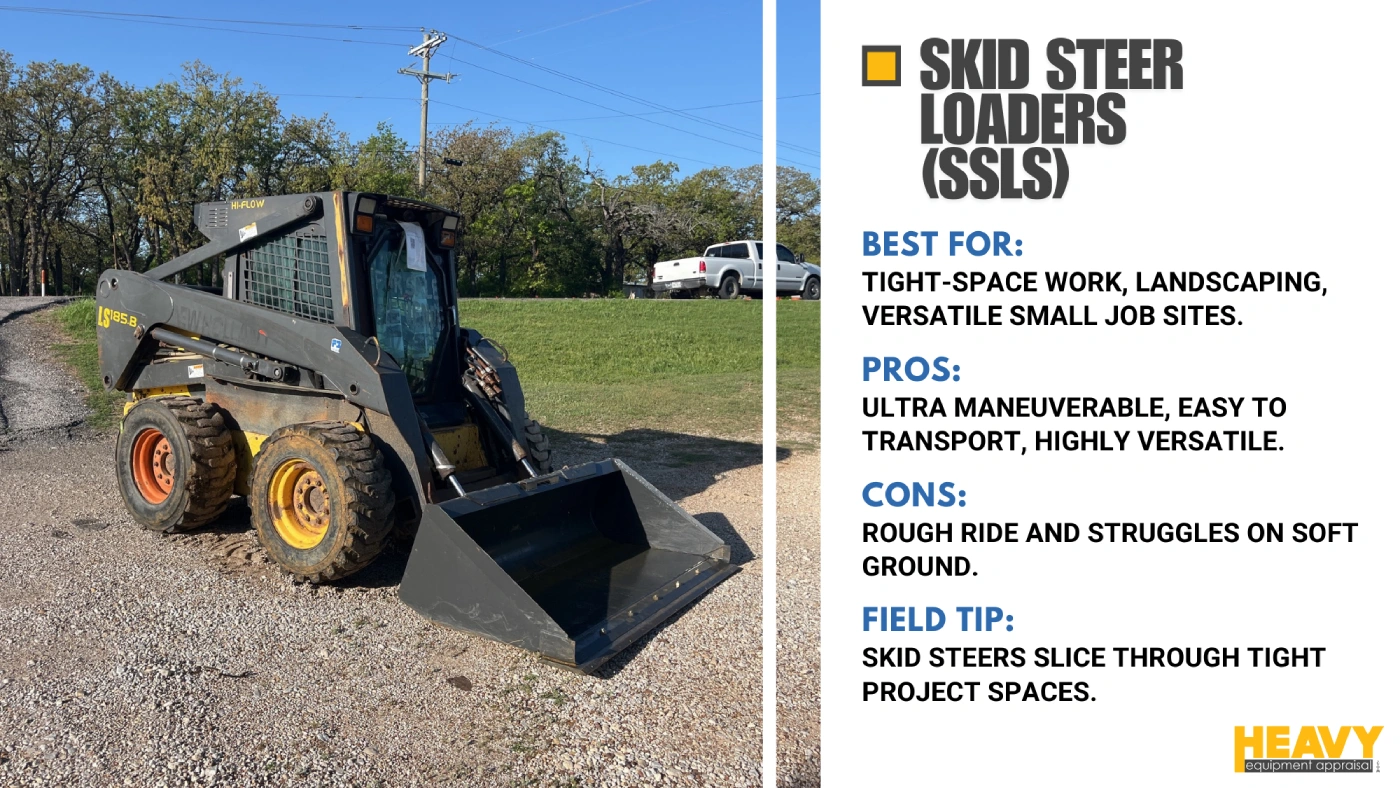
Not all heavy construction equipment needs to be huge- you can also find smaller machines like skid steers.
A skid steer is a type of equipment that does various small-scale to medium-scale construction projects.
It is a single-person machine accepting several attachments to get the job done. Attach a fork, and it becomes a telehandler or a forklift. Placing a bucker at the front converts it into a mini loader or excavator.
Utility Vehicles
Also known as: UTV, side-by-side, Gator, Mule, RTV, buggy
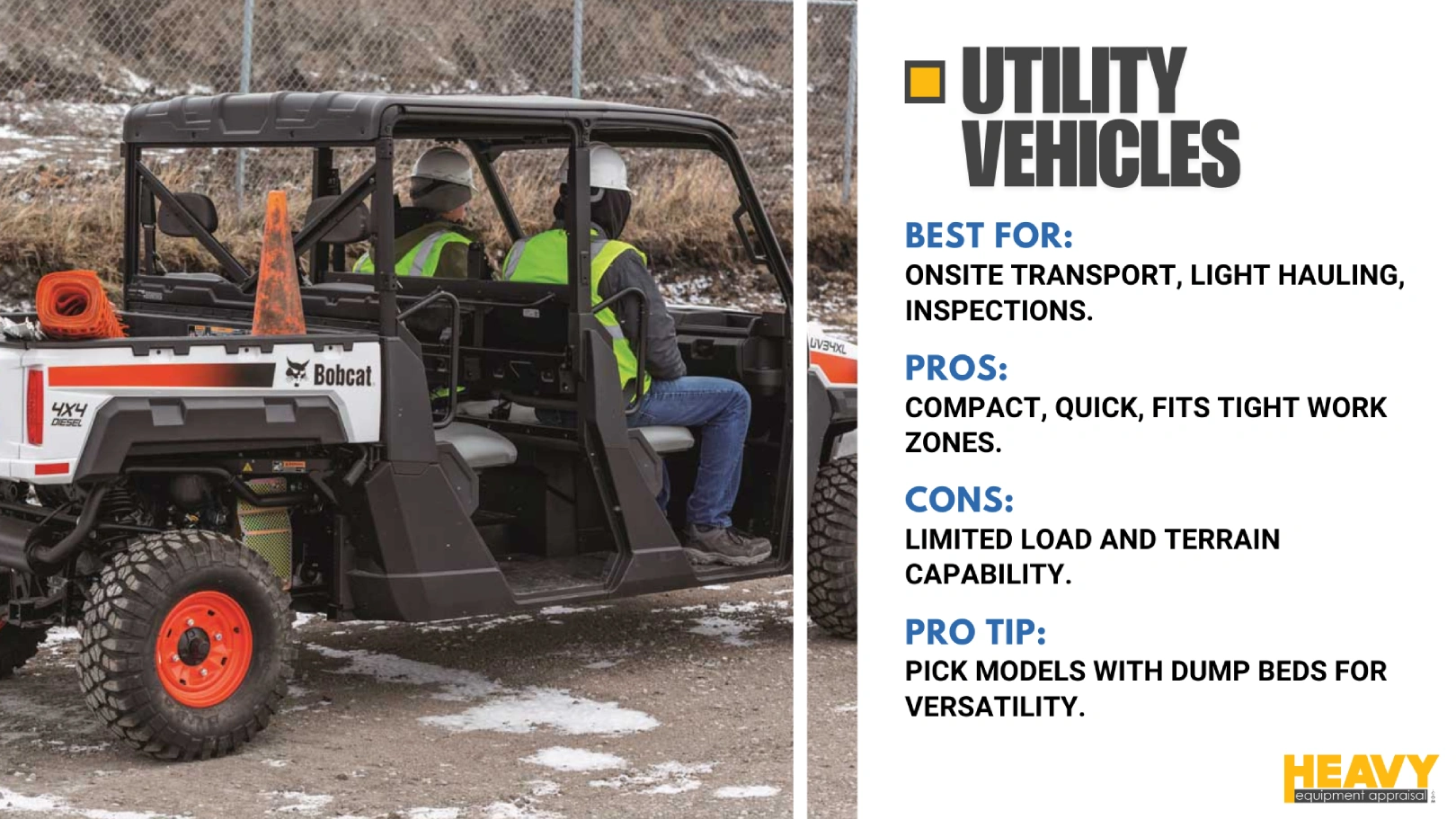
Moving from one location to the other in your construction site can be tiring, especially if you’re in an overseeing role. Utility vehicles are popular machines that come in different shapes and sizes.
Utility vehicles on worksites are crucial because they can do light work other than transporting people, such as hauling materials, safe transportation in hazardous areas, landscaping, etc.
They can be four or six-wheeled with various details and custom features.
Compact Track Loaders
Also known as: CTL, track loader, compact loader, mini track loader, rubber track loader
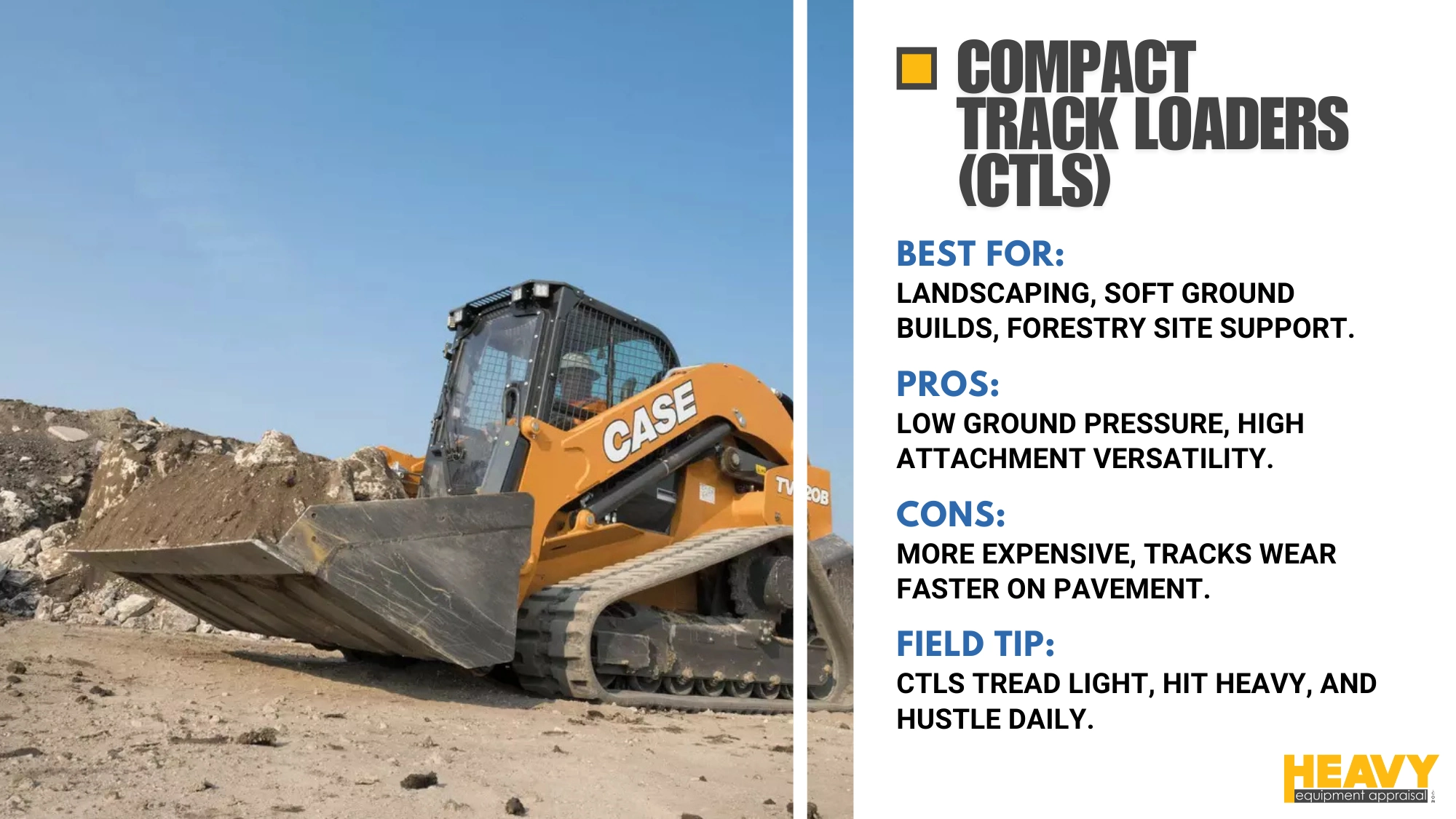
Compact track loaders (CTLs) are high-torque machines designed for maximum traction and stability in rough terrain, equipped with durable rubber tracks that provide a low ground pressure footprint.
Unlike skid-steer loaders, CTLs excel in environments with loose soil, mud, and uneven ground, thanks to their enhanced undercarriage system.
These machines feature radial or vertical lift paths, with hydraulic systems optimized for running various attachments like mulchers, augers, and grapples.
Uses of a Compact Track Loader
CTLs are indispensable for site preparation, land clearing, grading, and heavy lifting in challenging conditions where traditional wheeled equipment would struggle to maintain traction and stability.
Compact track loader value is one machine on the spec sheet and a different machine once the attachments are accounted for. In a 2017 inspection, we appraised a 2011 Cat 299C CTL with 3,056 hours at $40,000 - and separately appraised its mounted RT 3000 Turbo Saw rotating boom attachment at $4,000. Same physical asset on the yard. Two line items on the report. If the equipment list shows "Cat 299C" and stops there, the appraisal misses 10% of the value sitting on the coupler. CTLs are appraised this way because attachments drive utility and resale: a base CTL with a bucket has a wide buyer pool; the same CTL with a specialty cutting head has a narrower one, but for the right buyer the attachment is the reason they showed up.
Specialized Types of Heavy Equipment
Some jobs demand more than standard machinery - they require specialized equipment designed for niche tasks. These machines are essential for addressing unique challenges that general equipment can’t efficiently manage.
Here are some examples of specialized equipment built for these specific purposes:
Pile Driving Machine
Also known as: pile driver, piling rig, hammer
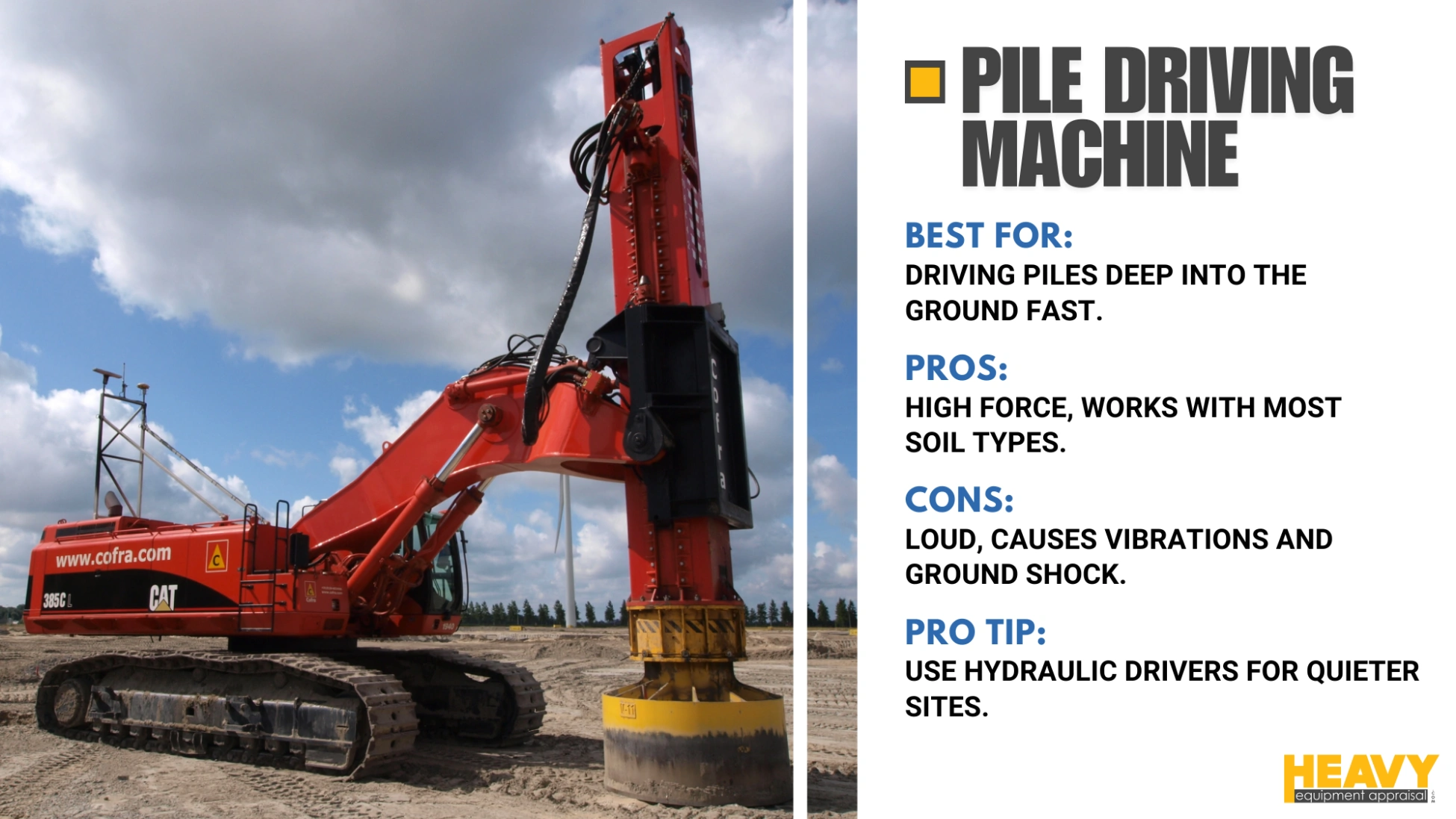
When the construction requires a solid foundation or layers of soil in the ground, a pile-driving machine is the only machine up for this task.
It is a heavy piece of equipment that uses its weight between glides to drive piles vertically into the ground.
Pile drivers come in different types and sizes, including hydraulic hammers, hydraulic press-ins, vertical travel lead systems, and piling rigs. They are also typically categorized into three sizes:
- Small size- has an engine power of 108kW, 60-100kN torque, drilling depth 40m, drilling diameter 0.5-1.2m, overall quality 40 t.
- Medium size- has an engine power of 125-200kW, 120-180kN torque, drilling diameter 0.8-1.8m, drilling depth 60m, overall quality 45-65 t.
- Large size- has an engine power of 300kW, 240kN m torque, drilling diameter 1-1.25 m, drilling depth 80m, overall quality 100 t.
Pile Boring Machine
Also known as: auger, drill rig, boring machine, piling machine
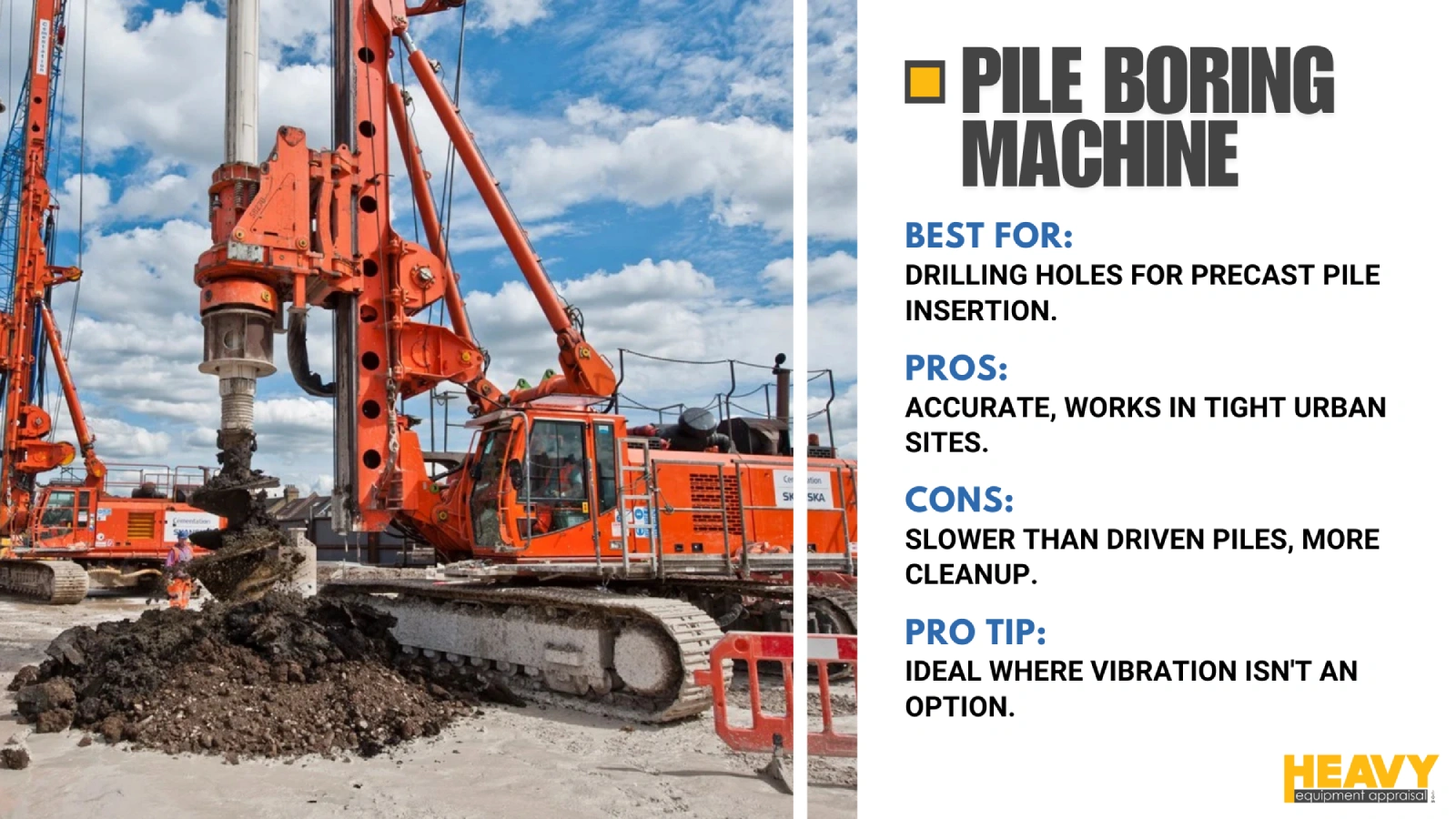
The pile boring machine is quite similar to a pile driver, only that its main purpose is to make bore holes in a construction site to insert precast piles.
FAQ
What are the main categories of heavy machinery?
The main categories of heavy machinery are earthmoving equipment, material handling equipment, construction and road equipment, lifting equipment, mining and quarry equipment, forestry equipment, agricultural equipment, and demolition equipment. Each category groups machines by primary job type, such as moving soil, lifting loads, or building and maintaining roads.
How is heavy machinery classified by industry (construction, mining, agriculture)?
Heavy machinery is classified by industry based on primary use. Construction machinery includes excavators, bulldozers, cranes, and loaders. Mining machinery includes haul trucks, draglines, shovels, and drilling rigs. Agricultural machinery includes tractors, harvesters, sprayers, and tillage equipment, each designed for industry-specific tasks and operating conditions.
What factors influence the choice of heavy equipment for a specific project?
The choice of heavy equipment depends on project type, site conditions, material volume, load capacity, and required reach or depth. Budget, fuel efficiency, equipment availability, operator skill level, safety regulations, and project timeline also directly influence equipment selection for efficient and compliant operations.
When should I use tracked heavy equipment instead of wheeled equipment?
Use tracked heavy equipment when the site has soft ground, mud, sand, snow, steep grades, or uneven terrain. Tracks lower ground pressure, increase traction, and improve stability for heavy pushing and high breakout force. Use wheeled equipment when you need higher travel speed, frequent road moves, tight paved work, and lower operating cost.
Which heavy equipment types are most cost-effective for small construction sites?
The most cost-effective heavy equipment for small construction sites includes compact excavators (3–8 tons), skid steer or compact track loaders, mini wheel loaders, and backhoe loaders. These machines handle digging, grading, loading, and trenching in tight spaces while minimizing transport costs, fuel use, and operator time compared to full-size equipment.
Is it better to lease or buy heavy equipment for short-term projects?
Lease heavy equipment for short-term projects because leasing avoids large upfront cash, reduces repair risk, and matches costs to the project schedule. Buy heavy equipment when you will use it at least 60–70% of working days for 24–36 months, you can keep it utilized between jobs, and you can manage maintenance, storage, insurance, and resale.