
Sales Comparison Approach for Equipment Appraisal

The sales comparison approach (SCA) estimates equipment value by analyzing recent sales of comparable machines and adjusting those prices to account for differences between the comps and the subject. It is the default valuation method for heavy equipment categories with active resale markets: excavators, motor graders, crawler dozers, wheel loaders, and similar iron that trades regularly at auction and through dealer networks.
Lenders, attorneys, and fleet owners rely on SCA-based appraisals because the method is grounded in what buyers and sellers actually pay, not what it costs to replace the machine or what income it might generate.
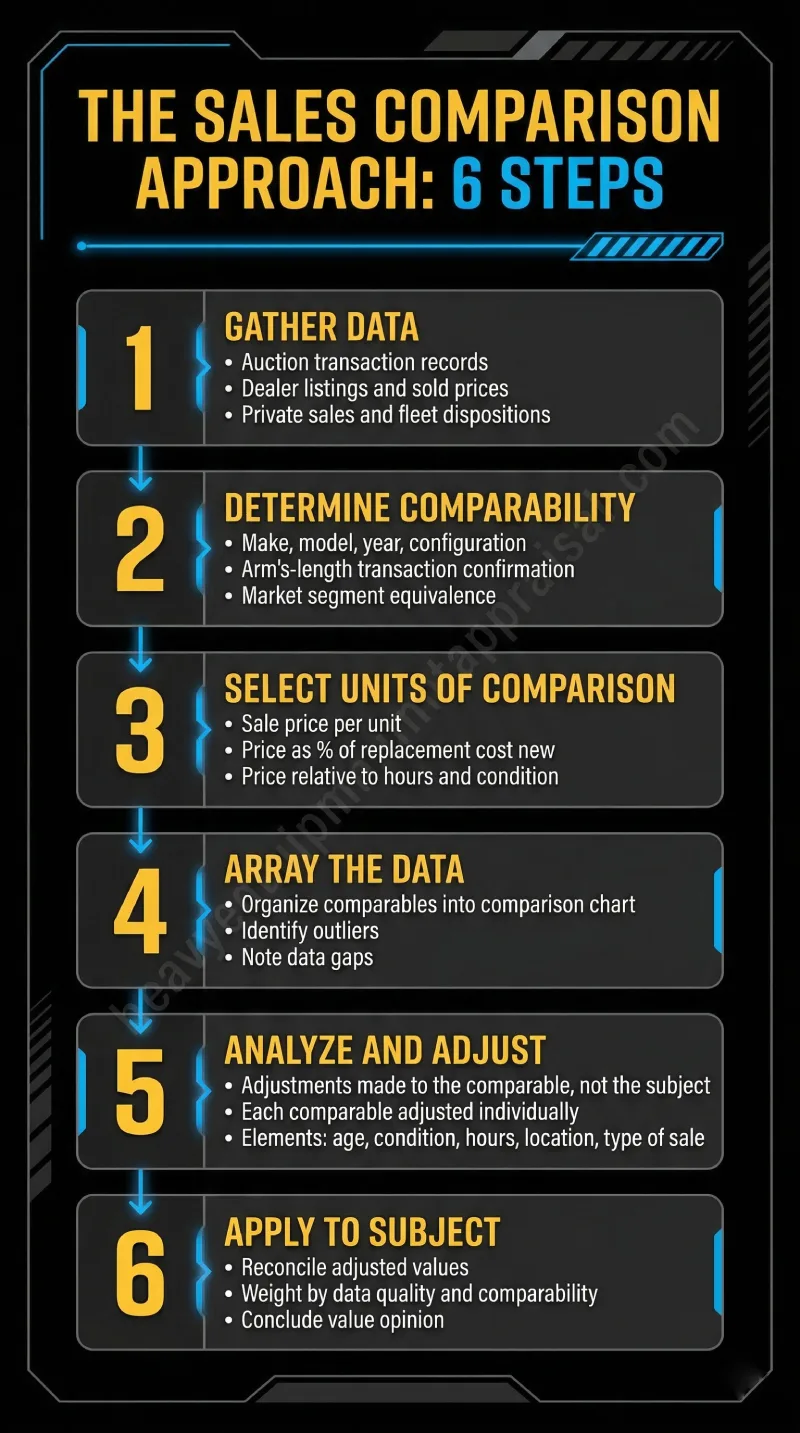
What Is the Sales Comparison Approach?
The sales comparison approach derives an opinion of value by analyzing recent sales of similar properties and adjusting those sale prices to reflect differences between each comparable and the subject equipment.
The underlying logic is the principle of substitution: an informed buyer will not pay more for a piece of equipment than what it would cost to acquire another machine with equivalent utility. That principle anchors all 3 valuation approaches, but the SCA applies it most directly by measuring what the market actually paid.
Heavy equipment appraisals are governed by USPAP Standards 7 and 8, which establish the development and reporting requirements for personal property appraisals. Those standards require the appraiser to consider all 3 approaches to value (the SCA, the cost approach to equipment appraisal, and the income approach) and to explain why any approach not relied upon was omitted.
One reason the SCA is preferred for common heavy equipment categories is its treatment of depreciation. The approach captures all 3 forms simultaneously: physical deterioration from wear and hours, functional obsolescence from outdated technology or configuration, and economic obsolescence from market conditions external to the machine. In the cost approach, each form must be identified and deducted separately. In the SCA, they are already embedded in what buyers paid for comparable equipment in the real market.
How Appraisers Find Comparable Sales
The SCA depends entirely on the quality of its underlying data, so the first task is identifying where comparable sales actually exist. For heavy equipment, appraisers draw from 4 primary source types:
- Auction transaction databases
- Records of completed auction sales, including equipment description, condition, sale price, date, and location. Ritchie Bros. and IronPlanet (both operating under RB Global, which processed $15.9 billion in gross transaction value across its platforms in 2024) are the largest sources of this data for construction and heavy equipment categories. IronPlanet’s weekly Thursday auctions include IronClad Assurance inspection reports, which add condition documentation to the transaction record and make those sales more defensible as comparables.
- Dealer listings and transaction records
- Asking prices from used equipment dealers indicate current retail market levels. Dealers can also provide actual sale prices when contacted directly, which are more useful than asking prices because they reflect what the market accepted. The gap between asking and sold price is itself informative about current demand conditions.
- Private sales and fleet dispositions
- End-user to end-user transactions, often undocumented publicly. These require direct contact with buyers, sellers, or brokers who participated in the transaction. Well-documented private sales at arm’s length are often the strongest comparable evidence because they reflect pure market conditions with no liquidation pressure.
- Pricing guides and online marketplaces
- Published guides and listing platforms such as Machinery Trader and Equipment Trader provide market exposure data. These are useful for establishing a range of asking prices but require adjustment downward to reflect actual transaction prices.
The hierarchy matters. Completed sales are always preferred over listings. A listing is an offer. A transaction is evidence. When sold data is available and verifiable, it takes precedence. When only listing data exists, the appraiser must adjust for the spread between asking and selling prices, which varies by equipment category and market conditions.
The appraiser targets a minimum of 3 comparables per subject asset. When fewer exist, the weight given to each increases and the overall reliability of the SCA decreases. If an active market cannot produce 3 defensible comparables, the approach may need to be supplemented or replaced by the cost approach.
How Comps Are Made Equal
Finding a comparable sale is the start, not the finish. Because no two pieces of equipment are identical in every relevant characteristic, the appraiser adjusts each comparable’s sale price to reflect what it would have sold for had it matched the subject exactly.
Adjustments are always made to the comparable, not to the subject. If multiple comparables are found, each must be adjusted individually before any aggregate analysis. Averaging unadjusted comparables and then adjusting the average produces distorted results.
The elements of comparison for heavy equipment are as follows:
| Element | What Is Being Adjusted |
|---|---|
| Chronological and effective age | Calendar age plus condition-adjusted age; rebuilds and major overhauls reduce effective age |
| Condition | Physical state at time of sale is the most impactful variable for used equipment |
| Hours of use | Direct proxy for wear: a 2,500-hour machine and a 7,000-hour machine of the same model are not the same comparable |
| Capacity and configuration | Bucket size, lift capacity, blade width, attachments, capacity differences require price adjustment |
| Features and accessories | Technology packages, cab configuration, auxiliary hydraulics, quick-attach systems |
| Location | Regional demand affects value; a Komatsu WA500 commands different prices in Alberta oil country than in the southeastern U.S. |
| Date of sale | Market conditions change: older sales require a time adjustment to reflect conditions as of the appraisal date |
| Type of sale / level of trade | Dealer-to-end-user, end-user-to-dealer, and auction sales all reflect different price levels for the same machine |
| Quantity | Bulk or fleet sales depress per-unit prices relative to single-unit transactions |
| Cash equivalency | Sales involving favorable financing or trade-ins must be restated on a cash basis |
| Environmental and safety compliance | Non-compliant equipment may require deduction for remediation cost |
After adjustments, the appraiser examines the spread across all comparables. A tight range indicates a reliable conclusion. A wide spread after adjustments is a diagnostic signal: some factor affecting value was not adequately accounted for. The appraiser must identify what was missed before reconciling to a final value opinion.
Auction Data and Value Type
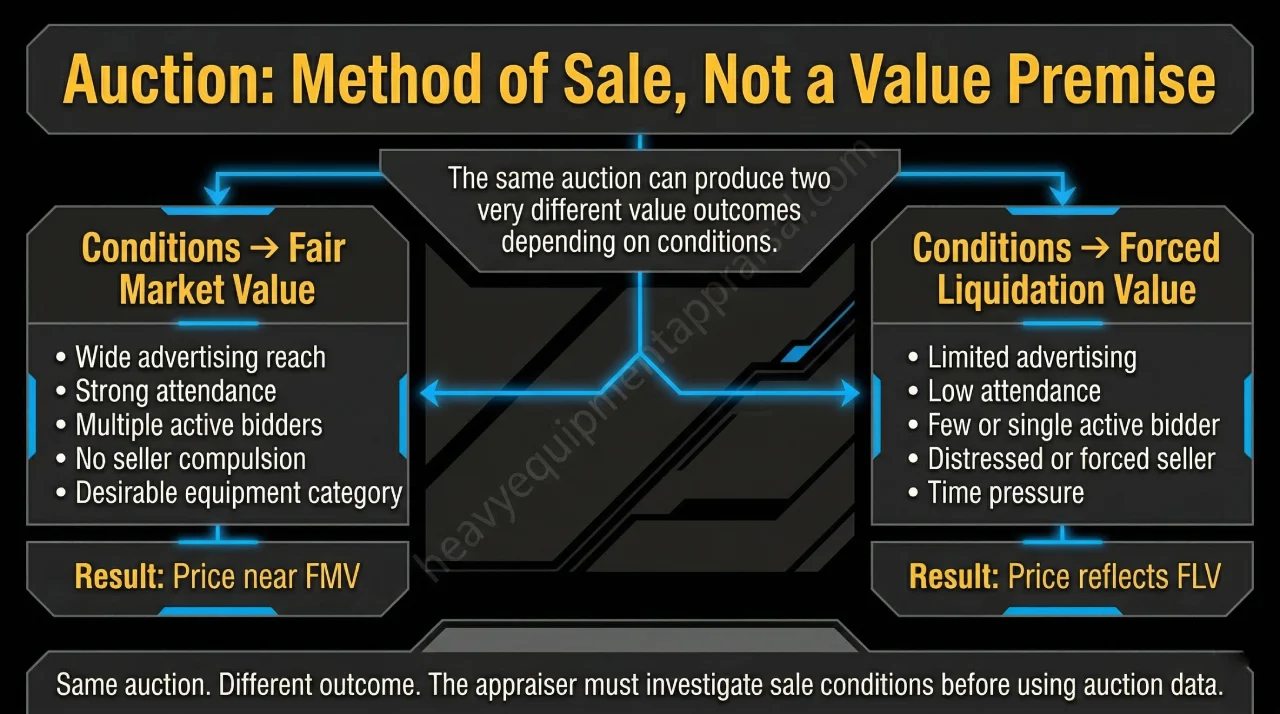
Auction results are the most abundant source of comparable sales data for heavy equipment, and also the most frequently misapplied. The critical distinction: an auction is a method of sale, not a value premise.
Treating every auction result as a forced liquidation value (FLV) conclusion is a methodological error that systematically understates fair market value (FMV) in appraisals prepared for lending, insurance, and litigation purposes.
Whether an auction sale reflects FMV or FLV depends on the circumstances of that specific sale. A well-advertised unreserved auction with strong attendance and competitive bidding on desirable equipment can produce prices at or near FMV. A poorly attended sale with a single active bidder produces something closer to distress pricing. The appraiser cannot determine which applies without investigating the conditions surrounding the sale: advertising reach, attendance, number of active bidders, weather, and whether the seller was under compulsion.
When auction data is used in an FMV appraisal, the appraiser must document the adjustment from liquidation conditions to market conditions explicitly. An appraisal report that references auction comparables without this adjustment lacks the support USPAP requires and will not survive scrutiny in lender review or litigation. The level of trade adjustment (from auction purchase price to retail end-user price) reflects the dealer’s margin and reinstallation costs, and it is not trivial. The same machine that clears $80,000 at auction may sell for $105,000 from a dealer lot to an end user ready to put it to work.
For appraisals targeting orderly liquidation value (OLV) or FLV directly, well-documented auction data with known conditions is often the strongest available evidence and requires little or no level-of-trade adjustment.
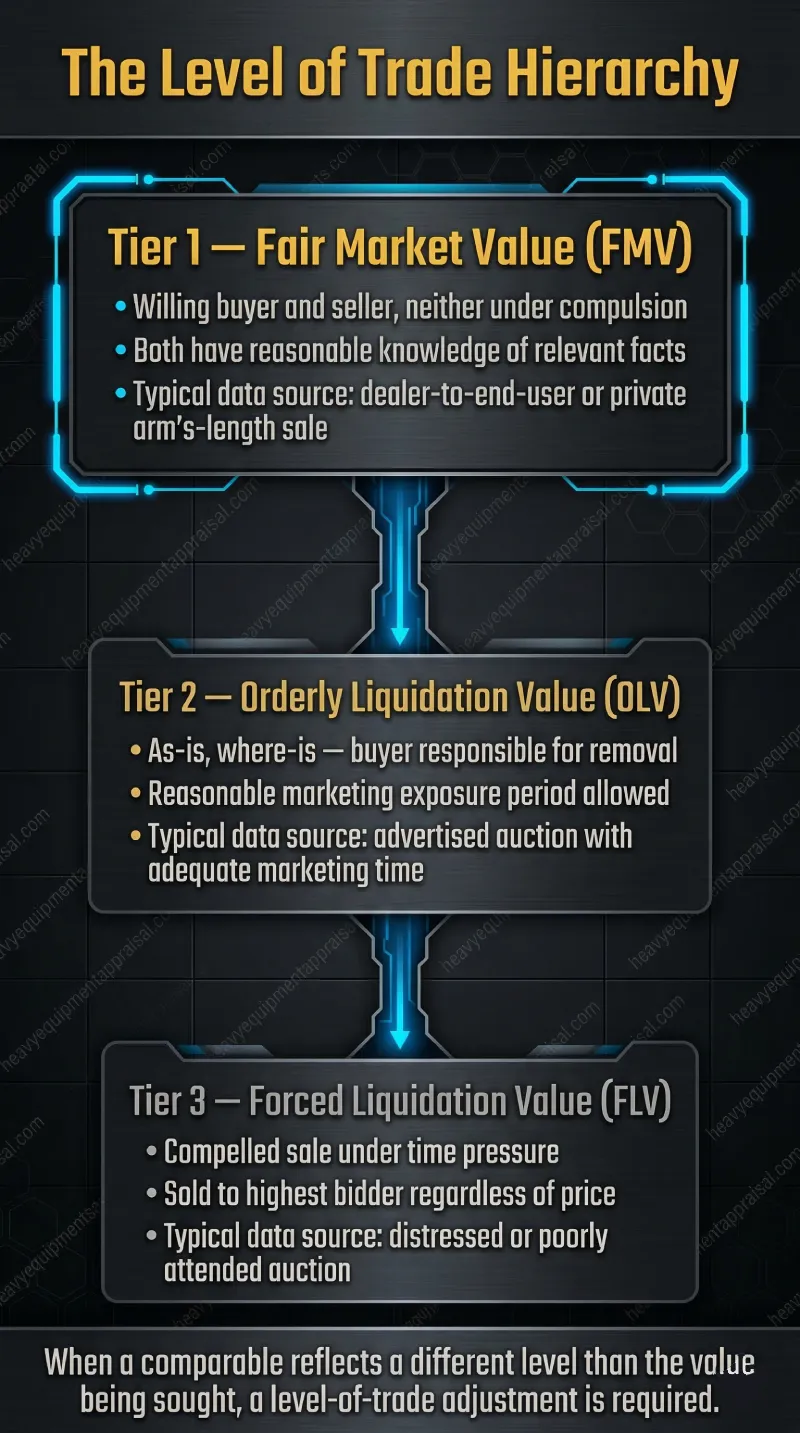
The comparison of FMV, OLV, and FLV is where value type selection and data source selection intersect: the right comparable depends entirely on what value is being sought.
Direct Match vs. Comparable Match
Once comparables are located, the appraiser applies one of 3 techniques to establish value, each with a different level of precision and subjectivity.
Direct match finds sales of equipment identical to the subject in make, model, year, and configuration. Adjustments are limited to condition and hours. This technique produces the most defensible value conclusion because the comparable and subject differ only in measurable ways. Pricing guides that compile large volumes of identical equipment transactions (organized by manufacturer, model, and age) support direct match analysis for high-volume categories like excavators, wheel loaders, and motor graders.
Comparable match applies when no identical equipment has sold. The appraiser identifies sales of machines with equivalent utility (different manufacturer, similar capacity and configuration) and adjusts for the additional differences. A Caterpillar 320 and a Komatsu PC290 occupy the same market segment and a credentialed appraiser can support an adjustment between them. The technique is more subjective than a direct match and the adjustment rationale must be documented explicitly.
Percentage of cost establishes a ratio between the sale price of comparable equipment and its replacement cost new (RCN) at the time of sale. If market data shows that similar machines in comparable condition are selling at 40 to 50 percent of RCN, the subject's value is concluded within that range as applied to its own RCN. This technique is most useful when comparable sales exist but differ enough in size or capacity that direct price comparison requires additional bridging logic.
Subjectivity increases at each step:
- A direct match leaves little room for dispute.
- A comparable match requires the appraiser to defend manufacturer and configuration equivalence.
- Percentage of cost requires a defensible RCN estimate before the ratio can be applied.
When the technique used is less precise, the quality of documentation in the appraisal report becomes correspondingly more important.
When the Sales Comparison Approach Works and When It Doesn't
The SCA is the most reliable valuation method for heavy equipment when an active market exists with a sufficient number of verifiable comparable sales. For standard construction equipment categories (excavators, bulldozers, wheel loaders, motor graders, compactors), that condition is almost always met. The auction market alone generates tens of thousands of transactions annually across these categories, providing the data depth the approach requires.
The approach becomes less reliable under these 3 conditions.
The first is specialty or custom equipment with limited resale market activity. A purpose-built tunneling machine, a process-specific material handler, or heavily modified equipment may have no meaningful comparable sales anywhere in the national market. When the used market is effectively nonexistent, the SCA cannot produce a credible value conclusion and the cost approach becomes the primary method.
The second is geographic thinness. For common equipment categories, the relevant market is national or international, so regional data scarcity rarely disqualifies the approach entirely. For equipment that is expensive to transport relative to its value, however, local market conditions carry more weight and thin regional transaction volume can limit the approach's reliability.
The third is a market disrupted by external conditions. Supply chain shocks, commodity price collapses, and credit contractions can create a used equipment market where transaction volume drops sharply and recent sales reflect distress rather than normal market conditions. In those periods, an inactive or thin market is itself evidence of economic obsolescence, and the cost or income approaches may provide a more supportable value indication than a handful of distress sales.
When the SCA is not feasible as the primary approach, a credentialed appraiser will state why and shift reliance to the cost approach or a weighted combination of both.
An equipment appraisal overview covers how the 3 approaches interact and when each takes precedence.
What a Credible SCA Conclusion Looks Like
A defensible sales comparison approach conclusion rests on 4 things:
- Documented comparables
- Explicit adjustments
- Reconciled value opinion
- Clear statement of the value premise being sought.
Documented comparables means the appraisal report identifies each sale with sufficient detail for the intended user to evaluate its relevance. Source, date, location, condition, hours, and transaction type are the minimum. A comparable pulled from an auction database with no condition information or sale circumstances noted is not a documented comparable. It is a number with unknown provenance, and it will not hold up in lender review or court.
Explicit adjustments means every material difference between the comparable and the subject is identified and a direction and magnitude assigned to it. The adjustment does not need to be precise to the dollar, but it must reflect market evidence, not assumption. An appraiser who assigns a $15,000 condition adjustment without explaining what that adjustment is based on has not completed the analysis.
Reconciliation means the appraiser resolves the adjusted comparable values into a single opinion, with reasoning. When comparables cluster tightly after adjustment, the reconciliation is straightforward. When a wide spread remains, the appraiser must explain it, weight the comparables by reliability, and document why certain sales received more influence than others.
Value premise means the report states explicitly what type of value the SCA conclusion represents: fair market value, orderly liquidation value, or forced liquidation value. That statement determines which comparables are appropriate, what level of trade they must reflect, and how auction data is adjusted (or not). A report that concludes "fair market value" but relies on unadjusted auction data has a premise mismatch that invalidates the conclusion regardless of how many comparables were assembled.
What is the sales comparison approach in heavy equipment appraisal?
The sales comparison approach in heavy equipment appraisal estimates value by comparing the subject machine to similar equipment that recently sold. Appraisers adjust for age, condition, hours, attachments, brand, location, and market demand. This approach works best when reliable sales data exists for comparable machines.
What data sources do appraisers use to find comparable heavy equipment sales?
Appraisers use auction data, dealer records, equipment marketplaces, liquidation sales, and valuation databases to find comparable heavy equipment sales and verify price, condition, hours, and configuration.
Does auction data always represent forced liquidation value?
Auction data does not always represent forced liquidation value. Heavy equipment auctions can reflect orderly liquidation value, forced liquidation value, or fair market value depending on sale timing, marketing exposure, buyer participation, and equipment condition. Appraisers analyze the auction context before using the sale as a comparable indicator of value.
What adjustments are made when comparable equipment isn't identical to the subject?
Appraisers adjust non-identical comparable equipment for differences in age, hours, condition, specifications, attachments, wear, location, sale terms, and market timing to align the comparable sale with the subject machine.
When does the sales comparison approach not apply to heavy equipment?
The sales comparison approach does not apply well when comparable heavy equipment sales are scarce, outdated, unverifiable, or too dissimilar from the subject machine. It also becomes weak in distressed, highly specialized, or inactive markets. In those cases, appraisers rely more on the cost approach, income approach, or broader market analysis.
What is the difference between a direct match and a comparable match?
The main difference between a direct match and a comparable match is that a direct match closely mirrors the subject equipment in make, model, age, configuration, and condition, while a comparable match requires adjustments for differences that affect value. Appraisers give more weight to direct matches because they need fewer value adjustments.