
Excavator Price & Value Calculator
Not sure where to start? Choose one setup below 👇 to pre-load the excavator value calculator, then adjust the filters until it matches your machine.
How Much Does an Excavator Cost?
An excavator typically costs US$20,000–US$250,000 used and US$60,000–US$500,000+ new, depending on size and condition. A 1–6 ton mini excavator costs US$10,000–US$90,000, a 20-ton class excavator costs US$150,000–US$300,000 new, and 30+ ton machines cost US$300,000–US$700,000+.
Based on 3,382 closed excavator auction sales closing Jan–Dec 2025, the typical used excavator sold-price band (P10–P90) is $16,500–$100,000 (median $43,000).
This table shows the typical used excavator sold-price band using P10, median (P50), and P90 to bracket excavator value. Prices reflect closed auction results, not dealer asking prices.
| Metric | Sold price | Meaning for excavator value |
|---|---|---|
| P10 | $16,500 | Lower-end sold excavator value in this scope (often higher hours / condition drag) |
| Median (P50) | $43,000 | Midpoint sold excavator value in this scope |
| P90 | $100,000 | Upper-end sold excavator value in this scope (often lower hours / cleaner configuration) |
Use the band as your baseline, then anchor the machine into the right size class before refining by hours.
Excavator Prices by Size Class
Excavator cost increases by size class. Mini excavators (0.8–6 t): $25k–$90k used, $60k–$160k new. Midi (7–12 t): $60k–$160k used, $120k–$260k new. Standard (13–25 t): $90k–$240k used, $180k–$450k new. Large (26–45 t): $180k–$500k used, $350k–$900k new. Mining (45 t+): $500k–$5M+.
Size class sets the baseline for excavator value because it groups the biggest functional drivers buyers pay for into comparable buckets. Pick size class first, then refine within that band using hours.
| Size class | Sold results (n) | P10 | Median (P50) | P90 |
|---|---|---|---|---|
| MIDI | 18 | $7,450 | $18,250 | $41,700 |
| Standard | 4,854 | $18,500 | $45,000 | $113,000 |
| Large | 715 | $20,000 | $60,000 | $186,500 |
Choose the matching size class, treat P10–P90 as the typical sold-value band for that class, then use hours/condition to place the machine within it.
Excavator size class selection (quick rules):
- MIDI: Lowest band; buyers prioritize transportability and lighter-duty work.
- Standard: Most “typical excavator value” questions land here.
- Large: Higher and wider band; configuration and job demand vary more.
Excavator Value by Hours
Excavator operating hours reduce resale price because hours predict wear on pumps, pins, bushings, engine, and undercarriage. Value drops fastest in the first 2,000–4,000 hours, then declines more steadily. Expect a clean machine at 6,000–8,000 hours to sell about 20–40% less than a comparable unit under 2,000 hours, unless maintenance records and major rebuilds offset wear.
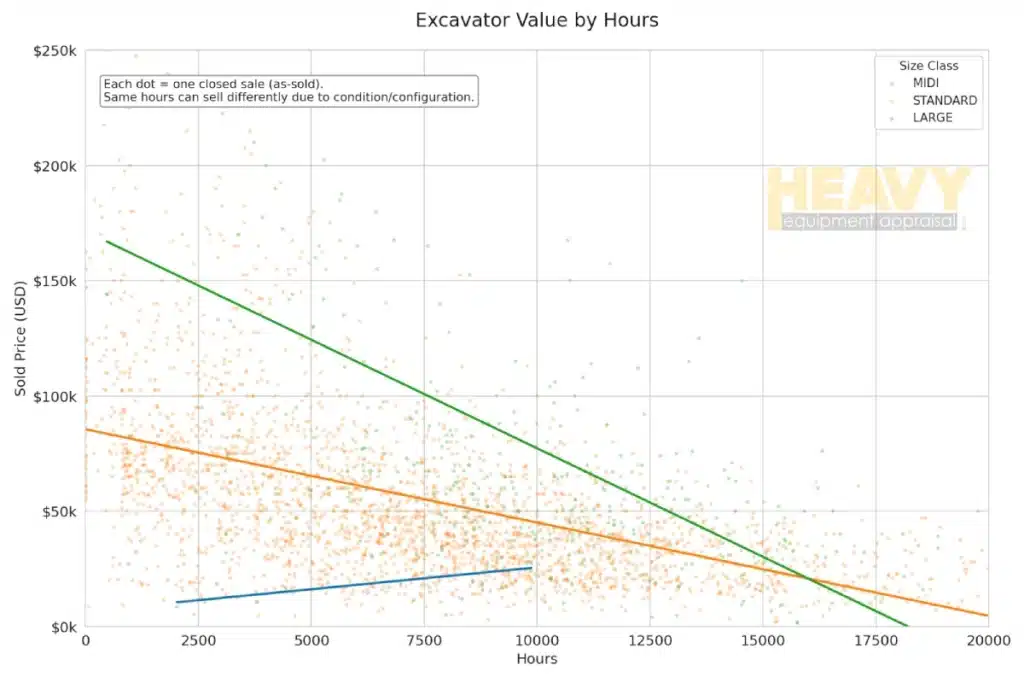
Hours are one of the strongest drivers of used excavator value because they proxy wear, remaining service life, and near-term repair risk. After size class, hours is usually the first adjustment that moves a machine toward P10, median, or P90.
| Hours band | Sold results (n) | P10 | Median (P50) | P90 |
|---|---|---|---|---|
| <1k | 210 | $48,900 | $88,750 | $173,000 |
| 1k–2.5k | 291 | $31,000 | $71,000 | $137,000 |
| 2.5k–5k | 550 | $28,000 | $65,000 | $142,000 |
| 5k–10k | 1,156 | $20,000 | $43,000 | $82,750 |
| 10k+ | 947 | $14,000 | $31,000 | $60,000 |
After size class, use hours to anchor closer to P90 (lower-hour / cleaner) or P10 (higher-hour / more wear risk), then tighten the estimate with model year.
Excavator Prices by Model Year
Average excavator cost drops with model year because depreciation reduces value. For a standard 20–25 ton excavator (new typically $200k–$350k), expect: 0–2 years old $170k–$350k, 3–5 years $110k–$260k, 6–10 years $70k–$190k, 11–15 years $45k–$120k, 16–20 years $25k–$70k, and 20+ years $15k–$50k.
Model year shifts excavator value because it often tracks spec packages, emissions tier, and buyer preferences, but it works best as a refinement step after size class and hours.
Newer year bands generally lift the median, while older bands widen due to condition and configuration variance.
| Model year band | Sold results (n) | P10 | Median (P50) | P90 |
|---|---|---|---|---|
| 2004–2006 | 312 | $10,000 | $21,250 | $40,000 |
| 2007–2009 | 211 | $14,500 | $26,000 | $41,000 |
| 2010–2012 | 337 | $17,000 | $33,000 | $49,400 |
| 2013–2015 | 559 | $21,000 | $39,000 | $66,000 |
| 2016–2018 | 627 | $29,000 | $52,000 | $85,400 |
| 2019–2021 | 646 | $42,000 | $71,000 | $125,000 |
| 2022–2024 | 329 | $57,000 | $98,000 | $190,500 |
| 2025 | 33 | $56,000 | $67,000 | $111,600 |
After size class and hours, use model year to refine within the same placement—especially when year implies a different emissions tier or common spec package; high hours can pull a newer machine down, and strong condition can push an older machine up.
Next, use make and model to explain any premium/discount versus peers before validating with sold comps.
Excavator Prices by Make & Top Models
Make/model is a residual signal after size class, hours, and year because excavator demand varies by brand platform and support economics (parts/service depth, common spec packages).
Use make + high-volume model medians as distribution signals to justify a premium/discount versus peers, then confirm with sold comps matched on hours and configuration.
| Make | Sold results (n) | Median sold price | Hours coverage |
|---|---|---|---|
| Cat | 1,382 | $53,000 | 95.30% |
| Komatsu | 501 | $37,000 | 90.62% |
| John Deere | 382 | $38,000 | 96.07% |
| Volvo | 203 | $40,000 | 91.63% |
| Hitachi | 180 | $38,500 | 97.78% |
| Hyundai | 166 | $39,500 | 87.95% |
| Kobelco | 130 | $24,250 | 91.54% |
| Case | 77 | $28,000 | 94.81% |
| Doosan | 75 | $47,000 | 86.67% |
| Link-Belt | 69 | $31,000 | 92.75% |
| XCMG | 39 | $59,000 | 97.44% |
| Sany | 34 | $66,750 | 97.06% |
Treat the make median as a brand signal, not a standalone estimate. Your likely number still depends on size class, hours, year, and configuration.
| Model | Sold results (n) | Median sold price |
|---|---|---|
| Cat 336 | 66 | $106,250 |
| Cat 323D3 | 62 | $70,000 |
| Cat 336E L | 57 | $41,000 |
| Cat 336F L | 53 | $62,500 |
| Cat 349F L | 50 | $60,000 |
| Komatsu PC490LC-11 | 46 | $47,000 |
| John Deere 350G LC | 45 | $40,000 |
| Cat 320D2 | 44 | $39,000 |
| Cat 320 | 40 | $91,250 |
| Cat 320D | 34 | $34,500 |
| Cat 320GC | 34 | $75,500 |
| Komatsu PC360LC-11 | 34 | $55,000 |
| Cat 336FL | 24 | $57,750 |
| Cat 320C L | 23 | $36,000 |
| Cat 349E L | 22 | $43,000 |
If your exact model appears here, use the model median as a sanity check against the range you built from size class → hours → year, then confirm with comps that match hours and configuration.
Quick rules:
- Use make/model to explain premium/discount after size and hours placement.
- If make/model medians conflict with hours placement, trust the hours signal first.
- Higher-volume models usually produce more stable medians.
Once you’ve sanity-checked brand/model, validate the estimate with sold comps that match size class and hours first, then year and configuration.
Sold Excavator Comps
Sold comps are the best final check for excavators because undercarriage wear and configuration often explain the spread after hours. Match size class + hours, then refine by year and configuration to bracket the sold range.
Comps near the low end (around P10)
| Year | Make | Model | Hours | Sold price |
|---|---|---|---|---|
| 2010 | Cat | 323D L | 5,236 | $18,000 |
| 2005 | Komatsu | PC300LC-7 | 7,542 | $18,000 |
| 2006 | Hitachi | ZX-200-LC | 11,918 | $18,000 |
| 2012 | Hyundai | Robex 480LC-9 | 8,789 | $18,000 |
| 2012 | Cat | 312D | 12,613 | $18,000 |
Comps that land near the low end are often pulled down by higher hours and/or condition risk, which is why hours placement comes before make/model.
Comps near the midpoint (around the median)
| Year | Make | Model | Hours | Sold price |
|---|---|---|---|---|
| 2017 | Cat | 349F L | 10,966 | $45,000 |
| 2016 | John Deere | 245G LC | 7,211 | $45,000 |
| 2014 | Cat | 349FL | 10,719 | $45,000 |
| 2022 | Cat | 323D3 | 6,722 | $45,000 |
| 2015 | Volvo | EC250E LR | 9,081 | $45,000 |
Midpoint comps help calibrate what your filters produce when a machine sits near the “typical” center of the market for this dataset.
Comps near the high end (around P90)
| Year | Make | Model | Hours | Sold price |
|---|---|---|---|---|
| 2022 | Cat | 315 | 794 | $102,500 |
| 2021 | John Deere | 200G LC | 1,013 | $102,500 |
| 2022 | Cat | 313 GC | 458 | $102,500 |
| 2021 | Cat | 320 GC | 2,662 | $102,500 |
| 2023 | John Deere | 130 P-Tier | 809 | $102,500 |
Higher-end comps often represent lower-hour, cleaner machines that buyers treat as lower risk within the same dataset.
Excavator Market Trends (2026)
This table shows how used excavator sold prices moved by close month across the 2025 dataset. Use it to sanity-check timing (some months ran higher/lower), but don’t mix this with dealer asking prices.
| Month (2025 close month) | Sold results (n) | P10 | Median (P50) | P90 |
|---|---|---|---|---|
| Jan | 29 | $44,800 | $82,000 | $122,400 |
| Feb | 488 | $21,000 | $57,500 | $127,500 |
| Mar | 417 | $16,500 | $38,000 | $90,000 |
| Apr | 96 | $14,250 | $37,000 | $96,500 |
| May | 383 | $15,500 | $40,000 | $101,800 |
| Jun | 291 | $12,500 | $36,000 | $82,000 |
| Jul | 172 | $16,000 | $42,250 | $92,000 |
| Aug | 195 | $13,700 | $38,000 | $82,000 |
| Sep | 355 | $16,200 | $43,000 | $86,900 |
| Oct | 248 | $13,850 | $40,500 | $80,000 |
| Nov | 142 | $17,050 | $50,000 | $154,750 |
| Dec | 566 | $17,750 | $46,000 | $100,000 |
What this means for excavator pricing in 2025 (read this before you overreact to a month):
- High-end swings = different machines sold, not “the whole market changed.” When P90 jumps (like Nov’s $154,750), that’s usually a month with more larger and/or newer, lower-hour excavators clearing the auction mix.
- The low end stays steadier because the “work-worn” side of the excavator market (higher hours / more wear risk) shows up every month, so P10 moves less (~$12.5k–$21k across the year).
- Use the monthly median only as a timing check for machines like yours. If your excavator is Standard vs Large, or low-hour vs 10k+, the relevant “market month” can look different—so don’t treat one month’s median as a blanket adjustment.
How to Value an Excavator
Value an excavator by assessing its age, hours of use, brand, model, condition, and market demand. Check comparable sales data, factor in attachments, and subtract depreciation. Use heavy equipment appraisal guides or resale platforms like MachineryTrader to estimate market value accurately. Engage a professional heavy equipment appraiser if a defensible valuation is required.
This page is built from closed (sold) excavator auction results—not listings—then refined using the same ordered drivers buyers actually price: size class → hours → model year → make/model, with sold comps as the final sanity check.
In the benchmark dataset (3,382 closed sales, USD, Jan–Dec 2025), the typical sold-price band (P10–P90) is $16,500–$100,000 (median $43,000).
Data rules (what’s in / out): Closed auction sales only (USD, Jan–Dec 2025 close dates, excavators, as-sold condition). Dealer asking prices and listings are excluded.
Why the order matters: Size class sets the baseline band; hours usually does the biggest placement move inside that band; year and make/model explain residual differences; comps confirm you’re not relying on a statistic when a comparable transaction exists.
How to read P10 / median / P90: Use P10 when hours/condition risk is heavier, median when the machine is typical for its band, and P90 when it’s cleaner, lower-hour, and better-configured.
FAQ
How much does a new excavator cost?
A new excavator usually costs US$60,000 to US$500,000+, depending on operating weight and configuration. A 1–6 ton mini excavator costs US$25,000–US$90,000, a 20-ton class excavator costs US$150,000–US$300,000, and 30+ ton machines cost US$300,000–US$700,000+. Price rises with brand, engine tier, hydraulics, and attachments.
How much do new vs used excavators typically cost?
The main difference between new vs used excavators is price. New excavators typically cost US$60,000–US$500,000+ (minis US$25,000–US$90,000; 20-ton class US$150,000–US$300,000). Used excavators typically cost US$20,000–US$250,000, often 30%–60% less than new, depending on hours, year, condition, and attachments.
Do excavators hold their value?
Excavators hold value better than many vehicles, but they still depreciate. A typical excavator loses 15%–30% in the first 12 months, then 5%–12% per year for the next 3–7 years. Well-kept, high-demand models often retain 45%–70% of purchase price after 5 years, depending on hours, condition, brand support, and service history.
How much does a new CAT excavator cost?
A new CAT (Caterpillar) excavator typically costs US$120,000–US$800,000+, depending on size and configuration. A CAT mini excavator (1–6 tons) usually costs US$45,000–US$120,000. A CAT 20–25 ton excavator typically costs US$200,000–US$350,000. A CAT 30–40+ ton excavator typically costs US$350,000–US$800,000+. Price increases with hydraulics packages, tech options, and attachments.
Excavator Value Calculator
Calculate excavator value by starting with the comparable-sale price for the same make, model, and year, then adjust for hours, condition, and attachments. Subtract 3%–7% for each 1,000 hours above average, subtract $5,000–$25,000 for undercarriage wear, and add 40%–70% of attachment resale value (bucket, thumb, coupler). Most excavators lose 20%–30% in year 1, then 8%–15% per year after.
